By Team INVC | INVC NEWS
WASHINGTON, United States | September 16, 2026 —
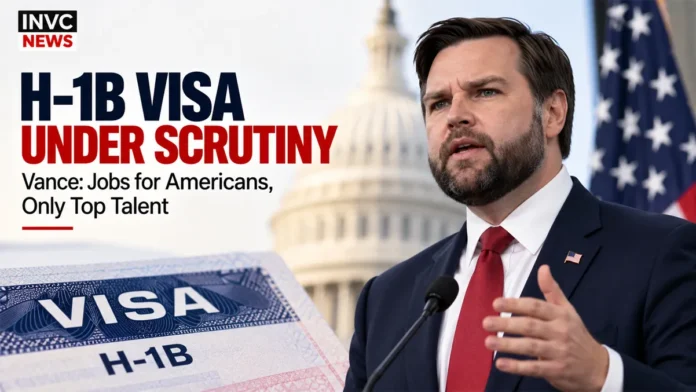
U.S. Vice President JD Vance has defended the Trump administration’s increasingly restrictive approach to the H-1B visa program, saying companies should not use the system to replace American employees with lower-paid foreign workers and that visas should instead focus on exceptional global talent.
Speaking on the All-In Podcast released September 15, Vance said the administration had examined what it considers abuse within the H-1B system and turned to executive and administrative measures because Congress was unlikely to pass major changes.
Vance said the administration wants companies seeking H-1B workers to demonstrate that the person would make a significant contribution to the U.S. economy or technology sector rather than simply provide cheaper labor.
The comments come as the Department of Homeland Security pushes a separate proposal that would impose an additional $103,265 fee on H-1B cap-subject petitions, dramatically increasing the cost for employers seeking workers through the annual H-1B lottery.
Vance: H-1B Should Not Replace American Workers
Vance used a hypothetical example involving an American accountant earning $60,000 being replaced by a foreign employee earning $45,000.
He argued that this was not the purpose of the H-1B program.
The vice president said the administration wants H-1B hiring to concentrate on people with unusually valuable skills who can strengthen U.S. technology, innovation or the broader economy.
His comments reflect a broader Trump administration argument that some employers have used legal immigration programs to reduce labor costs.
Business groups and technology companies have pushed back against that characterization, arguing that H-1B visas help employers fill specialized positions when sufficiently qualified U.S. workers are unavailable. Reuters notes that the program remains particularly important in technology, education and research.
What Is the New $103,265 H-1B Fee?
The Department of Homeland Security proposed the new fee in August.
Under the rule, employers filing H-1B cap-subject petitions would pay an additional $103,265 per petition, on top of other applicable filing charges.
DHS estimates the rule would apply to approximately 85,000 cap-subject petitions annually and could generate about $8.8 billion in revenue.
The government says the money would help cover costs associated with administering the lawful immigration system across several federal agencies.
DHS also says the much higher fee could discourage employers from choosing an H-1B worker over a qualified American employee unless a legitimate need for specialized skills exists.
Is the $103,265 Fee Already in Force?
No.
That distinction is crucial.
The $103,265 charge is currently a proposed rule, not a finalized permanent fee.
The Federal Register notice gives the public until September 24, 2026 to submit comments. DHS would then need to review feedback before issuing any final rule.
Therefore, headlines claiming that every H-1B applicant “must now pay” more than $100,000 are premature.
Who Would Actually Pay the Fee?
The proposed charge applies to the petitioner — normally the U.S. employer filing for the H-1B worker.
It is not simply a personal visa fee that an Indian engineer or other foreign professional would directly pay to obtain a job in America.
DHS specifically describes it as an additional fee on cap-subject H-1B petitions filed by employers.
That makes the economic effect different from a conventional visa application charge.
A company deciding whether to sponsor a worker would have to factor the six-figure cost into its hiring decision.
What Happened to Trump’s Earlier $100,000 H-1B Fee?
President Donald Trump initially imposed a $100,000 payment requirement in September 2025.
However, a federal judge ruled in June 2026 that the administration lacked legal authority to impose the charge in that form and blocked its collection.
The administration appealed that decision.
DHS subsequently proposed the new $103,265 regulatory fee, seeking to establish the charge through the formal federal rulemaking process.
Reuters reported that the permanent proposal could be finalized later in 2026, although legal challenges are likely to continue.
Why Indian Professionals Are Watching Closely
The H-1B program matters enormously to Indian professionals.
USCIS data show that 71% of approved H-1B petitions in fiscal 2024 went to beneficiaries born in India, far more than any other country. China ranked second at roughly 12%.
That concentration means changes to fees, selection rules or employment protections can have an outsized effect on Indian technology workers and companies employing them.
However, the proposed fee does not mean every existing Indian H-1B employee would immediately face a $103,265 charge personally.
Its scope is tied specifically to cap-subject petitions under the proposed rule.
Administration Also Targets Companies That Lay Off Americans
Vance said the administration is examining ways to deal with companies that seek H-1B workers while simultaneously laying off large numbers of American employees.
He questioned situations in which companies claim they cannot find workers while having recently eliminated thousands of U.S. jobs.
This could become another major policy battleground.
Employers often restructure for reasons involving business units, locations or different skill requirements, meaning a company can lay off workers in one area while hiring people with different qualifications elsewhere.
Any new restrictions would therefore need clear legal and regulatory definitions.
Trump Administration Is Tightening H-1B Rules on Several Fronts
The proposed fee forms only one part of a broader immigration crackdown.
The administration has also increased vetting of H-1B applicants and introduced a visa-selection system designed to favor higher-skilled and better-paid applicants.
Separately, the administration has proposed eliminating the existing 60-day grace period that allows many H-1B workers to remain in the United States after losing their jobs while they seek another employer or make other arrangements.
That proposal has not yet become final either.
What Does This Mean for H-1B Applicants?
Three points matter most.
First, JD Vance has made clear that the administration wants H-1B visas focused more heavily on exceptional skills rather than lower-cost labor.
Second, DHS is proposing a dramatic $103,265 additional employer fee for cap-subject H-1B petitions.
Third, the fee is not yet final and should not be described as a charge every foreign worker must currently pay.
The immediate date to watch is September 24, 2026, when the public-comment period on the proposed fee closes.
After that, DHS will decide whether to revise, finalize or otherwise proceed with the regulation.
For Indian professionals and U.S. technology companies alike, the H-1B debate is therefore entering another critical phase — but the final rules are still being written.