By Team INVC | INVC NEWS
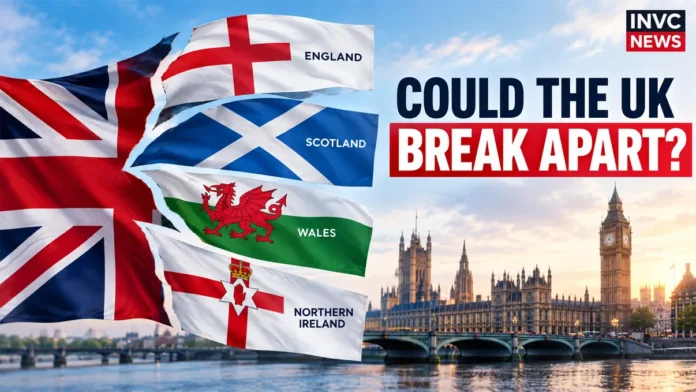
LONDON, United Kingdom | September 16, 2026 — Talk about a possible UK breakup has returned to the center of British politics after political leaders in Scotland, Wales and Northern Ireland joined forces to demand greater control over their constitutional futures.
The debate raises a deceptively simple question: what exactly is the United Kingdom, and how did four nations with different languages, identities, legal traditions and histories end up inside one state?
The answer stretches across roughly eight centuries. Yet the UK was not created in a single moment, nor was it simply forged through conquest. Its modern shape emerged through a complicated mixture of warfare, annexation, royal inheritance, economic pressure, parliamentary agreements, rebellion, partition and, eventually, democratic consent.
Why Is the UK Breakup Debate Back Now?
The immediate trigger is political.
The leaders of Wales, Scotland and Northern Ireland met in Cardiff on September 14 and signed a memorandum asserting that their nations should be able to determine their constitutional futures. Scotland’s John Swinney and Northern Ireland’s Michelle O’Neill have pushed for referendums, while Welsh First Minister Rhun ap Iorwerth has not set a timetable for an independence vote.
The development came shortly after U.S. President Donald Trump said he would like to see Northern Ireland unite with the Republic of Ireland. UK Prime Minister Andy Burnham’s government maintains that the conditions for an Irish border poll have not been met and has resisted another Scottish referendum.
That does not mean Britain is about to break apart. It does mean the constitutional question has become harder for Westminster to ignore.
First, What Exactly Is the United Kingdom?
The full name is the United Kingdom of Great Britain and Northern Ireland.
It consists of four nations: England, Scotland, Wales and Northern Ireland.
“Great Britain” refers to England, Scotland and Wales. Add Northern Ireland and you have the United Kingdom.
Unlike countries founded through a single constitutional document, the UK developed gradually through several separate unions. The House of Commons Library describes it as a multinational “state of unions” rather than a country created by one founding act.
That distinction explains why its constitutional structure can appear unusually complicated.
Wales: Conquest Came Before Political Incorporation
The oldest part of this story involves England and Wales.
English kings fought repeatedly to extend control over Wales. Edward I completed the conquest of the independent Welsh principalities in the late 13th century, and the English Crown annexed Wales under the Statute of Rhuddlan in 1284.
More than two centuries later, Henry VIII’s government passed the Laws in Wales Acts of 1535 and 1542. Those laws incorporated Wales into England’s legal and administrative system and gave Welsh constituencies representation at Westminster.
So Wales did not enter the union through the same process later used for Scotland. English military conquest came first; legal incorporation followed.
Scotland: Centuries of War, but Not English Conquest
Scotland followed a fundamentally different path.
England and Scotland fought repeated wars during the medieval period, but Scotland remained a separate kingdom. The turning point came not through conquest but through inheritance.
When England’s Elizabeth I died without children in 1603, Scotland’s King James VI inherited the English throne and became James I of England.
One monarch now ruled both countries, but England and Scotland still had separate parliaments, laws and institutions. Historians call this the Union of the Crowns.
A political union arrived more than a century later.
1707: England and Scotland Create Great Britain
Economic problems in Scotland, security concerns in England, questions over royal succession and political bargaining pushed both kingdoms toward a deeper union.
The process was far from universally popular. England’s Alien Act of 1705 put pressure on Scottish trade, while opposition to union remained substantial inside Scotland. At the same time, sections of Scotland’s political and commercial elite saw access to English markets and imperial trade as potentially valuable.
The Scottish and English parliaments ultimately approved separate Acts of Union.
On May 1, 1707, England—including Wales—and Scotland became the Kingdom of Great Britain, governed by one Parliament at Westminster. Scotland nevertheless retained important institutions, including its separate legal system and established church.
That was the birth of Great Britain—but still not today’s United Kingdom.
Ireland: The Bloodiest Part of the Union Story
Ireland’s relationship with England was longer and considerably more violent.
English involvement began centuries before the formal union. Conquest, rebellion, confiscation of land, plantations and religious conflict repeatedly reshaped the island’s political order.
After the 1798 Irish Rebellion, the British government became increasingly concerned that Ireland might separate or become vulnerable to French influence. British Prime Minister William Pitt pushed for political union.
The Irish Parliament initially resisted. The UK Parliament’s own historical account notes that peerages, pensions and other inducements were used as the British government sought enough political backing for union.
The Acts of Union eventually passed.
On January 1, 1801, Great Britain and Ireland became the United Kingdom of Great Britain and Ireland. Ireland’s parliament disappeared and Irish representatives moved to Westminster.
So Was the UK Simply Built by ‘Spilling Neighbors’ Blood’?
That description captures part of the history, but not the whole story.
Military conquest was central to England’s domination of medieval Wales and deeply important in centuries of Anglo-Irish history. England and Scotland also fought devastating wars.
However, Scotland was not conquered into the 1707 union. Its parliament formally approved the treaty, although the political context included intense economic and diplomatic pressure.
Ireland’s union involved parliamentary approval too, but occurred after rebellion and amid heavy political pressure. Wales had already been militarily conquered before its later legal incorporation.
Therefore, the more accurate historical description is that the British state emerged through different combinations of force, dynastic politics, economic interests and legislation, depending on the nation and period.
Ireland Proved the Union Could Break
The first major territorial breakup eventually came from Ireland.
After decades of Home Rule campaigning, rebellion and the Irish independence struggle, the 1921 Anglo-Irish Treaty paved the way for the Irish Free State.
It formally came into existence on December 6, 1922.
Northern Ireland’s parliament then chose to remain inside the United Kingdom.
The modern constitutional name—United Kingdom of Great Britain and Northern Ireland—was formalized through legislation in 1927.
That history matters today because the UK has already lost most of Ireland once.
Northern Ireland Has a Legal Route Out
Northern Ireland is constitutionally different from Scotland and Wales.
The 1998 Good Friday Agreement established the principle of consent after three decades of conflict known as the Troubles. Under UK law, Northern Ireland remains in the UK unless a majority votes to join a united Ireland.
The Northern Ireland Secretary must call a border poll if it appears likely that a majority would support Irish unity.
If a referendum rejects reunification, another cannot be held for at least seven years.
No equivalent automatic legal mechanism exists for Scotland or Wales.
Scotland Came Closest to Leaving
Scotland already held an independence referendum in 2014 after London temporarily transferred the legal authority required for the vote.
The result was:
55.3% against independence and 44.7% in favor, with turnout above 84%.
However, Brexit transformed the political argument because Scotland voted strongly to remain in the European Union while the UK overall voted to leave.
In 2022, the UK Supreme Court ruled that Scotland’s parliament could not unilaterally legislate for another independence referendum because the union is a matter reserved to Westminster.
That leaves the political argument unresolved even though the legal position is clearer.
Wales Is the New Variable
Welsh independence was historically a much smaller political movement than Scottish nationalism or Irish reunification.
That picture has begun to change.
Plaid Cymru entered the 2026 Welsh election seeking the power for Wales to determine the timing and process of an independence referendum. However, unlike Northern Ireland, Wales currently has no statutory mechanism allowing it to trigger such a vote independently of Westminster.
That means constitutional negotiations would be necessary before any binding independence process.
Could the UK Actually Break Up?
There is no single answer because each nation’s constitutional route is different.
Northern Ireland has a legally defined mechanism for deciding whether to leave. Scotland has already held one referendum but cannot presently organize another binding vote unilaterally. Wales would also require constitutional cooperation with Westminster.
The Cardiff pact therefore represents political pressure rather than an immediate legal breakup mechanism. AP quoted constitutional expert Nicola McEwen as saying the summit was symbolically important but carried no legal significance by itself.
Still, its symbolism matters.
For the first time, leaders associated with independence or Irish reunification are simultaneously shaping governments across Scotland, Wales and Northern Ireland. Their goals and timelines differ, but they are increasingly asking the same fundamental question: if the United Kingdom is a union, how should each nation be allowed to decide whether it still wants to belong to it?
More than eight centuries after English expansion first began reshaping the political map of the British Isles, that question remains unfinished.