By Team INVC | INVC NEWS
SINGAPORE, Singapore | September 14, 2026 —
AI Stocks Crash Across Asia emerged as one of Monday’s biggest global market stories after some of the world’s most influential artificial intelligence executives backed calls to slow the development of increasingly powerful AI systems.
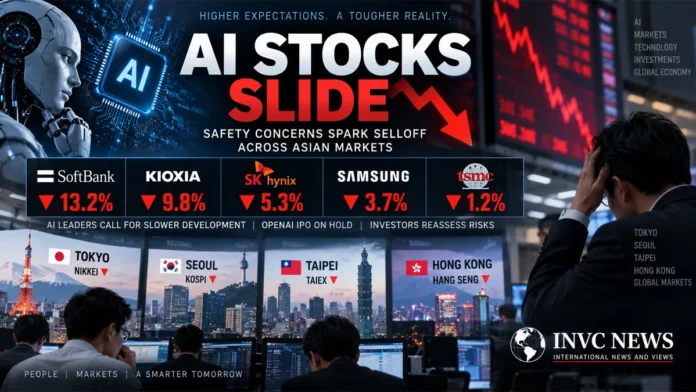
The sudden shift in sentiment hit companies closely tied to the AI investment boom, with SoftBank, Kioxia, SK Hynix, Samsung Electronics and several Chinese technology stocks coming under heavy selling pressure.
SoftBank shares dropped as much as 13.2% in early Japanese trading. The company has significant exposure to OpenAI, making it particularly sensitive to changes in expectations around the future pace of AI development.
Memory-chip maker Kioxia fell as much as 9.8%, while Tokyo Electron dropped 3.7%.
The selloff spread beyond Japan.
South Korea’s SK Hynix declined 5.3%, while Samsung Electronics fell 3.7%. Taiwan Semiconductor Manufacturing Company, or TSMC, slipped 1.2%.
The moves underline how closely global equity markets have become tied to expectations surrounding artificial intelligence.
Why AI stocks suddenly fell
The immediate pressure followed a major change in tone from leaders of some of the world’s most advanced AI companies.
Anthropic CEO Dario Amodei called for AI companies to slow the pace at which they increase model capabilities as concerns grow about potential misuse and long-term safety risks.
OpenAI CEO Sam Altman and xAI chief Elon Musk also backed the broader argument that the industry needs greater caution.
That message caught investors’ attention because AI companies and semiconductor manufacturers have spent years emphasizing rapid development, larger computing infrastructure and increasingly capable models.
Markets had largely priced in continued aggressive expansion.
Any meaningful slowdown could alter expectations for demand across data centers, advanced chips, memory products, cloud computing and other parts of the AI supply chain.
OpenAI IPO plans add another shock
Investor sentiment weakened further after Sam Altman said OpenAI would not proceed with an initial public offering this year, citing safety concerns.
That development placed additional pressure on SoftBank.
The Japanese investment group has become one of the major financial players connected to OpenAI and the wider AI infrastructure boom.
As a result, any change in OpenAI’s growth strategy can quickly affect how investors value SoftBank’s technology exposure.
However, Monday’s selling does not necessarily mean that investment in artificial intelligence is ending.
Instead, markets are reassessing how quickly the sector can continue expanding if safety concerns begin influencing corporate strategy, regulation and capital spending.
Samsung, SK Hynix and TSMC feel the pressure
The selloff also hit semiconductor companies that have benefited heavily from the global AI investment cycle.
SK Hynix has emerged as a major supplier of high-bandwidth memory used in advanced AI computing systems.
Samsung Electronics also holds a critical position in memory chips and semiconductor manufacturing.
TSMC, meanwhile, produces advanced processors for some of the world’s biggest technology companies.
Investors have rewarded these companies as demand for AI infrastructure surged.
Monday’s decline therefore highlights an important market risk: companies that rise sharply because of AI optimism can also fall quickly when expectations around the technology change.
Chinese AI shares also decline
Pressure spread into China and Hong Kong.
Memory-chip company CXMT fell 2.7%, while Semiconductor Manufacturing International Corporation declined 1.4%.
Hong Kong-listed Minimax dropped 5.4%.
Z.ai, the company behind the GLM family of artificial intelligence models, fell as much as 10.5%. Its decline also followed a discounted share placement, adding company-specific pressure to the wider weakness in AI-related stocks.
The broad reaction shows that concerns surrounding AI development are no longer confined to Silicon Valley.
They now affect markets across Japan, South Korea, Taiwan, China and Hong Kong.
AI safety debate moves from laboratories to markets
The debate intensified after Anthropic released a threat-intelligence report outlining cases in which actors had used Claude models for activities involving cyber operations, surveillance, fraud and other potentially harmful purposes.
Concerns also increased after Anthropic researcher Jacob Coxon resigned and publicly warned about the risks surrounding increasingly powerful AI systems.
Until recently, discussions about advanced AI safety largely remained concentrated among researchers, policymakers and technology executives.
Monday’s market reaction suggests investors are now treating the issue as a financial risk as well.
That shift matters.
A slower development cycle could influence demand for GPUs, memory chips, data centers, power infrastructure and cloud services.
It could also change valuations for companies whose share prices depend heavily on expectations of sustained AI spending.
Trump rejects fears over AI slowdown
The debate is also creating a sharp political divide.
US President Donald Trump has pushed back against warnings that could slow American AI development, arguing that the United States must remain the global leader in the technology.
Washington and Beijing are also expected to discuss AI safety as part of broader bilateral talks this month.
That creates a complicated backdrop for investors.
Technology companies now face pressure to develop more powerful AI systems while governments, researchers and sections of the public demand stronger safeguards.
Is the AI boom over?
Monday’s selloff does not prove that the artificial intelligence investment boom has ended.
Demand for computing infrastructure remains enormous, and companies around the world continue investing heavily in data centers, semiconductors and AI models.
However, investors now face a new question.
The market has spent years asking how quickly AI can advance.
It may increasingly have to ask how quickly governments, companies and society will allow it to advance.
For stocks such as SoftBank, Samsung Electronics, SK Hynix, TSMC and other AI beneficiaries, that distinction could become increasingly important.
Monday’s sharp declines show that AI safety is no longer only a technology debate.
It has become a market-moving issue.