By Team INVC | INVC NEWS
NEW DELHI, India | September 14, 2026 —
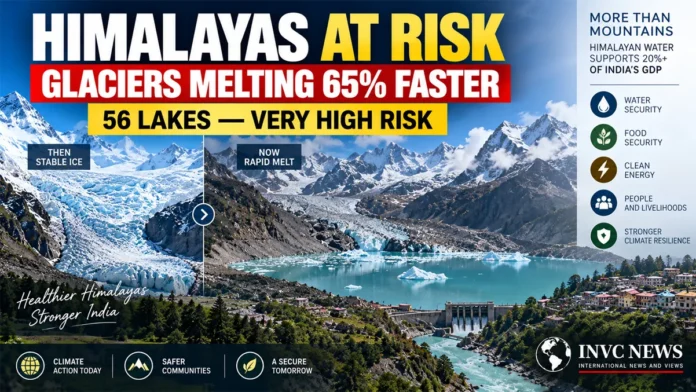
Himalayas Near Tipping Point has emerged as a major climate warning for India after new research found that Himalayan glaciers are losing mass 65% faster than they were a decade ago, while 56 glacial lakes in India now fall into the “very high risk” category.
The findings raise concerns far beyond mountain communities.
The Himalayan system supports water supplies, agriculture, hydropower, infrastructure and economic activity across much of South Asia. The new assessment estimates that Himalayan water ultimately underpins more than 20% of India’s GDP.
Researchers argue that the mountains should therefore be treated as national infrastructure rather than as a remote environmental concern.
The report also identifies black carbon pollution as one of the climate risks India can address relatively quickly. Its analysis estimates that roughly one-third of Himalayan glacier melt is linked to black carbon, much of it originating from sources such as brick kilns in the plains.
At the same time, nearly 200 Indian glacial lakes have been classified as high risk, including 56 in the most serious “very high risk” category.
Why the Himalayan Glacier Warning Matters
The Himalayas are often called the world’s “Third Pole” because they contain one of the largest stores of frozen freshwater outside the Arctic and Antarctic.
Unlike those polar regions, however, hundreds of millions of people live directly downstream from the Himalayan cryosphere.
Glaciers and snow help regulate rivers that support drinking water, irrigation, food production, hydropower and industry.
When glaciers retreat rapidly, that system begins to change.
At first, faster melting can increase river flows.
Later, as the volume of glacier ice declines, the amount of meltwater available during dry periods can fall.
Scientists often describe this transition as “peak water.”
The danger is therefore not simply that glaciers disappear.
The greater problem is that the timing, quantity and reliability of water can change for entire river basins.
Himalayan Glaciers Losing Mass 65% Faster
The headline figure in the latest assessment is stark.
Himalayan glaciers are losing mass 65% faster than they were a decade earlier, according to Systemiq’s new research.
The finding aligns with earlier scientific warnings from the Hindu Kush Himalaya region.
Previous ICIMOD research found that glacier ice loss accelerated substantially during the 2010s compared with the previous decade.
Scientists have warned that, depending on future global warming, a substantial share of Himalayan glacier volume could disappear by the end of this century.
That acceleration increases both long-term water-security risks and near-term disaster threats.
56 Indian Glacial Lakes Rated ‘Very High Risk’
Retreating glaciers can leave behind large lakes.
Many of these lakes are held in place by unstable natural barriers consisting of ice, loose rock and sediment.
If those barriers fail, enormous quantities of water can rush downstream within minutes.
Such events are known as Glacial Lake Outburst Floods, or GLOFs.
The latest assessment says India has nearly 200 high-risk glacial lakes, with 56 classified as very high risk.
The danger increases when settlements, roads, bridges, hydropower projects or other infrastructure lie downstream.
That makes monitoring and early-warning systems increasingly important.
What Is a Glacial Lake Outburst Flood?
A GLOF occurs when water stored in a glacial lake suddenly escapes.
Several triggers can cause such a failure.
An avalanche or landslide can fall into a lake and create a powerful displacement wave.
Melting ice can weaken the natural dam.
Extreme rainfall can increase water levels.
Earthquakes or unstable mountain slopes can also raise the risk.
Once the barrier breaks, floodwater can carry rocks, mud, ice and debris at enormous speed.
This means communities many kilometers away can face danger with little warning.
Recent Himalayan Disaster Shows the Risk
The report arrives shortly after a catastrophic glacier-related disaster near the Nepal-Tibet border.
The August 2026 event triggered devastating floods and landslides, causing extensive loss of life and infrastructure damage across the region.
That disaster has intensified scrutiny of Himalayan glacier stability and the vulnerability of downstream hydropower, transport and settlement networks.
The latest report had already been under development before that disaster.
Its authors released an abridged version ahead of the full report, which is scheduled for publication in October.
Only a Tiny Fraction of Himalayan Glaciers Are Closely Monitored
One of the biggest weaknesses identified in current climate preparedness is the monitoring gap.
Reuters reported that only 21 of an estimated 40,000 glaciers across the Hindu Kush-Himalaya region are currently monitored directly.
That creates a major information problem.
Satellites can monitor large-scale changes, but ground-based instruments provide more detailed information about glacier mass, ice movement, melt rates and local hazards.
Better monitoring could help governments identify dangerous changes earlier.
It could also improve flood forecasting and long-term water planning.
Himalayas Support More Than 20% of India’s GDP
The economic importance of the Himalayan region is one of the report’s most striking findings.
Systemiq estimates that once downstream economic activity is included, Himalayan water supports more than 20% of India’s GDP.
That value extends far beyond tourism or mountain agriculture.
It includes water used by farms, cities, industries and power systems.
For that reason, the report argues that Himalayan ecosystems should be treated as national infrastructure.
A damaged glacier system can eventually translate into agricultural losses, disrupted electricity generation, infrastructure damage, insurance costs and pressure on cities.
Climate resilience in the Himalayas is therefore also an economic-security issue.
Himalayas Face Disproportionate Disaster Risk
The Indian Himalayan region covers a relatively limited share of the country’s land area but experiences a disproportionately large share of natural disasters.
According to the new assessment, the Himalayan region accounts for about 18% of India’s land area but roughly 35% of its natural disasters.
Steep terrain, earthquakes, cloudbursts, landslides, floods and changing snow and glacier conditions combine to create a complex risk environment.
Climate change can amplify several of these threats simultaneously.
That is why researchers increasingly describe Himalayan hazards as cascading risks rather than isolated events.
Black Carbon Could Be a Major Part of the Problem
Carbon dioxide is not the only pollutant affecting glaciers.
Black carbon also matters.
These tiny dark particles are produced by incomplete combustion from sources including diesel engines, biomass burning and traditional brick kilns.
When black carbon settles on snow and ice, it darkens the surface.
A darker surface absorbs more solar radiation instead of reflecting it.
That can accelerate melting.
Systemiq’s assessment estimates that roughly one-third of Himalayan glacier melt is driven by black carbon, much of it associated with pollution from brick kilns in the plains.
The estimate is important because black-carbon emissions can potentially be reduced faster than global atmospheric carbon dioxide concentrations.
Brick Kilns Could Become a Climate Priority
Northern India and neighboring South Asian countries contain large numbers of brick kilns.
Many rely on older combustion technologies that release black carbon and other air pollutants.
Modernizing these kilns could produce several benefits at once.
Cleaner technology could reduce local air pollution.
Workers and nearby communities could experience health benefits.
Lower black-carbon emissions could also reduce one source of Himalayan glacier warming.
That makes brick-kiln modernization an unusual climate measure: it can potentially deliver relatively fast regional benefits while longer-term global decarbonization continues.
Melting Permafrost Creates Another Threat
Glaciers are only one part of the Himalayan climate system.
Permafrost — ground that remains frozen for long periods — also helps stabilize high mountain slopes.
As temperatures increase, frozen ground can thaw.
That can weaken rock faces and slopes.
The result may be more landslides, rockfalls and other mountain hazards.
Such events can also interact with glacial lakes.
For example, a landslide falling into a lake can generate a powerful wave and trigger an outburst flood.
Researchers therefore warn that the Himalayan threat cannot be understood by looking at glacier melt alone.
Hydropower Faces Growing Exposure
India and neighboring countries have invested heavily in Himalayan hydropower.
The region’s steep valleys and powerful rivers make it attractive for electricity generation.
However, those same characteristics can expose dams, tunnels, roads and transmission systems to climate hazards.
Recent Himalayan disasters have damaged hydropower projects and buried infrastructure.
Future investment may therefore require stronger climate-risk assessments before projects receive approval.
Engineering standards may also need to account for hazards that were considered extremely rare when older infrastructure was designed.
Agriculture and Food Security Could Feel the Impact
Changes in Himalayan water systems could eventually affect agriculture across large parts of northern India.
Farmers depend on rivers fed partly by snow and glacier melt.
During dry seasons, those flows can become particularly important.
If melt initially increases but later declines, agricultural regions could face a difficult transition.
Floods can destroy crops in the short term.
Reduced dry-season water availability can affect food production over the longer term.
That is why Himalayan climate resilience connects directly with India’s food security.
Cities Are Also Downstream
The Himalayan climate threat is sometimes presented as a problem affecting remote villages.
That view is misleading.
Large cities and industrial regions downstream depend on river systems whose headwaters originate in the mountains.
Water availability, hydropower generation and food supplies can therefore carry Himalayan climate impacts hundreds or thousands of kilometers downstream.
The mountains function as part of an interconnected economic system.
Their stability matters even to people who may never visit the Himalayas.
Climate Resilience Investment Could Deliver Major Returns
The new report does not only describe the risks.
It also argues that investing in resilience could generate substantial economic benefits.
Researchers identify 10 critical transitions needed to build a more resilient Himalayan economy.
When economic, ecological, social and avoided-loss benefits are considered together, the report estimates an average adjusted return of roughly eight times every rupee invested.
Those investments could include better monitoring, early-warning systems, resilient infrastructure, ecosystem restoration and cleaner industries.
Early-Warning Systems Could Save Lives
Some climate impacts can no longer be completely avoided.
That makes adaptation essential.
Glacial lakes can be monitored using satellites, sensors and field surveys.
Warning systems can alert downstream communities when lake levels or slopes become unstable.
Emergency routes and evacuation plans can reduce fatalities.
Authorities can also map areas that should not be used for future construction.
The technology already exists.
The challenge is deploying it across a vast and difficult mountain region.
The Himalayas Cross National Borders
Climate risk does not stop at international boundaries.
The Hindu Kush-Himalaya stretches across Afghanistan, Bangladesh, Bhutan, China, India, Myanmar, Nepal and Pakistan.
Many major rivers also cross borders.
That makes data-sharing and regional cooperation especially important.
A dangerous glacial lake in one country can affect communities downstream in another.
ICIMOD Director General Pema Gyamtsho has argued that cross-border monitoring, shared risk information and coordinated investment are increasingly necessary for protecting lives and economies across the region.
Are the Himalayas Really at a ‘Tipping Point’?
The term needs careful interpretation.
It does not mean the entire Himalayan system will suddenly collapse on one specific date.
Instead, researchers warn that several environmental systems are approaching thresholds after which change may become increasingly difficult to reverse or manage.
Those systems include glaciers, permafrost, water supplies, forests and mountain ecosystems.
The risks can also reinforce one another.
Glacier retreat can create unstable lakes.
Permafrost thaw can destabilize slopes.
Landslides can trigger lake failures.
Floods can destroy infrastructure.
That interconnected chain explains why scientists and resilience experts use the language of cascading tipping points.
What India Can Do Now
Some of the causes of Himalayan warming require global action.
India cannot stop global climate change alone.
However, several risks can be addressed domestically.
Reducing black-carbon pollution offers one opportunity.
Expanding glacier and glacial-lake monitoring is another.
Infrastructure planning can incorporate more realistic climate risks.
Early-warning networks can protect communities.
Natural ecosystems can also help stabilize slopes, regulate water and reduce disaster exposure.
The report’s central argument is that Himalayan resilience should become an economic-development strategy, not merely an environmental program.
Why This Story Matters for Every Indian
The Himalayan crisis may appear geographically distant from much of the country.
Its consequences are not.
The mountains influence rivers, farms, electricity systems, food prices, infrastructure and economic growth.
A glacier melting high above sea level can ultimately affect communities far downstream.
That is why the latest warning carries national significance.
The Himalayas are not simply India’s northern boundary.
They are part of the country’s water, food and economic infrastructure.
Protecting them may increasingly become one of India’s biggest climate-security challenges.
Frequently Asked Questions
Are Himalayan glaciers melting faster?
Yes. New Systemiq research says Himalayan glaciers are losing mass about 65% faster than they were a decade ago.
How many Indian glacial lakes are at very high risk?
The assessment identifies 56 Indian glacial lakes in the “very high risk” category.
What is a GLOF?
A Glacial Lake Outburst Flood occurs when a glacial lake suddenly releases a large volume of water after its natural barrier fails.
Why is black carbon dangerous for glaciers?
Black carbon darkens snow and ice, allowing them to absorb more sunlight and melt faster.
How important are the Himalayas to India’s economy?
The report estimates that Himalayan water underpins more than 20% of India’s GDP when downstream economic activity is considered.
Are the Himalayas already beyond a tipping point?
The report says the region is approaching cascading tipping points. It does not claim the entire Himalayan system has already crossed one irreversible threshold.
Can India reduce the risk?
Yes. Better glacier monitoring, early-warning systems, resilient infrastructure, cleaner brick kilns and ecosystem protection can reduce exposure and improve resilience.