By Team INVC | INVC NEWS
MUMBAI, India | September 13, 2026 —
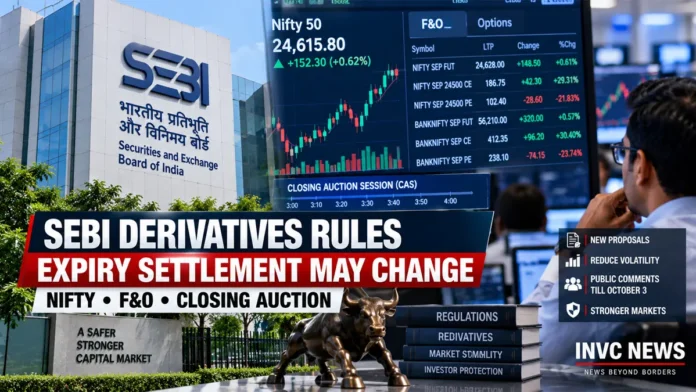
SEBI Derivatives Rules could soon change how index and stock futures and options contracts are settled on expiry days after the market regulator proposed a review of settlement pricing following sharp volatility linked to the newly introduced Closing Auction Session.
The Securities and Exchange Board of India has released a consultation paper proposing changes to expiry-day settlement methodology after feedback from market participants raised concerns about unusual price swings during the closing auction.
SEBI introduced the Closing Auction Session, or CAS, on August 3 to improve transparency and closing-price discovery in the cash market.
However, the new mechanism created fresh complications for derivatives traders because the auction price can influence final settlement values on expiry days.
The regulator has now proposed alternative methods designed to reduce that risk without abandoning the closing auction framework.
SEBI Derivatives Rules Focus on Expiry-Day Pricing
The central issue concerns how final settlement prices for derivatives should be determined when contracts expire.
Under the current framework, the official closing price generated through the closing auction can influence the settlement price.
That linkage becomes particularly important on derivatives expiry days because even a relatively small change in the final index level can significantly affect the value of options and futures positions.
Market participants raised concerns after some expiry sessions showed unusually sharp movements during the closing auction.
SEBI has consequently proposed changes that could separate or reduce the influence of the auction on derivatives settlement calculations.
What Is the Closing Auction Session?
The Closing Auction Session is a separate trading window used to determine the official closing price of securities.
Instead of relying only on the final trades executed during normal market hours, the auction allows buyers and sellers to submit orders during a dedicated closing-price discovery process.
The idea is to improve transparency and create a more representative final price.
Closing auctions are widely used in major global markets.
However, India’s derivatives market is unusually large and heavily concentrated around index options.
That structure makes expiry-day settlement particularly sensitive to late market movements.
Option 1: Blend Normal Trading and Closing Auction Prices
Under one proposal, the settlement price would combine information from the final 30 minutes of normal trading with prices generated during the 10-minute closing auction.
This blended approach would reduce the impact of a sudden move occurring only during the auction.
It would also preserve CAS as part of the closing-price discovery process.
For traders, this could mean a settlement mechanism that reflects a broader period of market activity rather than relying excessively on a short closing window.
Such a structure may reduce the possibility that temporary or unusually concentrated orders sharply influence the final expiry value.
Option 2: Keep CAS Out of Derivatives Settlement
SEBI has also proposed a second option.
Under this method, derivatives settlement prices would rely solely on the final 30 minutes of regular trading.
The Closing Auction Session would continue to determine the official cash-market close, but that auction price would not determine derivatives expiry settlement.
This separation could remain in place for at least one year.
The regulator could then review market behaviour before deciding whether to integrate CAS into derivatives settlement again.
For F&O traders, this proposal could provide greater predictability because expiry settlement would depend on trading activity before the auction begins.
Why Traders Are Concerned About CAS
Expiry-day moves carry unusually high significance in India’s derivatives market.
Options contracts can move rapidly as they approach expiry because their remaining time value falls sharply.
At the same time, large institutional positions may require hedging or adjustment near the market close.
A sudden index swing during the final minutes can therefore create large gains or losses for traders holding options near their strike prices.
The introduction of CAS added another price-discovery phase after normal continuous trading.
That created uncertainty over where the final settlement level could eventually land.
For systematic and algorithmic strategies, the additional closing-auction movement can also complicate risk models.
Sensex and Nifty Have Seen Sharp Closing Moves
Recent market sessions have highlighted these concerns.
The Sensex experienced significant late volatility during several expiry-day closing auctions after CAS was introduced.
The Nifty 50 also became volatile during the new closing process on recent expiry days.
Such moves raised questions about whether the auction was creating unintended effects when combined with derivatives settlement.
Importantly, SEBI’s current review does not mean the regulator has concluded that the Closing Auction Session itself has failed.
Instead, the regulator is examining how CAS should interact with the settlement of expiring derivatives contracts.
SEBI Also Proposes Restrictions on Order Cancellations
The consultation paper goes beyond the settlement-price formula.
SEBI has proposed restrictions on certain order cancellations during the closing auction.
The regulator is considering limits where orders move beyond 1% of a reference price.
Such restrictions could make it harder for participants to place aggressive orders and then withdraw them in a way that distorts price discovery.
The proposal reflects SEBI’s broader effort to strengthen the closing auction and reduce the risk of artificial price movements.
Post-Closing Auction Window May Be Shortened
Another proposed change involves the post-closing auction trading period.
SEBI is considering reducing that window to five minutes.
A shorter post-auction period could streamline the closing process and reduce unnecessary volatility after the official closing price has been determined.
Market participants will likely examine how this change could affect order execution, passive funds and institutional portfolios.
Indicative Index Closing Levels Could Be Withheld
SEBI has also proposed changing the information displayed during the auction.
Indicative equilibrium prices for individual stocks would continue to be available.
However, the regulator has proposed withholding indicative closing levels for major indices during the auction.
This could reduce the ability of traders to continuously adjust orders based on how the index appears likely to settle.
The proposal is particularly relevant for traders holding index derivatives.
If market participants cannot see the evolving indicative index close, they may have less opportunity to aggressively reposition expiry-day trades during the auction itself.
Why This Matters for Nifty and Bank Nifty Traders
The proposed SEBI Derivatives Rules could directly affect traders in Nifty and other index derivatives.
Settlement methodology determines the final value at which expiring futures and options are closed.
Therefore, even small changes to the calculation process can affect:
- Option buyers
- Option sellers
- Futures traders
- Arbitrage desks
- Institutional investors
- Algorithmic trading strategies
- Market makers
- Hedging strategies
Retail traders could also feel the impact because many short-term strategies depend on expiry-day price behaviour.
This Is Not a Ban on Closing Auction Session
The consultation should not be interpreted as SEBI abandoning the Closing Auction Session.
CAS was introduced to strengthen closing-price discovery.
The regulator is instead trying to resolve a specific interaction between the cash-market closing mechanism and derivatives expiry settlement.
That distinction is important.
SEBI appears focused on refining the framework rather than reversing the entire reform.
Earlier Manipulation Concerns Added to Scrutiny
The closing-auction mechanism has also faced regulatory scrutiny over alleged manipulation.
SEBI previously restricted two entities over allegations related to trades executed during the new closing-price mechanism.
Those restrictions were connected to concerns that aggressive orders may have distorted Sensex-related closing prices.
The regulator later lifted broader trading restrictions after the firms deposited alleged gains, although investigation-related restrictions involving the auction session continued in one case.
These developments have increased attention on how India’s closing auction operates.
F&O Market Already Facing Regulatory Tightening
The settlement review comes during a broader period of regulatory change in India’s derivatives market.
SEBI has introduced several measures in recent years aimed at reducing excessive retail speculation and improving market stability.
These measures have affected contract structures, expiry schedules and trading activity.
Options volumes have also come under pressure.
That matters for exchanges because derivatives trading generates a major portion of transaction revenue.
The latest consultation therefore represents another important adjustment in India’s rapidly evolving F&O market.
Public Comments Open Until October 3
SEBI has invited public feedback on the proposed changes.
Market participants can submit comments until October 3, 2026.
The regulator will evaluate feedback before deciding whether to adopt either settlement option or modify the proposal further.
That means no final change has yet been implemented.
Traders should therefore avoid treating the proposed methodology as an active rule.
What Happens Next?
Three developments will matter most.
First, SEBI will review responses from exchanges, brokers, institutional investors, traders and other market participants.
Second, the regulator may refine the proposed settlement framework.
Third, SEBI could issue a final circular establishing the new methodology and its implementation date.
Until that happens, the current proposal remains under consultation.
What Traders Should Watch
For market participants, the biggest question is whether SEBI ultimately separates derivatives expiry pricing from the Closing Auction Session.
If it does, expiry-day settlement may become more predictable.
However, the final impact will depend on the precise methodology adopted.
Traders should watch for:
Final settlement formula
Effective date
Treatment of index and single-stock derivatives
Closing auction order rules
Indicative index-price disclosure
Post-auction trading window
Any change could materially affect expiry-day strategy.
SEBI Derivatives Rules Could Reshape Expiry Trading
India’s derivatives market has become one of the world’s most active, particularly in index options.
That scale makes the settlement mechanism critical.
The new Closing Auction Session was designed to improve cash-market price discovery, but its interaction with derivatives expiry created unexpected volatility.
SEBI is now trying to strike a balance between accurate closing prices and stable derivatives settlement.
For traders, the outcome could materially change how the final minutes of expiry day are approached.
The consultation therefore deserves close attention from anyone trading Nifty, index options, stock futures or other expiring derivatives contracts.