By Team INVC | INVC NEWS
DUBLIN, Ireland | September 12, 2026 —
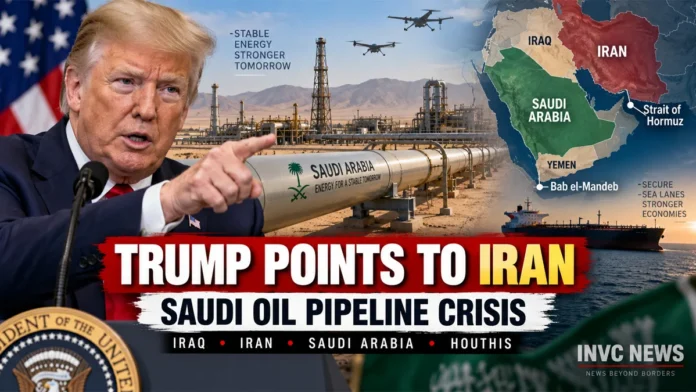
Saudi Oil Pipeline Shutdown tensions escalated sharply Saturday after US President Donald Trump said Iran was “probably” responsible for the aerial attack that forced Saudi Arabia to close its critical East-West crude pipeline, while revealing that Yemen’s Iran-aligned Houthis had contacted his administration and indicated they did not want the United States to become directly involved in the widening conflict.
Trump made the comments while speaking to reporters in Dublin.
Asked whether he believed Iran was responsible for the attack, the US president said he thought it probably was.
However, no conclusive public evidence has yet established that Tehran ordered the strike.
Iraq has confirmed that the drones involved in the attack originated from Iraqi territory and has launched an investigation.
The development raises the stakes around one of the world’s most strategically important oil routes at a time when disruption in the Strait of Hormuz has already increased the importance of Saudi Arabia’s Red Sea export infrastructure.
Trump speaks to Saudi Crown Prince
Trump also confirmed that he had spoken with Saudi Crown Prince Mohammed bin Salman.
The US president described the Saudi leader as a good friend but did not publicly disclose the full substance of their latest conversation.
The contact comes as Riyadh weighs its response to the pipeline attack.
Saudi Arabia has so far refrained from immediate retaliation after Iraq requested an opportunity to investigate the incident.
However, Riyadh has made clear that it retains the right to take measures necessary to protect its sovereignty, national security and critical infrastructure.
That leaves the region in a delicate position.
A direct Saudi military response could expand an already dangerous confrontation involving Iran-aligned groups across Iraq and Yemen.
Houthis contact Trump administration
Trump’s comments about the Houthis introduced another significant development.
According to the US president, the group contacted his administration and indicated that it would prefer Washington not to become directly involved in the conflict.
Trump said the Houthis were allowing most maritime traffic to pass.
The statement suggests that communication channels remain open even as the group expands its military position around the Red Sea.
It does not, however, amount to a ceasefire or broader peace agreement.
The Houthis remain a major factor in the security of the Bab el-Mandeb Strait, one of the world’s most important maritime chokepoints.
Iraq confirms drones came from its territory
Iraq’s government has now confirmed that the attacks against the Saudi pipeline originated from Iraqi territory.
That confirmation significantly changes the political dimension of the incident.
Baghdad has promised an investigation and moved against senior security officials in Maysan province near the Iranian border.
Authorities dismissed senior officials as pressure increased on the Iraqi government to determine who launched the drones and prevent armed groups from using Iraqi territory for regional attacks.
Iran-backed militias operate in parts of Iraq.
Nevertheless, the presence of those groups does not by itself establish that Iran ordered the pipeline strike.
Some Iran-aligned Iraqi militias have denied responsibility and said they would cooperate with the investigation.
Saudi Arabia says drones were launched from Iraq
Saudi Arabia has formally condemned the drone attack and said the aircraft were launched from Iraqi territory.
The kingdom’s Energy Ministry said the East-West Pipeline was subjected to multiple attacks in the Riyadh and Madinah regions on September 10.
Authorities shut the pipeline as a precaution.
The attacks caused injuries, and emergency teams began assessing the safety of the infrastructure.
Saudi Arabia has not announced a timetable for fully restoring pipeline operations.
That uncertainty is particularly important for energy markets.
Why the East-West Pipeline matters
Saudi Arabia’s East-West Pipeline stretches roughly 1,200 kilometers across the Arabian Peninsula.
It connects the kingdom’s oil-producing areas near the Gulf with the Red Sea export terminal at Yanbu.
The system can transport around 7 million barrels of crude per day under maximum operating conditions.
Recent flows have reportedly been around 4 million to 5 million barrels per day.
That volume represents roughly 4% to 5% of global oil supply.
The pipeline has become even more important because it allows Saudi crude to bypass the Strait of Hormuz.
Strait of Hormuz disruption makes pipeline critical
The Strait of Hormuz normally serves as one of the world’s most important oil-shipping corridors.
Conflict involving Iran and the United States has severely disrupted traffic through the waterway.
Saudi Arabia therefore increased its reliance on the East-West Pipeline to move crude toward the Red Sea.
That strategy created an alternative export route.
The drone attack has now exposed the vulnerability of that alternative.
If both the Hormuz route and the Saudi overland pipeline face prolonged disruption, energy markets could lose confidence in the region’s ability to move crude reliably.
Red Sea route faces a second threat
Saudi Arabia’s challenge does not end at the pipeline.
The Red Sea route itself is under pressure from Yemen’s Houthis.
The group has expanded its position along Yemen’s western coast and seized strategically important territory around the Bab el-Mandeb Strait.
The narrow waterway connects the Red Sea with the Gulf of Aden and the Arabian Sea.
Around 12% of global trade passes through the route.
Any sustained disruption there could affect oil tankers, container shipping and supply chains connecting Asia, Europe and the Middle East.
That means Saudi Arabia now faces pressure at both ends of its alternative export strategy.
Perim Island increases Bab el-Mandeb concerns
Houthi forces have seized Perim, also known as Mayun Island, at the entrance to the Bab el-Mandeb Strait.
Its location gives the island considerable strategic importance.
Control of the island does not automatically mean the Houthis have closed the entire strait.
Commercial shipping continues.
However, the development increases the group’s ability to exert pressure around one of the world’s busiest maritime routes.
That distinction matters.
Reports should not describe Bab el-Mandeb as completely closed unless maritime authorities confirm such a shutdown.
Saudi Arabia holds back retaliation
Riyadh’s immediate response has been relatively restrained.
Saudi Arabia said it chose not to retaliate at this stage following a request from Iraq’s prime minister.
The kingdom is giving Baghdad an opportunity to identify those responsible and take action.
At the same time, Saudi officials stressed that the country reserves the right to protect its critical infrastructure.
That approach suggests Riyadh is trying to avoid an immediate regional escalation while keeping military options open.
The effectiveness of Iraq’s investigation could therefore become crucial.
Iraq closes crossings with Iran
Iraqi authorities have also closed key border crossings with Iran as investigators examine possible security violations.
The move adds another layer to Baghdad’s effort to contain the fallout.
Iraq faces a difficult balancing act.
It maintains significant political and economic ties with Iran while also trying to prevent armed groups operating inside the country from dragging Baghdad into wider regional conflicts.
The pipeline attack puts that challenge under intense international scrutiny.
Iran-backed militias deny responsibility
Iran-aligned armed groups in Iraq have denied carrying out the attack.
Their denial is important because no group has publicly claimed responsibility for the pipeline strike.
Iraq’s investigation must therefore determine who operated the drones, where exactly they were launched and whether the operation received outside direction.
Until investigators provide evidence, Trump’s statement about Iranian responsibility remains an assessment rather than a confirmed finding.
That distinction is essential as governments consider their next moves.
Saudi oil exports face mounting pressure
The pipeline disruption arrives during an already difficult period for Saudi energy exports.
Saudi Arabia has increasingly depended on the Red Sea route as Gulf shipping became more dangerous.
Now the East-West Pipeline and Bab el-Mandeb route are simultaneously under security pressure.
The combination could increase transportation costs and insurance premiums.
Traders will also watch how quickly Saudi Arabia restores normal pipeline operations.
A short precautionary shutdown would have a different market impact from prolonged infrastructure damage.
Oil prices remain exposed to geopolitical risk
Global oil prices have already reacted strongly to Middle East instability.
Energy markets now face several overlapping risks:
disruption around the Strait of Hormuz,
uncertainty surrounding the Saudi East-West Pipeline,
Houthi expansion near Bab el-Mandeb,
and the possibility of further attacks on regional energy infrastructure.
Together, those risks create a potentially dangerous supply picture.
Saudi Arabia remains one of the world’s largest crude exporters, so disruption to its export infrastructure can affect markets far beyond the Middle East.
Washington appears reluctant to widen the conflict
Trump’s comments about the Houthis also point to a complicated US strategy.
The president said the group does not want direct American involvement.
Washington has so far avoided committing itself to a major new military intervention on Saudi Arabia’s behalf.
That does not mean the United States has withdrawn from regional security.
US intelligence and military capabilities remain deeply involved in monitoring threats across the Middle East.
However, direct intervention against the Houthis or Iran-aligned Iraqi groups could significantly widen the conflict.
The Trump administration therefore faces pressure to balance deterrence with the risk of escalation.
Iran denies directing regional allies
Iran has long maintained close relationships with armed groups across the Middle East, including the Houthis and several Iraqi militias.
Tehran describes these groups as allies rather than forces under direct Iranian command.
Iran has repeatedly rejected accusations that it controls every operation conducted by regional armed groups aligned with it.
That makes attribution particularly important.
A drone originating from Iraqi territory does not automatically prove that Tehran ordered its launch.
Investigators will need stronger evidence to establish a direct chain of command.
The next 48 hours could prove critical
Several developments could determine whether the crisis stabilizes or escalates.
First, Iraq’s investigation may identify the group responsible for launching the drones.
Second, Saudi Arabia must decide when the East-West Pipeline can safely return to normal operation.
Third, Riyadh will have to determine whether it continues its policy of restraint.
Finally, Washington’s contacts with the Houthis could reveal whether a limited de-escalation around Red Sea shipping remains possible.
Any direct evidence connecting the pipeline attack to Tehran would dramatically increase political pressure on Saudi Arabia and the United States.
For now, that evidence has not been made public.
Trump has pointed toward Iran.
Iraq has confirmed the drones originated on its territory.
Saudi Arabia has stopped short of immediate retaliation.
The Houthis, meanwhile, appear to be signaling that they do not want a direct confrontation with Washington.
Those competing signals leave the Middle East at a highly uncertain point — with global oil supplies and two of the world’s most important shipping corridors caught in the middle.