BELGRADE, Serbia | September 10, 2026 —
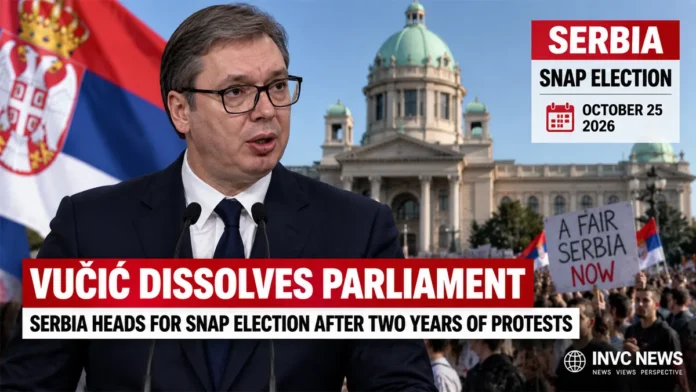
Serbia Snap Election 2026 has become one of Europe’s most closely watched political contests after President Aleksandar Vučić dissolved parliament and called an early national election for October 25, setting up a high-stakes vote after nearly two years of anti-government protests.
The decision brings Serbia to the polls more than a year ahead of the country’s next regularly scheduled parliamentary election.
Vučić signed the decree dissolving the National Assembly on September 9 after the Serbian government formally proposed early elections two days earlier.
The October vote will now test whether Vučić and his Serbian Progressive Party can preserve their political dominance amid a prolonged protest movement, growing public anger over corruption allegations and continuing questions about Serbia’s democratic institutions.
Vučić dissolves Serbia’s parliament
Serbia’s presidency formally announced that Vučić had dissolved the parliament elected in December 2023 and scheduled fresh parliamentary elections for October 25.
The government had requested dissolution on September 7, arguing that an early election could reduce political tensions and allow citizens to decide the country’s direction.
Vučić said the election was necessary to preserve democratic stability during a period of intense political confrontation.
The move dramatically accelerates Serbia’s political calendar.
The next regular parliamentary vote had been expected in December 2027.
Instead, voters will now choose a new legislature in just over six weeks.
Why Serbia is going to an early election
The immediate political crisis has its roots in the Novi Sad railway-station disaster of November 2024.
A concrete canopy at the station collapsed, killing 16 people.
The tragedy triggered public outrage and quickly expanded into one of the most sustained protest movements Serbia has faced during Vučić’s years in power.
Students became the most visible force behind the demonstrations.
Protesters accused the government of corruption, weak oversight and failing to ensure accountability for the disaster.
Those allegations evolved into broader criticism of Serbia’s political system.
Opposition groups have also accused Vučić and his allies of weakening media freedom and concentrating political power.
Vučić and the government have repeatedly rejected allegations of systemic corruption and authoritarian rule.
Nearly two years of student-led protests changed the political equation
The Novi Sad disaster transformed Serbian politics.
What began as protests over accountability developed into a nationwide movement involving students, academics, opposition supporters and civil-society groups.
Large demonstrations took place across Belgrade and other cities.
Participants demanded greater transparency, stronger institutions and accountability for those responsible for the railway-station collapse.
The protests persisted even as the government attempted to contain political pressure.
That endurance appears to have changed the calculation inside Serbia’s ruling establishment.
Instead of waiting until 2027, Vučić has now chosen an early vote.
Vučić could seek return as prime minister
The October election carries another potentially major political consequence.
Vučić has dominated Serbian politics for more than a decade, serving as either prime minister or president since 2014.
His current presidential mandate does not give him an unlimited path to remain in that position.
The Serbian Progressive Party has nominated him for prime minister, raising the possibility that he could attempt to move back into the premiership after the parliamentary election.
That would represent a major reshaping of Serbia’s leadership structure without necessarily ending Vučić’s central role in government.
Whether he would resign the presidency before the election or how any transition would be managed remains an important question.
October 25 becomes a referendum on Vučić
The election will effectively become a public judgment on Vučić’s long period of political dominance.
His supporters credit him with delivering infrastructure investment, economic development and maintaining Serbia’s ability to balance relations with the European Union, Russia and China.
Critics argue that the same period has produced increasing concentration of power and declining institutional independence.
The snap election therefore goes far beyond a routine parliamentary contest.
It will test whether months of street protests have translated into enough electoral support to challenge the ruling party.
Opposition faces a difficult decision
The opposition now has only a short period to prepare.
Serbia’s anti-government movement is politically diverse.
Students have played a central role in protests, but the movement is not identical to Serbia’s established opposition parties.
That creates a strategic challenge.
The student movement must decide whether to directly support candidates, endorse a broader opposition platform or maintain its independence from traditional political organisations.
Fragmentation could benefit Vučić.
A unified challenge could make the October vote considerably more competitive.
Novi Sad tragedy remains at the heart of election
Despite the broader political issues now involved, the Novi Sad railway-station collapse remains the symbolic centre of the crisis.
Sixteen people died when the canopy collapsed in November 2024.
The disaster became a national symbol of what protesters describe as failures in governance, transparency and public infrastructure oversight.
For many demonstrators, accountability for Novi Sad has never been separated from wider demands for political reform.
That means the October election will almost certainly return repeatedly to questions about responsibility for the tragedy.
Serbia’s EU path will also be under scrutiny
The political battle has consequences beyond Serbia.
The country remains a candidate for membership in the European Union.
Brussels has repeatedly emphasised rule-of-law standards, electoral conditions, judicial independence and media freedom as central issues in Serbia’s accession process.
At the same time, Belgrade has maintained close economic and political relationships with China and Russia.
Vučić has frequently presented that balancing strategy as essential to Serbia’s national interests.
The election could therefore influence not only domestic politics but Serbia’s foreign-policy direction.
Why the election matters for Europe
Serbia is one of the most politically influential countries in the Western Balkans.
Political instability in Belgrade can affect regional relations involving Kosovo, Bosnia and Herzegovina and neighbouring Balkan states.
Serbia’s relationship with Kosovo remains particularly sensitive.
The European Union has spent years trying to encourage diplomatic normalisation between Belgrade and Pristina.
A highly polarised Serbian election could make progress on that issue even more difficult.
European governments will therefore follow the campaign closely.
Vučić still enters election with major advantages
Despite the protests, Vučić remains Serbia’s dominant political figure.
His Serbian Progressive Party has a powerful national organisation and has controlled Serbian politics for years.
The ruling movement also benefits from strong name recognition and deep political infrastructure.
Those advantages make it difficult to assume that months of protests will automatically produce an opposition victory.
The real question is whether dissatisfaction visible on Serbia’s streets can be converted into votes.
Student movement could determine the outcome
The role of student protesters could become one of the election’s decisive factors.
Their movement gained credibility partly because it developed outside Serbia’s conventional party system.
That independence helped mobilise people who might otherwise avoid opposition politics.
However, an election requires candidates, organisation and voter mobilisation.
How students approach that transition could significantly shape the contest.
If protest groups and opposition parties coordinate effectively, they could create the strongest challenge Vučić has faced in years.
If they remain divided, the ruling party could retain a substantial advantage.
October 25 campaign could become intensely polarised
The campaign is likely to focus on several major themes.
Corruption and government accountability will remain central.
Economic performance, living costs and infrastructure development will also matter.
Questions surrounding media freedom, the rule of law and Serbia’s European future are likely to feature heavily.
Vučić will probably frame the election around stability and continuity.
Opposition groups are expected to argue that Serbia needs institutional change after more than a decade of concentrated political power.
What happens next
Election procedures began after the dissolution decree entered into force.
Political parties and electoral groups will now prepare candidate lists and campaign platforms.
The coming weeks will also show whether Serbia’s student movement formally enters electoral politics.
Another major question is how Vučić structures his own political role.
If he campaigns for a return to the prime minister’s office, the election could effectively determine both the composition of parliament and the future architecture of Serbia’s leadership.
Serbia faces its biggest political test in years
The Serbia Snap Election 2026 is not merely an early parliamentary vote.
It is the culmination of nearly two years of political pressure that began with a deadly infrastructure disaster and expanded into a nationwide challenge to Serbia’s political establishment.
Vučić enters the contest with formidable political advantages.
His opponents enter it with something they have struggled to sustain for years: a large, persistent protest movement demanding change.
October 25 will reveal which force proves stronger.