By Team INVC | INVC NEWS
BALASORE, India | September 9, 2026 —
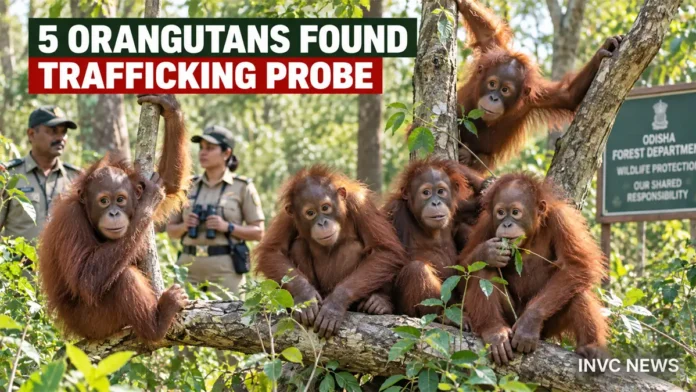
Odisha Orangutans have become the center of an unusual wildlife investigation after forest officials rescued five young orangutans from a forested area in Balasore district. Orangutans do not live naturally in India, so officials are examining whether wildlife trafficking brought the animals to Odisha.
Local residents spotted the young apes near Badapai village in the Bhograi area on Tuesday morning.
The discovery quickly attracted large crowds. Therefore, Forest Department teams moved the animals to a secure location for observation and veterinary care.
Officials are now trying to establish where the orangutans came from, how they entered India and why they appeared together in an Odisha forest.
Five Young Orangutans Found in Balasore
Residents first noticed the five orangutans moving through trees in a forested area near Badapai village.
Their appearance immediately stood out because orangutans are not native to India.
After receiving information from local residents, forest personnel reached the area and rescued all five animals.
Officials then moved them to a forest facility, where veterinary teams began monitoring their condition.
The authorities have not yet announced a final conclusion about the animals’ exact origin.
Why the Odisha Orangutans Discovery Is So Unusual
Wild orangutans occur naturally in parts of Indonesia and Malaysia, particularly on the islands of Borneo and Sumatra.
India does not have a wild orangutan population.
Moreover, no natural wildlife corridor connects their native range with Odisha.
For that reason, officials consider natural migration extremely unlikely.
Instead, investigators are examining whether people transported the animals into India.
Wildlife Trafficking Angle Under Investigation
The presence of five young orangutans together has raised concerns about possible illegal wildlife trafficking.
However, authorities have not yet identified who transported the animals or confirmed the route they may have taken.
Therefore, the trafficking connection remains under investigation.
Forest officials want to establish whether the animals entered India through an organized international network or another form of unauthorized wildlife movement.
Investigators may also examine whether someone abandoned the animals after transporting them.
Officials Focus on Human-Assisted Movement
A senior forest official has said the animals were unlikely to have reached Balasore through natural migration.
That leaves human-assisted movement as the main question for investigators.
However, officials have not yet disclosed evidence identifying an individual, group or transport network.
INVC NEWS therefore treats wildlife trafficking as a suspected explanation, not an established conclusion.
Further investigation will determine how the animals reached the area.
Wildlife Crime Control Bureau Could Examine the Case
The case could also draw the attention of the Wildlife Crime Control Bureau.
The central agency works with state authorities to investigate organized wildlife crime and cross-border trafficking.
If investigators find evidence of an international route, authorities may examine transport records, border movements and connections with known wildlife-trafficking networks.
They could also coordinate with agencies outside Odisha.
For now, however, the immediate priority remains the safety and health of the five orangutans.
Why Balasore Could Matter to the Investigation
Balasore lies in coastal Odisha and connects with major road networks leading toward West Bengal and other eastern regions.
As a result, investigators may examine different transportation possibilities.
They could look at road movements as well as potential coastal connections.
Still, authorities have not officially confirmed whether the orangutans reached Odisha by road, sea or another route.
Any specific transport claim would therefore be premature.
Crowds Gather After the Unusual Sighting
News of the animals spread quickly through nearby communities.
As more residents arrived to see them, forest officials faced another challenge.
Large crowds can increase stress for young wild animals, particularly when they are already in an unfamiliar environment.
Consequently, officials removed the orangutans from the area and placed them under controlled observation.
This also allowed veterinary teams to examine them away from the crowd.
What Happens to the Five Orangutans Now?
Veterinary care will guide the immediate next steps.
Officials will need to evaluate the animals’ health, nutritional condition and approximate ages.
They may also seek specialist advice to confirm their species and determine appropriate long-term care.
Authorities could later consider transferring the orangutans to a suitable wildlife-care or zoological facility.
However, officials have not yet announced a final relocation plan.
Any international repatriation would require additional legal, veterinary and diplomatic procedures.
Orangutans Face Serious Conservation Threats
Orangutans face major conservation challenges in their natural range.
Habitat loss and illegal wildlife trade continue to threaten populations in parts of Southeast Asia.
Young orangutans also remain dependent on their mothers for an extended period.
Therefore, the discovery of several juveniles together could help investigators understand how the animals entered human custody before reaching Odisha.
However, officials have not yet established what happened to their mothers.
The investigation must answer that question before authorities draw conclusions.
India Faces a Wider Wildlife-Trafficking Challenge
The Balasore case also highlights the wider challenge of moving non-native wildlife across international borders.
Illegal wildlife networks can transport animals through complicated routes involving several locations and intermediaries.
Law-enforcement agencies must therefore track not only the final destination but also the entire movement chain.
The five orangutans could provide investigators with useful clues if authorities establish where they originated.
Veterinary examinations, transport records and intelligence from wildlife agencies may all contribute to that process.
Why Using the Right Language Matters
The orangutans are non-native to India, but that does not make the animals themselves a threat or a problem.
The central concern is how they reached Odisha and whether people moved them illegally.
That distinction is important.
Wildlife investigations should focus on trafficking, animal welfare and conservation rather than describe the animals in a way that could create unnecessary fear.
Officials Have Not Identified Suspected Traffickers
No individual or organization has been officially identified as responsible for transporting the orangutans.
Similarly, authorities have not announced arrests in connection with their discovery.
The investigation remains at an early stage.
Therefore, reports should avoid presenting suspected wildlife trafficking as a solved crime.
Any later identification of suspects, transport routes or seizures should be added only after official confirmation.
Key Questions Investigators Must Answer
The Odisha Forest Department and other agencies now face several important questions:
- Where did the five orangutans originate?
- How did they enter India?
- Who transported them?
- How did they reach Balasore?
- Why were all five found together?
- Were they abandoned?
- Did the same route carry other protected wildlife?
- Can authorities identify a wider trafficking network?
Answers to these questions could determine whether the case remains an unusual wildlife rescue or develops into a major international trafficking investigation.
Why the Case Has Wider Conservation Significance
The discovery could also reveal gaps in wildlife enforcement.
Moving five young great apes over a long distance would require considerable planning if investigators confirm deliberate trafficking.
Therefore, authorities may eventually look beyond the immediate Balasore discovery.
They could examine how the animals crossed borders, how transporters concealed them and whether enforcement agencies missed earlier warning signs.
However, those questions remain part of the investigation rather than confirmed facts.
Odisha Orangutans Mystery Remains Unsolved
The Odisha Orangutans case has turned an unusual forest sighting into a significant wildlife investigation.
Officials safely rescued five young orangutans from Balasore.
The animals are not native to India, and natural migration does not offer a credible explanation for their presence there.
Still, investigators have not yet established who brought them to Odisha or how they reached the forest.
For now, two priorities remain clear: protect the animals and trace their journey.
The answers could reveal whether the five orangutans became part of a much larger wildlife-trafficking operation.