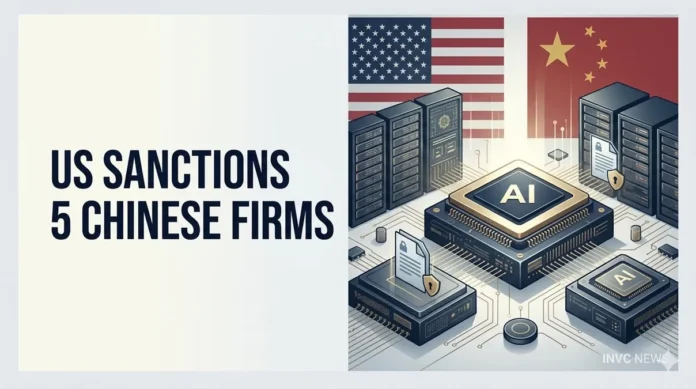
WASHINGTON, October 21, 2026 — The United States has imposed sanctions on five Chinese entities linked to former Google software engineer Linwei Ding, whose conviction for stealing confidential artificial intelligence trade secrets has triggered a new dispute between Washington and Beijing.
The US State Department announced the measures on October 19, saying the entities were connected to the alleged theft of sensitive American technology. China’s Commerce Ministry strongly opposed the action on October 20, arguing that it harmed the legitimate interests of Chinese businesses and warning that Beijing would take “necessary measures” in response. The ministry did not specify what steps China might take.
At the centre of the dispute are Ding’s AI startup, Shanghai Zhisuan Technology, and MiraclePlus, a Chinese startup incubator and investment firm that provided seed funding to Zhisuan in exchange for an ownership stake. Three additional entities linked to MiraclePlus are also covered by the US measures.
Which Five Chinese Entities Face US Sanctions?
According to the US State Department, the five designated entities are:
- Shanghai Zhisuan Technology Co. Ltd. — The AI company founded by Ding in 2023.
- Qiji Chuangtan Beijing Investment Management Co. Ltd., known as MiraclePlus — A venture capital firm and startup incubator that invested in Zhisuan.
- Beijing Qiji Chuangtan Phase I Venture Capital Center Limited Partnership — A venture capital fund managed by MiraclePlus.
- Beijing Qiji Chuangtan Phase II Venture Capital Center Limited Partnership — Another fund managed by MiraclePlus.
- Beijing Qiji Chuangtan Zhiyuan Enterprise Management Center Limited Partnership — An entity wholly owned by the Phase I fund, according to the State Department.
The US government says Zhisuan knowingly engaged in, or benefited from, significant theft of trade secrets belonging to US individuals or entities on or after January 5, 2023. It also alleges that MiraclePlus provided significant financial, material or technological support connected to the activity.
These are the US government’s stated grounds for imposing the sanctions. The designations do not, by themselves, establish that every named entity independently stole confidential technology.
What Is the Connection Between Linwei Ding, Zhisuan and MiraclePlus?
Ding founded Shanghai Zhisuan Technology in 2023, after working as a software engineer at Google. The company was presented as an AI venture developing infrastructure capable of accelerating machine-learning workloads, including the training of large-scale “super intelligence” models using supercomputing chips.
The State Department says Ding used his Google experience and knowledge of the company’s internal systems to promote Zhisuan. In an application to MiraclePlus’s startup incubation programme, he reportedly claimed that his company could replicate Google’s super-intelligence infrastructure technology.
MiraclePlus provided seed funding in return for an ownership stake in Zhisuan. The US sanctions also extend to three related entities that the State Department identifies as linked to, managed by or controlled through MiraclePlus.
The government’s case therefore connects the five entities through two central relationships: Ding’s founding of Zhisuan and MiraclePlus’s investment and organisational links to the startup.
What Did the US Accuse Ding of Doing?
US prosecutors alleged that Ding took confidential Google documents containing proprietary information about AI technology while pursuing business interests connected to China.
The case focused on information relating to the hardware infrastructure and software systems used to train large AI models. According to the US Justice Department, Ding uploaded thousands of pages of confidential material to a personal cloud account while he was employed by Google and was also pursuing work involving China-based technology companies.
A federal jury in San Francisco convicted Ding in January 2026 on seven counts of economic espionage and seven counts of theft of trade secrets. However, the legal position subsequently changed.
In August, a federal judge overturned the economic-espionage counts, ruling that prosecutors had not provided sufficient evidence that Ding intended or knew that his conduct would benefit the Chinese government, as those charges required. The court left the trade-secret-theft convictions intact.
Ding was sentenced in September to approximately 12 months in prison. The Justice Department is appealing the dismissal of the economic-espionage counts.
The distinction matters: the surviving trade-secret convictions and the dismissed economic-espionage counts are separate parts of the case. The sanctions announcement does not erase that distinction.
How Has China Responded?
China’s Commerce Ministry said the US action seriously harmed the legitimate rights and interests of Chinese companies. It urged Washington to correct what it called an erroneous decision and said Beijing would take necessary measures, without identifying any specific retaliation.
The ministry also rejected the suggestion that China’s AI progress depended on the theft of trade secrets. It said the country’s development in artificial intelligence reflected long-term investment in basic research, sustained innovation and independent scientific and technological development, alongside open cooperation.
Beijing’s response challenges the US government’s account of the case and frames the sanctions as a broader issue affecting Chinese technology businesses.
Why Does the Case Matter for the US-China AI Rivalry?
The dispute comes amid competition between the United States and China over advanced AI systems, computing infrastructure, semiconductor technology and the intellectual property that supports them.
For Washington, the measures signal that it intends to use legal and sanctions tools to respond to alleged theft of sensitive technology. For Chinese companies seeking investment, the case highlights the potential consequences of links to entities targeted by US restrictions.
The action also raises questions for venture capital firms and startup incubators that fund early-stage technology companies. Investment relationships can become a focus of scrutiny when US authorities allege that a portfolio company benefited from stolen intellectual property.
The immediate impact will depend on how the sanctions are implemented and whether China announces specific countermeasures. The broader dispute is likely to remain tied to the two countries’ competing approaches to protecting technology, enforcing intellectual-property rules and managing AI-related national security concerns.
The bottom line: The US sanctions target five Chinese entities connected, according to Washington, to Linwei Ding and his AI startup. China has condemned the measures and threatened an unspecified response. Ding remains convicted of trade-secret theft, while the separate economic-espionage counts were dismissed by a judge and are subject to a US government appeal.