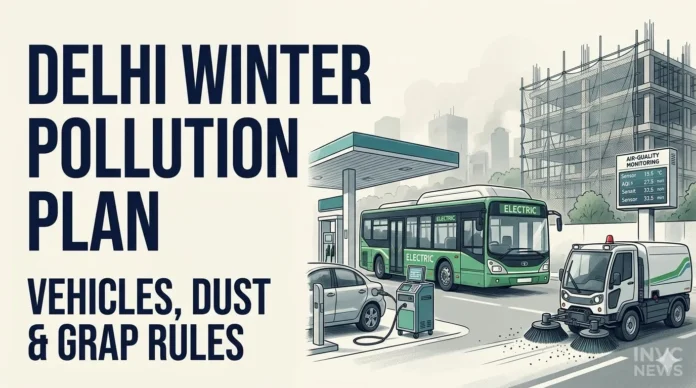
New Delhi | October 22, 2026 – Delhi-NCR is preparing for another challenging winter as deteriorating air quality raises concerns about pollution from vehicles, construction dust, industrial emissions and waste burning. The Delhi government’s Winter Action Plan for 2026–27 is set to introduce tighter controls from November 1, including restrictions on certain vehicles registered outside Delhi, a “No PUCC, No Fuel” policy, construction curbs and a proposed 50% work-from-home arrangement for government and private offices.
The measures come as the Commission for Air Quality Management (CAQM) has invoked Stage I of the Graded Response Action Plan (GRAP) across the National Capital Region. Delhi’s AQI reached 244 on October 21, placing it in the “Poor” category, according to the official announcement.
The winter plan combines restrictions with longer-term measures such as expanding public transport, mechanised road cleaning, monitoring industrial pollution, preventing open waste burning and increasing green cover. The challenge will be to ensure that these measures are enforced consistently across Delhi and the wider NCR, where pollution sources cross administrative boundaries.
The 60-second brief
- Winter Action Plan: Scheduled measures begin November 1, with the overall winter framework running through February 28.
- Vehicle restrictions: Non-Delhi-registered vehicles below BS-VI emission standards are to be barred from entering Delhi from November 1 to January 31, subject to specified exemptions.
- No PUCC, No Fuel: Vehicles without a valid Pollution Under Control Certificate will face restrictions on refuelling under the announced policy.
- Construction dust: Dust-generating demolition and outdoor civil construction activities are scheduled to face restrictions from November 1 to January 31, with a broader construction and demolition ban planned for December 10 to January 20.
- Work from home: A 50% work-from-home arrangement and staggered office timings are among the announced measures to reduce traffic pressure.
- GRAP Stage I: The first stage has been activated across NCR following Delhi’s AQI entering the Poor category.
1. Which vehicles will face restrictions from November 1?
Vehicle emissions are a major target of Delhi’s winter pollution strategy. Under the announced plan, vehicles registered outside Delhi that do not meet BS-VI emission standards will be restricted from entering the capital from November 1 to January 31.
The restriction is not a blanket ban on every vehicle below BS-VI across all circumstances. The announced framework includes exemptions for certain cleaner-fuel vehicles, such as CNG and electric vehicles, as well as specified emergency and essential-service vehicles. Motorists should check the applicable government order before travelling.
BS-VI is India’s Bharat Stage VI vehicle-emission standard, introduced for new vehicles from April 1, 2020. It imposes stricter limits on harmful emissions than earlier standards and requires more advanced pollution-control systems.
For commuters travelling from neighbouring cities, the key issue will be the vehicle’s registration location, emission standard and whether a stated exemption applies. Drivers should not assume that a vehicle is permitted simply because it is privately owned or used for daily commuting.
2. ‘No PUCC, No Fuel’: What motorists need to know
The government has also announced a “No PUCC, No Fuel” policy. PUCC stands for Pollution Under Control Certificate, which records whether a vehicle meets the applicable emission requirements at the time of testing.
Under the announced winter measures, enforcement and awareness campaigns will be conducted at 500 petrol pumps equipped with Automatic Number Plate Recognition (ANPR) cameras. Fuel stations that fail to comply with the applicable requirements may face action.
For vehicle owners, the practical steps are straightforward:
- Check whether the vehicle’s PUCC is valid.
- Renew an expired certificate through an authorised testing centre.
- Keep the vehicle’s registration and emission-related documents accessible.
- Avoid assuming that a recent fuel purchase or an older certificate guarantees compliance.
The policy is intended to make compliance easier to check at fuel stations, rather than relying only on roadside inspections.
3. Construction and demolition activities to face restrictions
Construction dust is another major contributor to particulate pollution in Delhi-NCR. The winter plan sets out restrictions intended to reduce dust from demolition, excavation and outdoor civil construction.
The announced schedule includes:
- November 1 to January 31: Restrictions on dust-generating demolition activities and outdoor civil construction work.
- December 10 to January 20: A complete ban on construction and demolition activities under the announced schedule, subject to applicable exemptions and official directions.
The government also plans to expand inspections and use AI-enabled cameras at construction sites connected to a command-and-control system. The objective is to identify violations more quickly and improve monitoring.
Construction and demolition waste management is also being tightened. Registration through the Malba App is to be linked to the building-plan approval process, according to the announced plan.
These restrictions could affect construction schedules, contractors, property developers and infrastructure projects. The exact work permitted during the restricted periods will depend on the applicable order and any exemptions for essential projects.
4. Could 50% work from home reduce traffic pollution?
The winter plan includes a 50% work-from-home arrangement for government and private-sector offices, alongside staggered office timings. These measures are intended to reduce the number of people travelling at the same time and ease congestion on major roads.
Heavy traffic can increase emissions through fuel consumption, idling and stop-start driving. Reducing peak-hour travel may therefore help limit some pollution, although the overall benefit will depend on how the policy is implemented and how many journeys are actually avoided.
Staggered office timings are designed to spread commuter traffic across a longer period rather than concentrating it within the usual morning and evening peaks.
For employees, implementation details matter. Employers and government departments will need to communicate the applicable attendance requirements, exemptions and schedules clearly. The announcement should not be interpreted as meaning that every employee can automatically work from home without further instructions.
5. Public transport and electric buses get a bigger role
Reducing dependence on private vehicles is a central part of the winter strategy.
According to the figures supplied by the Delhi government, the city’s bus fleet has grown to 6,840 buses, including 5,088 electric buses. The plan also emphasises last-mile connectivity to Delhi Metro stations and wider use of the Delhi Metro Sarthi app.
Better connections between buses, the Metro and local destinations can make public transport more convenient for commuters who might otherwise use private vehicles for the entire journey.
The impact, however, depends on reliability, frequency, crowding and access to services in residential and commercial areas. Expanding the fleet is important, but commuters also need dependable routes and convenient transfers to change their daily travel habits.
6. Road dust control: Mechanical sweeping across 609 kilometres
Road dust can contribute to PM10 pollution, particularly when dust accumulated on road surfaces is repeatedly lifted by passing traffic.
The government’s plan includes mechanical sweeping across approximately 609 kilometres of roads less than 10 metres wide. A total of 854 roads across 250 municipal wards have been identified for this purpose, according to the supplied figures.
The plan also prioritises road redevelopment, paving footpaths and completing outstanding work to reduce loose dust along roadsides. The government has reported that 1,193 kilometres of road redevelopment work has been completed, with remaining work targeted for completion by November 15.
A system is also planned to ensure that pollution and sanitation complaints are addressed within 72 hours under the prescribed process.
Mechanical sweeping can help remove accumulated dust, but its effectiveness depends on regular schedules, proper collection and disposal of swept material, and maintenance of road surfaces. Simply moving dust from one location to another would not deliver the intended result.
7. Open waste burning and industrial pollution under tighter watch
Burning municipal waste, leaves and other material in the open releases particulate matter and harmful gases. The winter plan calls for ward-, district- and subdivision-level monitoring teams, better waste collection in markets and a “zero burning” campaign.
Special attention is to be given to unauthorised settlements and other areas where waste collection or disposal can be difficult. The government has also reported that the number of material recovery and sorting centres has increased from 76 to 98.
Industrial emissions are another priority. The announced measures include:
- Increasing pollution monitoring stations from 47 to 60.
- Deploying 334 enforcement teams to check compliance.
- Activating an AI-enabled command-and-control centre.
- Strengthening daily air-quality bulletins and citizen complaint handling.
- Improving coordination among agencies across Delhi-NCR.
The effectiveness of these measures will depend on inspections, timely action against violations and transparent reporting of compliance.
8. The government says 71 lakh plants have been planted
Expanding green cover is another element of the winter plan. The Delhi government says 71 lakh plants have been planted and that 433 acres out of 434 identified acres have been greened.
The next step is to protect the plants and ensure they survive. Planting numbers alone do not establish how much pollution will be reduced; the survival rate, species, location, maintenance and long-term growth of trees all matter.
Green cover can support urban environmental quality, but it cannot replace measures that directly reduce vehicle emissions, industrial pollution, construction dust and waste burning.
9. IIT Delhi to study pollution sources
The Delhi government has approved a five-year collaboration with IIT Delhi to study the sources of air pollution and track their contributions over time.
The research is intended to help assess major sources of PM2.5 and PM10, including vehicle emissions, road dust and biomass burning. Understanding how the contribution of each source changes by location and time of day can help authorities target measures more effectively.
Source-apportionment studies are useful because Delhi’s pollution is not produced by a single activity. Local emissions, regional pollution, weather conditions and the movement of pollutants across state boundaries can all influence the AQI.
The value of the research will ultimately depend on how its findings are translated into practical enforcement, planning and public information.
10. What is GRAP Stage I, and what changes now?
The Graded Response Action Plan, or GRAP, is a set of emergency and preventive measures designed to respond to worsening air quality across Delhi-NCR.
CAQM invoked Stage I across the region on October 21 after Delhi’s AQI reached 244, within the Poor category. Stage I applies when the AQI is in the 201–300 range.
Measures at this stage include stricter enforcement against visibly polluting vehicles, dust-control steps at construction sites, prevention of open waste and biomass burning, better traffic management and intensified monitoring.
GRAP is a staged system. If air quality deteriorates further and the relevant conditions are met, additional restrictions can be activated under subsequent stages. The measures in force depend on CAQM’s orders and should not be confused with every restriction announced separately under the winter action framework.
For residents, the practical message is to follow current official directions rather than assume that all winter restrictions are already active simply because Stage I GRAP has been invoked.
What residents should do before November 1
Delhi-NCR residents can prepare by checking their vehicle’s emission standard and PUCC validity, planning public-transport alternatives, following official construction restrictions and avoiding the burning of waste or leaves.
Employers should watch for formal directions on work-from-home arrangements and staggered office timings. Construction firms should review the announced calendar and confirm any applicable exemptions before scheduling restricted activities.
Residents can also monitor official AQI updates and report pollution-control violations through the relevant government channels.
The bottom line
Delhi’s 2026–27 Winter Action Plan combines vehicle restrictions, fuel-station checks, construction curbs, work-from-home arrangements, road-dust control and stronger enforcement against waste and industrial pollution. Stage I GRAP has also been activated across NCR as air quality enters the Poor category.
The plan is broad, but its success will depend on implementation. Cleaner vehicles, better public transport and tighter controls on dust and waste can help reduce emissions, while source monitoring can improve the targeting of future measures.
For commuters and businesses, the immediate priority is to understand which restrictions apply, when they begin and whether exemptions are available. For the city as a whole, the real test will be whether these measures produce measurable improvements in air quality through the winter months.