By Team INVC | INVC NEWS
PARIS, France | September 9, 2026 —
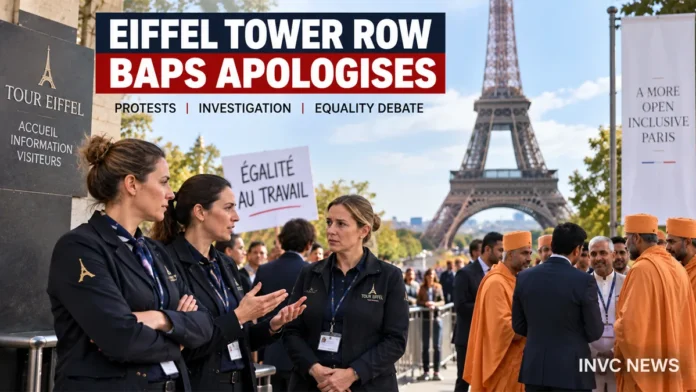
Eiffel Tower BAPS Row has triggered a major debate over gender equality after employees at the Paris landmark protested allegations that women staff were sidelined during a visit by a delegation linked to the Bochasanwasi Akshar Purushottam Swaminarayan Sanstha, or BAPS.
The dispute led employees to stage a walkout on Monday, temporarily closing the Eiffel Tower.
The monument reopened on Tuesday after talks between workers and management.
BAPS has apologised for any hurt or inconvenience caused while saying it did not intend to exclude anyone on the basis of gender.
Meanwhile, Paris authorities have ordered an investigation, and India’s Ministry of External Affairs has said the matter is between the entities concerned.
What Happened at the Eiffel Tower?
The controversy began after a BAPS-linked delegation of around 100 people visited the Eiffel Tower over the weekend.
Employees later alleged that women workers were instructed to limit their interactions with the visiting group.
Some staff members said women were moved away from their posts, replaced by male colleagues or told not to enter certain areas while the delegation was present.
The allegations quickly generated anger among employees.
Workers argued that such instructions conflicted with workplace equality and non-discrimination principles.
Their protest eventually resulted in a strike that closed one of the world’s most famous tourist attractions for a day.
Eiffel Tower Operator Acknowledges Management Failure
The company that operates the Eiffel Tower acknowledged that arrangements had been made to limit interactions between the delegation and women employees.
Importantly, the operator also said those conditions should not have been accepted.
That admission shifted part of the focus toward management decisions.
Employees argued that the Eiffel Tower, as a symbol of France, should uphold the country’s principles of equality regardless of who visits.
The controversy therefore developed beyond a dispute involving a religious delegation and became a wider debate about how public institutions respond to special visitor requests.
BAPS Apologises but Rejects Intent to Exclude Women
BAPS issued a statement after the controversy intensified.
The organisation said it had coordinated the visit with Eiffel Tower management because of the size of the delegation and wanted to minimize disruption to staff and other visitors.
BAPS said any coordination was not intended as a gender-based request.
It also said, to the best of its knowledge, nobody was denied access to the Eiffel Tower.
However, the organisation expressed regret over the controversy and apologised to anyone who felt hurt or inconvenienced.
BAPS further stressed that it supports equality, mutual respect and service regardless of gender, background or belief.
Paris Authorities Order Investigation
The incident has drawn strong political reaction in France.
Paris authorities announced an investigation into how the arrangements were approved.
French political figures also criticized the reported treatment of female employees.
The central issue is whether management allowed workplace practices that conflicted with France’s commitment to gender equality.
Authorities are expected to examine who approved the arrangements, how staff instructions were communicated and whether existing workplace rules were breached.
Eiffel Tower Reopens After Strike
The Eiffel Tower reopened after workers and management held discussions.
Visitors began returning to the landmark on Tuesday.
The reopening ended the immediate disruption, but the dispute has continued to attract public attention.
The Eiffel Tower receives millions of visitors every year and frequently hosts international leaders, celebrities, religious groups and large delegations.
Employees have said they routinely adapt to security and logistical requirements.
However, workers argued that gender-based restrictions crossed a line that ordinary visitor accommodations should not cross.
India’s MEA Distances Itself From Dispute
India’s Ministry of External Affairs has also responded to questions about the controversy.
The ministry said the dispute was a matter between the entities concerned.
That response effectively kept the Indian government away from the operational controversy at the Eiffel Tower.
The MEA also addressed questions about Prime Minister Narendra Modi’s earlier message connected with the opening of a BAPS temple in France.
Officials indicated that conveying good wishes during religious or cultural events forms part of normal diplomatic and public outreach.
The government has not taken responsibility for arrangements involving the BAPS delegation’s Eiffel Tower visit.
Why BAPS Was in France
The BAPS delegation was in France amid celebrations connected with the inauguration of a major Hindu temple in the Paris region.
BAPS is an international Hindu organisation associated with the Swaminarayan tradition and operates temples and community institutions across many countries.
The organisation regularly holds religious, cultural and charitable programmes.
Its presence in France had been expected to highlight the growth of the Hindu community and wider India-France cultural ties.
Instead, the Eiffel Tower incident has temporarily shifted attention toward questions of gender equality and workplace treatment.
Women Staff Say They Were Made Invisible
Employee accounts form the core of the controversy.
Workers said female staff were effectively removed from visibility in certain parts of the tower during the delegation’s visit.
They argued that women employees should not be treated differently because of their gender.
That explains why an operational workplace disagreement escalated into a national political issue.
BAPS Says Delegation Never Sought Discrimination
BAPS has pushed back against the suggestion that its purpose was to discriminate against women.
The organisation says the visit arrangements arose from logistical coordination rather than an intention to exclude female staff.
Its statement also emphasized that nobody, to its knowledge, was prevented from accessing the monument.
That version differs from the interpretation presented by employees, who say the instructions clearly affected women because of their gender.
The official investigation could help establish how the request was originally communicated and how management translated it into workplace instructions.
Why This Case Matters Beyond the Eiffel Tower
The Eiffel Tower BAPS Row raises a broader question faced by public institutions around the world.
How far should a landmark, workplace or government-run facility go when accommodating the cultural or religious preferences of visitors?
Religious freedom and cultural sensitivity remain important principles.
However, employee rights and anti-discrimination rules also carry legal and ethical weight.
The challenge arises when accommodation for one group appears to restrict the rights or working conditions of another.
The Paris controversy demonstrates how quickly that balance can become politically sensitive.
No Evidence of Criminal Charges Against BAPS
At this stage, the controversy centers on workplace arrangements, employee complaints, management decisions and the investigation ordered by Paris authorities.
No criminal finding against BAPS has been announced in connection with the incident.
Similarly, an apology does not amount to an admission of deliberate discrimination.
INVC NEWS therefore treats the allegations, responses and management acknowledgment separately rather than presenting disputed claims as established intent.
What Happens Next?
Three developments will determine how the story evolves.
First, Paris authorities may publish findings from their investigation.
Second, Eiffel Tower management could introduce clearer rules for future private or group visits.
Third, BAPS may issue additional clarification if new claims emerge.
The controversy could also lead to a broader discussion in France about how public monuments handle requests involving gender, religion and cultural practice.
Eiffel Tower BAPS Row Puts Equality Debate in Spotlight
The Eiffel Tower BAPS Row has moved far beyond a routine visitor-management dispute.
Female employees say they were sidelined because of their gender.
Eiffel Tower management accepts that arrangements limiting interactions with women should not have been approved.
BAPS says it never intended gender discrimination and has apologised for any hurt caused.
Paris authorities now want answers.
The Eiffel Tower has reopened, but the debate surrounding equality, religious accommodation and workplace rights is likely to continue long after tourists return to the monument.