By Team INVC | INVC NEWS
Published: August 31, 2026 |03 : 01 PM IST
BISHKEK, Kyrgyzstan | August 31, 2026 —
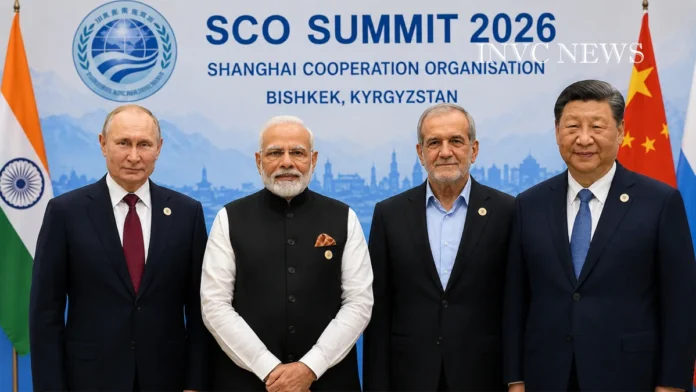
PM Modi SCO Summit 2026 diplomacy moved into sharp focus in Bishkek on Monday as Prime Minister Narendra Modi joined Russian President Vladimir Putin, Chinese President Xi Jinping, Iranian President Masoud Pezeshkian and other regional leaders at a gathering shaped by war, energy security, terrorism and a rapidly changing global order.
Prime Minister Narendra Modi is attending the 26th Shanghai Cooperation Organisation Summit during his two-day visit to Kyrgyzstan. His engagements with President Putin and President Pezeshkian are among the most closely watched meetings on the sidelines, while President Xi’s presence puts the leaders of India, China and Russia on the same diplomatic stage.
India has signalled that its message at the summit will centre on Security, Connectivity and Opportunity, with terrorism, separatism and extremism remaining major concerns for New Delhi.
Modi-Putin Meeting Puts Trade, Energy and Ukraine in Focus
Prime Minister Narendra Modi’s meeting with Russian President Vladimir Putin carries significant economic as well as geopolitical weight.
India and Russia continue to maintain a Special and Privileged Strategic Partnership, with energy, defence, trade, nuclear cooperation and technology forming important pillars of the relationship.
The Bishkek interaction comes shortly after External Affairs Minister S. Jaishankar’s Russia visit, where trade, energy cooperation and the long-term target of taking bilateral trade to $100 billion were among the important themes.
Energy security has become even more important for India as instability in West Asia affects crude oil supplies, shipping routes and global prices.
Also Read – : Jaishankar Russia Visit: $100 Billion Trade Goal, Energy Security and Lavrov Talks Take Center Stage
The Ukraine conflict is also expected to remain part of the wider geopolitical backdrop. India has consistently supported dialogue and diplomacy while maintaining close ties with Moscow.
Pezeshkian Talks Come at Critical Moment for India and Iran
Iranian President Masoud Pezeshkian’s presence gives the summit another layer of urgency.
His bilateral engagement with Prime Minister Narendra Modi comes against the backdrop of the continuing West Asia confrontation and heightened tension around the Strait of Hormuz, one of the world’s most important energy corridors.
For India, the consequences extend well beyond diplomacy.
Disruption around Hormuz can affect crude oil and LNG supplies, tanker insurance, shipping costs, inflation and the safety of Indian seafarers operating through the region.
India also has long-term strategic interests in connectivity with Iran, including the Chabahar Port corridor linking India with Afghanistan and Central Asia.
The Modi-Pezeshkian interaction is therefore expected to attract attention for any signals concerning regional de-escalation, energy security, connectivity and the safety of Indian nationals.
Also Read – : Trump Strait of Hormuz Tensions Rise as Iran Keeps Key Oil Route Restricted
Xi Jinping Shares SCO Stage With PM Modi
Chinese President Xi Jinping is also in Bishkek, creating another closely watched geopolitical moment.
However, as of Monday afternoon, no formal bilateral meeting between Prime Minister Narendra Modi and President Xi had been publicly scheduled.
An informal interaction during SCO events remains possible.
That distinction matters because India and China continue to manage a complicated relationship involving their disputed border, trade, regional competition and attempts to maintain high-level diplomatic engagement.
A Modi-Xi-Putin appearance at the same summit will inevitably draw global attention. However, it should not automatically be interpreted as evidence of a new trilateral strategic alliance.
India continues to follow an independent foreign policy while engaging with Russia, China, the United States, Europe, West Asia and the Global South according to its national interests.
Terrorism Likely to Remain Central to India’s SCO Message
Counter-terrorism is expected to remain one of India’s strongest themes at the SCO Summit 2026.
Before travelling to Kyrgyzstan, Prime Minister Narendra Modi emphasised India’s vision of a region protected from terrorism, separatism and extremism.
For New Delhi, that position has particular significance because security cooperation was one of the original foundations of the Shanghai Cooperation Organisation.
India is likely to push for stronger regional cooperation against terror networks while also stressing that countries should not apply selective standards when dealing with terrorism.
Why the Bishkek SCO Summit Matters for India
The 2026 summit marks 25 years of the Shanghai Cooperation Organisation.
India became a full member in 2017 and has increasingly used the grouping to engage Central Asia while maintaining direct contact with major powers including Russia and China.
Central Asia is strategically important to India because of its energy resources, critical minerals, trade potential and geographic position between Russia, China, Iran and South Asia.
However, India’s lack of direct land access to the region makes connectivity particularly important.
That is why New Delhi’s three-part SCO approach — Security, Connectivity and Opportunity — goes beyond diplomatic symbolism.
It connects counter-terrorism with infrastructure, trade, energy access and India’s broader effort to deepen relations with Central Asian countries.
Bishkek Becomes Centre of Global Diplomacy
The gathering comes at an unusually sensitive moment.
Russia remains engaged in the Ukraine war. Iran faces intense confrontation with the United States and wider tensions in West Asia. Global energy markets are watching the Strait of Hormuz, while relations among several major powers remain unsettled.
Against that backdrop, Prime Minister Narendra Modi’s meetings with President Putin and President Pezeshkian—and his presence alongside President Xi—give the Bishkek summit significance far beyond Central Asia.
The next major signals will come from the official bilateral readouts and Prime Minister Narendra Modi’s SCO address, particularly on terrorism, connectivity, the Ukraine conflict and stability in West Asia.