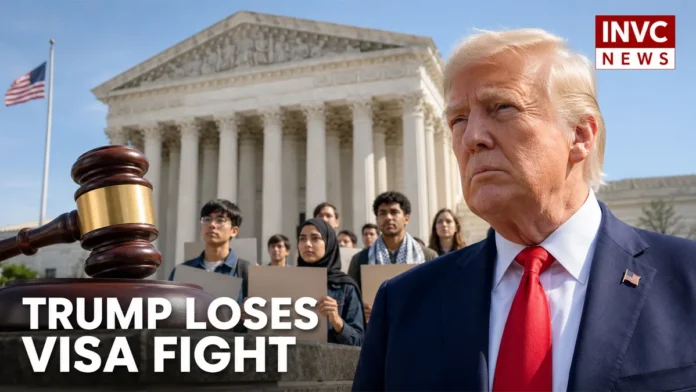
By Team INVC | INVC NEWS
Published: August 29, 2026 | 20 : 45 PM IST
SAN JOSE, California | August 29, 2026 —
The Trump administration suffered a major constitutional setback after a federal judge ruled that the government cannot use immigration law to cancel visas or pursue deportation against noncitizen students because of protected pro-Palestinian advocacy or criticism of Israel.
US District Judge Noël Wise held that the challenged provisions violated the First Amendment when enforced on the basis of protected speech. She also found that the provisions were unconstitutionally vague under the Fifth Amendment in that context.
The decision targets a central legal mechanism used by the administration to investigate foreign students, revoke visas and initiate removal proceedings over campus protests, social-media posts, opinion articles and political associations.
However, the ruling does not eliminate the government’s wider power to revoke visas or deport noncitizens for legitimate immigration, criminal or national-security reasons.
Court Strikes at Trump’s Ideological Deportation Campaign
The case, Stanford Daily Publishing Corporation v. Marco Rubio, was brought by Stanford University’s student newspaper and an anonymous international student holding an F-1 visa.
The plaintiffs argued that the administration had weaponised provisions of the Immigration and Nationality Act to punish foreign students for political expression the government opposed.
Judge Wise agreed that the government’s use of the challenged provisions against protected speech amounted to viewpoint- and content-based discrimination.
The court found that officials had relied on protest participation, association with pro-Palestinian organisations, social-media activity and opinion articles while building cases against foreign students.
Crucially, the record considered by the court stated that the cases did not rely on violence or material support for terrorist organisations.
Rubio’s Visa Powers Face Constitutional Limit
One disputed provision allowed the secretary of state to classify a noncitizen as deportable when their presence or activities were considered damaging to a compelling US foreign-policy interest.
A separate provision gave the secretary broad discretion to revoke a visa.
The administration argued that the measures protected US foreign-policy and national-security interests. The court, however, concluded that the government could not single out constitutionally protected speech simply because officials disagreed with its content or viewpoint.
Judge Wise declared four key findings:
- The challenged deportation provision violated the First Amendment when enforced against protected speech.
- The same provision was unconstitutionally vague under the Fifth Amendment in that context.
- The challenged visa-revocation provision violated the First Amendment when used against protected speech.
- The revocation provision was also unconstitutionally vague under the Fifth Amendment as applied.
The complete 90-page federal court decision was filed on August 28.
Why The Stanford Daily Went to Court
The case emerged after the Trump administration began targeting foreign students involved in pro-Palestinian campus activity in March 2025.
The arrest of Columbia University graduate Mahmoud Khalil became the most prominent example, although his individual deportation proceedings remain separate from the Stanford litigation.
The Stanford Daily said international student journalists and contributors had begun censoring themselves because they feared that reporting on Palestine, Gaza or campus demonstrations could trigger visa consequences.
The newspaper argued that this chilling effect damaged both freedom of speech and freedom of the press.
Also Read – : Latest World and Political News on INVC NEWS
Ruling Does Not End All Student Deportations
The scope of the decision is important.
The court did not rule that every visa revocation or deportation involving a foreign student is unconstitutional. Nor did it give noncitizens immunity from immigration enforcement.
Instead, the decision says the government cannot use the disputed powers against a person merely because of protected political speech.
The court also stopped short of issuing the full permanent injunction sought by the plaintiffs. Judge Wise said existing legal restrictions prevented the district court from granting some forms of injunctive relief against the deportation provision, which only the US Supreme Court may issue.
The judgment is therefore a powerful constitutional declaration, but further litigation or an appeal could determine how broadly it alters enforcement.
Political Battle Over Free Speech and Antisemitism
Trump officials have argued that the crackdown is necessary to confront antisemitism and protect Jewish students on American campuses.
Civil-liberties advocates counter that opposing Israel’s policies or expressing support for Palestinian civilians cannot automatically be treated as support for Hamas or another terrorist group.
The administration must now decide whether to appeal the ruling. The State Department and Department of Homeland Security had not immediately issued a detailed response to the decision.
The judgment could also influence other lawsuits involving student visas, campus demonstrations and the government’s power to invoke foreign-policy concerns against political expression.
For Trump, the decision creates a serious legal and political obstacle: his administration may enforce immigration law, but a federal court has now said it cannot use that power to silence protected opinions.