
By Team INVC | INVC NEWS
Published: August 29, 2026 | 08 : 05 PM IST
NEW YORK CITY, United States | August 29, 2026 —
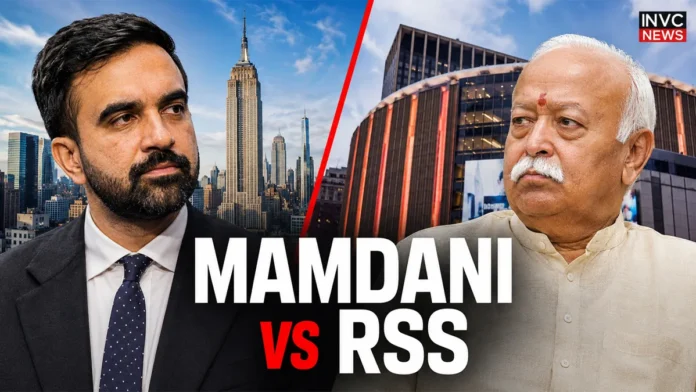
A major political confrontation has erupted in New York over RSS chief Mohan Bhagwat’s scheduled address to thousands of Indian Americans, with Mayor Zohran Mamdani openly opposing the organisation’s ideology while acknowledging that the city cannot simply cancel a lawful private event.
Bhagwat is due to headline the “Universal Oneness Celebration” in Manhattan on Saturday afternoon. The event has been promoted as a gathering dedicated to unity, community service and the ancient Indian principle of “Vasudhaiva Kutumbakam”—the world is one family.
However, civil-rights, interfaith and minority organisations have called for the appearance to be cancelled, transforming the gathering into a contentious debate over Hindu nationalism, religious freedom, pluralism and the RSS’s growing international profile.
Mamdani Says He Does Not Support the RSS Event
Mamdani, New York City’s first Indian-American and Muslim mayor, said he did not support the event because of his opposition to what he characterised as an exclusionary political vision.
He contrasted that ideology with the image of India he said he inherited from his family—a secular and pluralistic republic in which every citizen belongs, irrespective of religion or background.
At the same time, Mamdani accepted a critical legal distinction: the mayor’s political opposition does not automatically give New York City the authority to cancel a private gathering.
“I don’t support the rally, but I don’t know if the city has any jurisdiction on cancelling a private event,” Mamdani told reporters while addressing the controversy.
His intervention has placed him at the centre of an increasingly bitter dispute extending far beyond New York.
Critics of Mamdani accuse him of unfairly targeting a Hindu organisation while presenting himself as a defender of diversity. His supporters argue that opposing a political ideology is different from attacking Hinduism or Hindu Americans.
More Than 5,000 Attendees Expected
The official Universal Oneness Celebration website says the event will run from 2 PM to 5:30 PM Eastern Time on August 29.
Organisers say registration is closed and the programme is fully booked, with more than 5,000 participants expected. They also say more than 250 partner organisations are supporting the gathering.
The cultural programme will include music, dance and artistic presentations alongside Bhagwat’s address. The organisers describe it as a celebration of common heritage, civic engagement and respect for all creation.
According to the event’s stated vision, the principle of universal oneness requires people to treat every human being, tradition and living creature with respect and humility.
Bhagwat’s appearance forms part of the RSS’s centenary-year international outreach. The organisation, founded in 1925, describes itself as a cultural and volunteer movement focused on social service, discipline and national unity.
Civil-Rights Coalition Demands Cancellation
Opposition groups reject the organisers’ inclusive presentation of the event.
A coalition of civil-rights, faith and community organisations urged the venue and US authorities to act against Bhagwat’s appearance. Protesters include organisations representing Hindu, Muslim, Sikh, Christian and Dalit communities.
Some critics have demanded the cancellation of Bhagwat’s visa or sanctions against RSS figures. Such demands are political advocacy, however, and do not establish that Bhagwat has violated US law or that authorities have initiated action against him.
The campaign seeking cancellation of Bhagwat’s appearance alleges that the RSS promotes religious exclusion and does not represent the Hinduism its organisers practise.
The RSS rejects allegations that it promotes hatred or discrimination. Its representatives say the New York forum is open to dialogue and intended to communicate a message of unity across communities.
Also Read – : Latest India and Global Political News on INVC NEWS
BJP Leaders Hit Back at Mamdani
The controversy has also generated a political response in India.
BJP representatives accused Mamdani of contradicting his own commitment to pluralism. They argued that genuine pluralism should permit Bhagwat and RSS supporters to present their views at a lawful community programme, even when the mayor strongly disagrees with them.
The RSS has a longstanding ideological relationship with the BJP, although the two are separate organisations. Critics frequently describe the RSS as the BJP’s ideological parent, while its supporters emphasise its social-service activities and volunteer network.
The dispute therefore involves more than a single New York gathering. It reflects a wider global argument about how Indian politics, Hindu identity and diaspora influence are understood outside India.
Indian-American Community Faces an Ideological Divide
The controversy exposes deep divisions within the Indian-American community.
Supporters see Bhagwat’s appearance as recognition of Hindu Americans’ growing civic, professional and cultural contribution to the United States. They argue that critics are misrepresenting a programme centred on service, spirituality and common humanity.
Opponents contend that the language of unity cannot be separated from the RSS’s political record and influence in India. They argue that a prestigious New York platform could help the organisation present a softer international image without confronting accusations made by minority and human-rights groups.
Mamdani’s position gives the confrontation additional political weight. He has opposed the event but has not claimed the power to prohibit it, placing freedom of expression and lawful assembly alongside his criticism of the RSS.
What Happens Next?
The greatest scrutiny will now fall on Bhagwat’s address, the size and character of any protests, and whether the event proceeds without disruption.
Bhagwat’s exact remarks will determine whether the gathering remains focused on cultural unity or develops into a sharper political confrontation.
Until the programme concludes, reported attendance figures should be treated as organisers’ expectations rather than verified turnout. Similarly, planned demonstrations should not be described as having occurred until their scale and conduct are independently established.
Whatever happens outside the venue, the dispute has already achieved international political significance. A Hindu nationalist leader, New York’s Indian-American Muslim mayor and a divided diaspora have become the central figures in an argument over who defines pluralism—and whether unity can survive profound ideological disagreement.




Comments are closed.