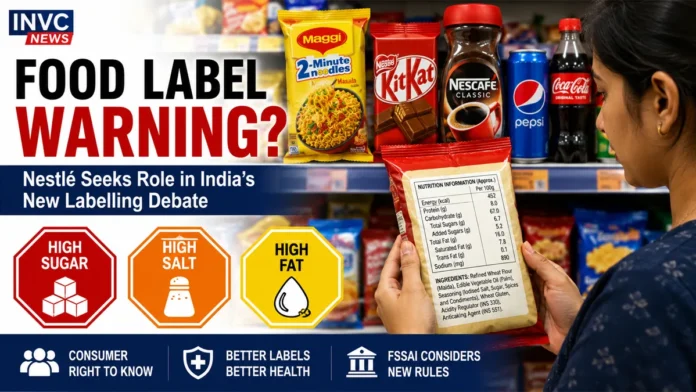
NEW DELHI, INDIA | August 27, 2026 —
India food warning labels are back at the center of a major consumer-health debate after Nestlé called for food companies to be consulted while the country considers rules for clearer front-of-pack nutrition warnings on packaged foods and beverages.
Nestlé CEO Philipp Navratil has said the company supports front-of-pack labelling for products high in sugar, salt and fat, but believes manufacturers should have a role in ensuring that any system introduced in India is scientifically designed.
The debate could eventually affect thousands of everyday products sold across Indian supermarkets—from noodles, biscuits and chocolates to soft drinks, snacks and breakfast foods.
However, consumers should note one critical point: India has not announced a new mandatory red-warning-label system for packaged foods at this stage.
What Are Front-of-Pack Food Labels?
Front-of-pack nutrition labels are designed to give consumers simplified nutritional information without requiring them to study the detailed nutrition table printed on the back of a packet.
Such systems can highlight excessive levels of:
- Sugar
- Salt or sodium
- Saturated fat
- Overall nutritional risk
Different countries use different formats.
Some use color codes, while others display warning symbols or simplified nutritional scores.
India’s food regulator, the Food Safety and Standards Authority of India (FSSAI), had earlier proposed a framework for Front-of-Pack Nutrition Labelling, or FOPNL, for foods high in fat, sugar and salt.
The broader question now is how strong and visible those warnings should be.
Why Nestlé Wants Companies Consulted
Nestlé’s position is that food manufacturers should be part of the consultation process because companies hold technical knowledge about ingredients, recipes, serving sizes and food manufacturing.
The company says any final system should be based on scientific evidence.
Critics, however, argue that companies whose products will be regulated should not have excessive influence over the rules used to warn consumers about unhealthy ingredients.
That disagreement has turned what might appear to be a simple packaging change into a significant public-health and corporate-policy battle.
Why This Matters for Indian Consumers
The issue is particularly important because India’s packaged-food market has expanded rapidly.
Consumers increasingly rely on ready-to-eat foods, snacks, beverages and processed products, particularly in urban areas.
At the same time, concerns about obesity, diabetes, hypertension and cardiovascular disease have intensified.
A prominent warning printed directly on the front of a packet could influence purchasing decisions much more quickly than a conventional nutrition table.
For example, a shopper choosing between two snacks could immediately identify which product contains particularly high amounts of sugar, sodium or saturated fat.
Also Read – : New Study Links Food Preservatives in Packaged Foods to Higher Blood Pressure and Heart Disease Risk
Would Maggi, KitKat or Other Nestlé Products Get Warnings?
It is too early to say.
Any product-specific warning would depend on the final Indian regulations, nutritional thresholds, serving-size methodology and composition of individual products.
Therefore, it would be misleading to claim that Maggi, KitKat, Nescafé or any other individual Nestlé product has already been ordered to carry a warning label.
The same applies to products sold by Coca-Cola, PepsiCo, Mondelez and other major food and beverage manufacturers.
Final requirements would apply according to the regulatory criteria—not simply because a product belongs to a particular company.
Why Sugar Has Become a Bigger Issue
Sugar consumption is one of the most closely watched parts of the debate.
Soft drinks, confectionery, biscuits, breakfast products and numerous packaged foods can contain significant quantities of added sugar.
India is also a huge sugar market, meaning any effort to reformulate mass-market packaged foods could have implications across the broader food industry.
Also Read – : Sugar Prices Surge 40%: India Allows 1 Million Tonnes of Duty-Free Imports Ahead of Festival Season
Food manufacturers argue that reformulation must also take consumer taste, affordability, shelf life and production requirements into account.
Health advocates counter that consumers deserve clearer information before making purchasing decisions.
India Already Requires Nutrition Information
India already requires nutritional information on packaged foods under FSSAI regulations.
The dispute is therefore not about whether nutrition information should exist.
Instead, it concerns how prominently health-related information should appear on the front of packaging and whether consumers should receive easily recognizable warnings when products exceed specified nutritional limits.
FSSAI’s earlier draft framework specifically defined front-of-pack nutrition labelling as simplified nutritional information displayed on the front of pre-packaged foods.
That provides the regulatory foundation for the current debate.
Supreme Court Pressure Adds Momentum
The issue has also reached India’s Supreme Court, where concerns have been raised over delays in implementing effective front-facing food labels.
That judicial scrutiny increases pressure on regulators and the government to eventually settle the matter.
Any final decision could have major consequences for India’s enormous FMCG sector.
Companies could potentially need to redesign packaging, reformulate products or change how nutritional information is communicated to consumers.
What Consumers Should Watch Next
The next major development will be whether FSSAI and the central government reopen or revise the front-of-pack warning framework and what role industry representatives, nutrition experts and consumer groups receive in that process.
Until final regulations are notified, shoppers should continue checking the existing nutrition panel for sugar, sodium, saturated fat and serving-size information.
The broader direction, however, is becoming increasingly important: India’s debate is shifting from whether packaged foods should disclose nutrition information to how clearly consumers should be warned about excessive sugar, salt and fat.