NEW DELHI, INDIA | AUGUST 25, 2026 —
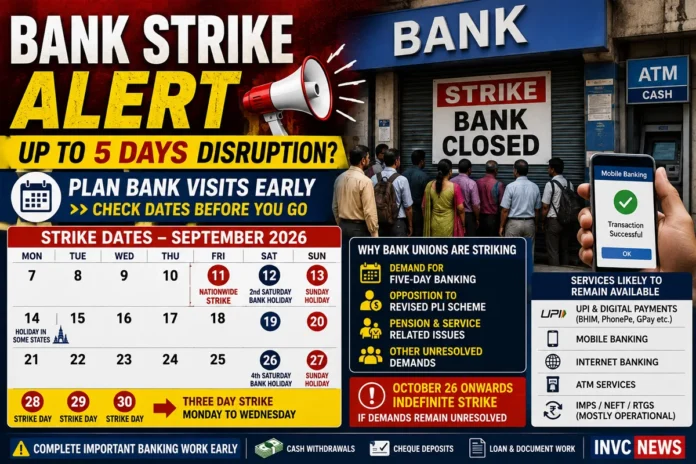
Bank Strike September 2026 could disrupt branch banking services across India after the United Forum of Bank Unions announced a nationwide strike on September 11, followed by a three-day strike from September 28 to 30 and the possibility of an indefinite strike beginning October 26 if key demands remain unresolved.
The planned action could be particularly important for customers who rely on branches for cheque-related work, cash deposits, passbook updates, pension services, loan documentation and other transactions that cannot always be completed digitally.
The September calendar could make the disruption more significant than a normal one-day strike.
September 11 falls on a Friday and is followed by the second Saturday and Sunday. In some states, an additional holiday on September 14 could extend the period during which customers have limited access to branches.
Even more importantly, the three-day strike scheduled for September 28, 29 and 30 comes immediately after the fourth Saturday and Sunday, potentially creating a five-day stretch of branch disruption from September 26 to September 30 if the strike goes ahead as planned.
Bank Strike September 2026: Full List of Dates
Customers should keep these dates in mind:
| Date | Day | Banking Status |
|---|---|---|
| September 11 | Friday | Nationwide bank strike called by UFBU |
| September 12 | Saturday | Second Saturday — regular bank holiday |
| September 13 | Sunday | Weekly bank holiday |
| September 14 | Monday | Holiday in some states depending on local festival calendar |
| September 26 | Saturday | Fourth Saturday — regular bank holiday |
| September 27 | Sunday | Weekly bank holiday |
| September 28 | Monday | Nationwide strike planned |
| September 29 | Tuesday | Nationwide strike planned |
| September 30 | Wednesday | Nationwide strike planned |
| October 26 onward | Monday onward | Indefinite strike threatened if demands remain unresolved |
The strike schedule has been announced by the United Forum of Bank Unions, while an official circular published by a constituent banking officers’ federation also lists the September 11 strike, the September 28-30 action and the proposed indefinite strike from October 26.
Will Banks Be Closed for Four Days After September 11?
Not everywhere.
This is an important distinction for customers.
September 11 is the proposed nationwide strike day.
September 12 is the second Saturday, when banks are normally closed across India, while September 13 is Sunday.
That means physical bank branches could remain inaccessible for three consecutive days in many places if the strike goes ahead.
September 14 could extend that period to four days in states where banks are closed for a locally notified festival or public holiday.
Therefore, reports of a “four-day bank shutdown” should not be interpreted as a uniform nationwide closure from September 11 to September 14.
Customers should check the Reserve Bank of India’s regional holiday calendar and their own bank’s notifications for the final position in their state.
RBI Bank Holiday Information:
https://www.rbi.org.in/Scripts/HolidayMatrixDisplay.aspx
Bigger Disruption Possible From September 26 to 30
The second strike window could be more significant.
September 26 is the fourth Saturday and September 27 is Sunday.
UFBU has then called a three-day strike for September 28, 29 and 30.
If all three strike days proceed, customers could face five consecutive calendar days without normal branch banking services.
That makes the end of September particularly important for businesses, pensioners, traders and customers with time-sensitive banking work.
The September 28-30 strike period also coincides with the banking industry’s half-yearly closing period, adding further operational importance to those dates.
Why Have Bank Unions Called the Strike?
The United Forum of Bank Unions has highlighted several unresolved issues.
The most prominent demand is the implementation of a five-day banking week.
Bank unions are also opposing the revised performance-linked incentive framework and have raised pension and other service-related issues.
UFBU represents multiple bank employee and officer unions and has been campaigning on these matters for an extended period.
What Is the Five-Day Banking Demand?
Bank employees currently work on the first, third and fifth Saturdays of a month, while branches are closed on the second and fourth Saturdays.
Unions want all Saturdays to become bank holidays.
According to the unions, the Indian Banks’ Association agreed during the wage-settlement process in March 2024 to recommend five-day banking to the government.
The proposed arrangement envisaged compensating for Saturday closures by increasing working hours from Monday to Friday.
However, unions say final government approval has remained pending.
The dispute has now become one of the principal reasons behind the fresh strike programme.
What Is the PLI Dispute?
The second major issue concerns the performance-linked incentive, or PLI, framework.
Bank unions have objected to changes in the incentive structure, particularly the manner in which performance may be assessed and benefits distributed among employees and officers.
Their position is that the incentive system should be determined through bilateral discussions and should not create unequal treatment among different categories of bank employees.
The unions are seeking changes to or withdrawal of the disputed framework.
Pension Issues Also Part of the Demands
Pension-related concerns are also included among pending demands.
These include issues affecting retired bank employees and other unresolved service matters.
The September strikes therefore go beyond a single demand for fewer working days and form part of a broader industrial-relations dispute between unions, banks and the government.
Will SBI and Other Public Sector Banks Be Affected?
Public sector banks are likely to face the greatest impact if employees and officers participate widely in the strike.
Customers of institutions such as State Bank of India, Punjab National Bank, Bank of Baroda, Canara Bank, Union Bank of India, Indian Bank and other public-sector lenders should watch for formal notices from their banks closer to the strike dates.
However, a strike call does not automatically mean every branch of every bank will remain completely closed.
The actual impact can vary depending on staff participation and local arrangements.
What About Private Banks?
Private-sector bank branches may face less disruption depending on employee participation and operational arrangements.
Customers should not assume that all private-bank branches will shut simply because UFBU has announced a nationwide strike.
Individual banks generally issue customer advisories when significant service disruption is expected.
Checking your bank’s official website, mobile app or customer-service alerts before visiting a branch is the safest option.
Will UPI, Mobile Banking and Internet Banking Stop?
Digital banking services are generally expected to remain available.
Services such as:
- UPI payments
- Mobile banking
- Internet banking
- IMPS
- NEFT
- Digital fund transfers
- Card payments
normally operate through electronic infrastructure and are not dependent on a customer physically visiting a branch.
However, customers should remember that no digital service is guaranteed to be immune from technical outages or bank-specific maintenance.
The strike itself does not mean UPI will be shut down.
What About ATMs?
ATMs are also expected to remain operational in most areas.
However, prolonged branch closures can occasionally affect cash replenishment.
This becomes more relevant during a three-day or five-day closure sequence, particularly in high-demand areas.
Customers who need significant cash should avoid waiting until the last working day before the strike.
Could Cheque Clearing Be Delayed?
Cheque processing and branch-based settlement work could face delays depending on employee participation.
Businesses that rely heavily on physical cheques or documentation should therefore plan transactions ahead of the proposed strike dates.
Loan documentation, demand drafts, branch-based fund transfers, cash deposits and other manual services could also take longer than normal.
What Bank Customers Should Do Before September 11
Customers with urgent banking work should avoid leaving it until the strike date.
Consider completing the following work in advance:
- Large cash withdrawals
- Cash deposits
- Demand drafts
- Cheque deposits
- Passbook updates
- Loan documentation
- Pension-related branch work
- KYC-related submissions
- Locker visits
- Business banking paperwork
Customers should also ensure that mobile banking and internet banking passwords are active and that registered phone numbers are up to date.
Could the Strike Be Called Off?
Yes.
Strike announcements can be withdrawn, postponed or modified if unions, bank management and government representatives reach an agreement before the scheduled date.
Therefore, customers should treat September 11 and September 28-30 as announced strike dates, not as irreversible bank closures.
Any last-minute settlement could change the situation.
INVC NEWS will update the status closer to the strike dates if negotiations lead to a postponement or cancellation.
Indefinite Bank Strike Threat From October 26
UFBU has also warned that employees could begin an indefinite nationwide strike from October 26, 2026 if the dispute remains unresolved.
An indefinite strike would have considerably greater implications than the September action because there would be no predetermined end date.
For now, however, it remains a proposed escalation rather than an ongoing shutdown.
The September strikes will therefore be an important indicator of whether negotiations can produce a settlement before October.
Bottom Line for Bank Customers
The most important dates are September 11 and September 28-30.
The September 11 strike could combine with the weekend to disrupt branch access for three consecutive days nationally and up to four days in some states.
The September 28-30 strike could be even more significant because it follows the fourth Saturday and Sunday, potentially creating a five-day branch-banking disruption from September 26 through September 30.
Digital payments and online banking are expected to continue, but customers with branch-dependent transactions should complete important work ahead of the proposed strike dates.