BEIJING, CHINA | AUGUST 25, 2026 —
A humanoid robot running 100 meters in 9.39 seconds has become one of the most striking moments of the 2026 World Humanoid Robot Games in Beijing, offering a dramatic glimpse of how quickly robotics, motion control and embodied artificial intelligence are advancing.
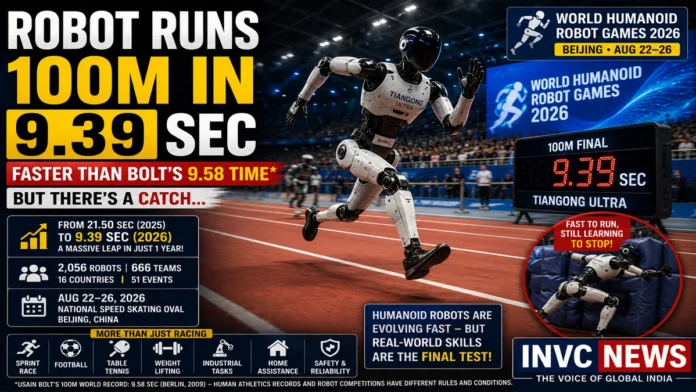
Tiangong Ultra, developed by the Beijing Humanoid Robot Innovation Center, completed the 100-meter distance in 9.39 seconds during an opening-day race at Beijing’s National Speed Skating Oval.
Another humanoid, Honor’s Lightning, finished in approximately 9.47 seconds.
On paper, both times are faster than the 9.58-second men’s 100-meter world record set by Usain Bolt in Berlin in 2009.
But there is an important distinction.
The robots have not broken Usain Bolt’s official World Athletics record. Human athletics records and humanoid-robot competitions operate under entirely different rules, eligibility standards, starting procedures, physical constraints and governing systems.
The more accurate conclusion is still extraordinary:
Humanoid robots have now covered 100 meters in less time than the fastest officially recorded human 100-meter sprint.
Robot 100m Time: What Actually Happened in Beijing?
Tiangong Ultra began the race behind Lightning but accelerated strongly enough to move ahead before the finish.
Its recorded time was 9.39 seconds.
Lightning crossed in roughly 9.47 seconds, also below Bolt’s 9.58-second human world-record time.
Yet what happened immediately after the finish demonstrated how far humanoid robots still have to go.
Instead of smoothly slowing down like human athletes, the machines continued forward into thick padded barriers designed specifically to stop them.
Tiangong Ultra also struggled with stability after finishing.
That produced perhaps the perfect summary of humanoid robotics in 2026:
The robots can now run extraordinarily fast. Stopping gracefully is still a challenge.
Did the Robot Really Beat Usain Bolt?
In terms of the raw stopwatch reading over a 100-meter distance:
Yes — 9.39 seconds is faster than 9.58 seconds.
In terms of an official athletics world record:
No.
Usain Bolt’s record was achieved under World Athletics competition rules for human athletes.
A humanoid robot has different mechanical capabilities, energy systems, mass distribution, starting conditions and competition regulations.
Robot performances are also not ratified as human athletics records.
So headlines claiming that a robot has officially “taken Usain Bolt’s world record” can create the wrong impression.
The real technological achievement needs no exaggeration.
A bipedal machine running 100 meters in 9.39 seconds is remarkable on its own.
The Bigger Story: Last Year’s Winning Time Was 21.50 Seconds
The 9.39-second number becomes much more significant when compared with 2025.
At the previous World Humanoid Robot Games, the best 100-meter performance was about 21.50 seconds.
Now the leading robots are running below 10 seconds.
That means the benchmark has effectively been cut by more than half in about a year.
This does not mean every humanoid robot is improving at the same rate.
But it demonstrates how quickly engineers are advancing areas including:
balance, actuator performance, leg coordination, real-time control, power management and high-speed locomotion.
Those improvements matter far beyond racing.
A robot capable of moving quickly while maintaining balance could eventually perform more effectively in factories, warehouses, emergency zones and other environments designed around human movement.
More Than 2,000 Robots Are Competing in Beijing
The scale of the second World Humanoid Robot Games is itself remarkable.
The competition runs from August 22 through August 26, 2026, at Beijing’s National Speed Skating Oval, popularly known as the Ice Ribbon.
Organizers say this year’s Games feature:
| World Humanoid Robot Games 2026 | Scale |
|---|---|
| Humanoid robots | 2,056 |
| Teams | 666 |
| Countries represented | 16 |
| Events | 51 |
| Competition sessions | 1,301 |
| Competitive events | 30 |
| Scenario-based events | 21 |
That is a substantial expansion from the inaugural 2025 event, which attracted about 280 teams and more than 500 robots.
Countries represented this year include major robotics and technology markets such as China, the United States, Germany and Japan.
These Are Not Just Robot Races
The viral sprint videos are attracting attention, but the Games are designed to test much more than speed.
Humanoid robots are competing in activities including athletics, football, table tennis, martial arts, gymnastics, weightlifting, dancing and other physical challenges.
But another set of competitions may ultimately matter more commercially.
The Games include scenario-based tasks built around environments such as:
factories, hotels, homes, logistics centers and emergency-response settings.
Robots are being tested on tasks such as moving objects, handling materials, performing maintenance, recognizing items and completing industrial operations.
That is where the event shifts from entertainment to economics.
A Robot Can Sprint — But Can It Plug In a Cable?
This may be the more important question.
Fast running creates spectacular videos.
Real-world robotics requires something harder: reliable manipulation.
A useful industrial or household humanoid must be able to recognize an object, reach toward it, judge distance, grip it with the correct amount of force, align it precisely and recover when something goes wrong.
Even apparently simple human actions can be difficult for robots.
Plugging a cable into a socket, opening a jar, picking up small objects or handling irregular materials demands a combination of perception, dexterity and feedback control.
That is why the scenario-based competitions in Beijing deserve as much attention as the sprint records.
A robot that runs faster than a human but cannot reliably manipulate everyday objects has limited commercial usefulness.
What Is Embodied AI?
The Beijing Games are also drawing attention to a rapidly growing technology concept:
Embodied AI
Traditional artificial-intelligence systems primarily process information.
A chatbot may analyze language.
An image model may recognize objects.
An embodied AI system must connect intelligence to a physical machine operating in the real world.
It has to perceive its surroundings, decide what action to take and then physically execute that decision.
Humanoid robots therefore combine multiple technologies:
AI software, sensors, cameras, processors, actuators, batteries, motors, control systems and mechanical engineering.
The result is a much harder engineering problem than generating text or images on a screen.
China Is Making Humanoid Robotics a Strategic Industry
The World Humanoid Robot Games also reflect China’s larger industrial ambitions.
Chinese companies, universities and research institutes are investing heavily in humanoid robots and embodied AI.
The goal is not simply to build machines capable of entertaining crowds.
Developers are targeting future use in:
- Manufacturing
- Warehousing
- Logistics
- Elder care
- Hospitality
- Retail
- Emergency response
- Hazardous environments
- Household assistance
China already possesses a massive electronics, battery, motor and manufacturing supply chain.
That industrial base could become a significant advantage as humanoid robots move from laboratory prototypes toward mass production.
AI, Manufacturing and Investment Are Becoming One Story
The rise of humanoid robots also illustrates how artificial intelligence is increasingly becoming connected to traditional manufacturing.
Training an AI model is only one part of the robotics equation.
Building millions of physical robots requires motors, sensors, processors, batteries, precision manufacturing, supply chains and enormous amounts of capital.
That shift is also relevant to India.
INVC NEWS recently reported how India’s revised FDI framework is attracting investment proposals across artificial intelligence, manufacturing and data-center infrastructure.
As robotics develops, the competition will increasingly involve not only who builds the best AI software, but also who can manufacture intelligent machines at scale.
India Is Also Building Its AI and Semiconductor Ecosystem
The humanoid-robot race depends heavily on advanced chips and computing infrastructure.
That makes semiconductor strategy increasingly relevant.
India is trying to build a much larger role in this ecosystem through semiconductor manufacturing, AI development, electronics production and global technology partnerships.
INVC NEWS has also covered how India and the United States are deepening cooperation in semiconductors, artificial intelligence, critical minerals and trusted technology supply chains.
For India, the emerging humanoid-robot industry could eventually create opportunities in software, engineering talent, electronics, sensors, AI models and component manufacturing.
Robots Are Getting Faster — But Reliability Matters More
The dramatic racing improvements can create the impression that humanoid robots are almost ready to match humans broadly.
That would be premature.
Speed is only one capability.
A genuinely useful general-purpose humanoid must combine:
mobility + dexterity + perception + reasoning + safety + battery life + reliability + affordability.
A robot that works perfectly for five minutes during a demonstration is very different from one capable of operating eight hours a day in a warehouse.
Industrial customers will care less about viral videos and more about uptime, maintenance costs, safety and return on investment.
Why Robot Failures at the Games Are Actually Valuable
Falls, crashes and failed tasks can look embarrassing.
From an engineering perspective, they are extremely useful.
Competitions place robots in unpredictable environments and force them to perform repeatedly under pressure.
Every failed grasp, balance error, navigation mistake and broken component generates information that engineers can study.
Competition can therefore accelerate development.
Motors can be strengthened.
Control algorithms can improve.
Hands can become more dexterous.
Recovery systems can become faster.
The robot that crashes into a padded wall this year may teach engineers how to build one that stops perfectly next year.
From 21.50 Seconds to 9.39 Seconds in One Year
That may ultimately be the number worth remembering.
In 2025, the leading humanoid 100-meter time at the Games was around 21.50 seconds.
In 2026, it is 9.39 seconds.
Whether robots continue improving at anything close to that pace remains unknown.
But the speed of progress is enough to turn humanoid robotics from a science-fiction curiosity into a serious industrial technology race.
Will Humanoid Robots Replace Human Workers?
Not overnight.
Current humanoid systems remain expensive and can struggle with tasks humans perform almost without thinking.
Real workplaces are also far less controlled than demonstration environments.
However, increasingly capable robots could eventually automate particular repetitive, dangerous or physically demanding jobs.
That does not necessarily mean entire professions disappear.
Technology often changes the mix of jobs while creating demand for engineers, robot technicians, software specialists, operators, safety experts and maintenance workers.
The economic impact will depend heavily on how quickly capable robots become reliable and affordable enough for large-scale deployment.
What to Watch Before the Games End on August 26
The 100-meter sprint has created the viral moment.
But the practical competitions may provide a better indication of how close humanoid robots really are to everyday use.
Watch how machines perform when asked to:
manipulate small objects, recover after making mistakes, navigate unfamiliar spaces, interact safely around people and complete long sequences of tasks without human intervention.
Those capabilities will matter far more to factories and homes than winning a sprint race.
Bottom Line
A humanoid robot covering 100 meters in 9.39 seconds is a remarkable engineering achievement.
The stopwatch reading is faster than Usain Bolt’s 9.58-second human world-record performance, but the two results should not be treated as equivalent official athletics records.
The bigger story is the speed of technological improvement.
The leading humanoid sprint performance at the event has fallen from roughly 21.50 seconds in 2025 to 9.39 seconds in 2026.
At the same time, the Beijing Games are exposing the limitations that remain.
Robots can sprint astonishingly fast — yet some still need padded barriers to stop.
That contrast is exactly why the World Humanoid Robot Games matter.
They show both how far humanoid machines have come and how much engineering remains before they become truly capable partners in factories, businesses and everyday life.