BEIJING, CHINA | AUGUST 25, 2026 —
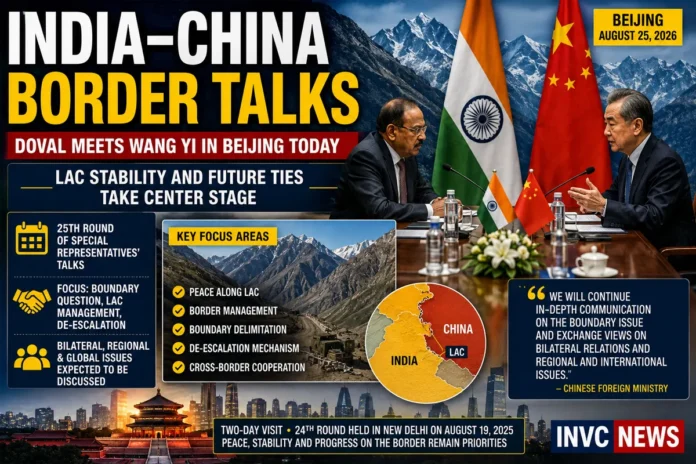
India-China border talks return to the highest-level boundary dialogue on Tuesday as National Security Advisor Ajit Doval meets senior Chinese leader Wang Yi in Beijing for the 25th round of Special Representatives’ talks, with border stability, management of the Line of Actual Control and the broader direction of bilateral relations firmly in focus.
Doval arrived in Beijing on Monday for a two-day visit at Wang’s invitation. Both officials serve as their countries’ designated Special Representatives on the India-China boundary question.
China’s Foreign Ministry confirmed that Wang Yi and Doval will co-chair the 25th round in Beijing on August 25. India’s Ministry of External Affairs has also confirmed Doval’s visit and the scheduled talks.
The meeting comes at an important moment for Asia’s two largest countries. Relations have improved from the severe tensions that followed the 2020 border crisis, but the long-running boundary question remains unresolved and peace along the frontier continues to be central to the future of India-China ties.
What Is on the Agenda for Doval-Wang Yi Talks?
The formal focus is the India-China boundary question.
However, the dialogue is expected to extend beyond the technical question of where the boundary should eventually be settled.
China has said the two sides will continue in-depth communication on the boundary question while also exchanging views on bilateral relations and international and regional issues.
That makes Tuesday’s meeting important on several levels.
Among the key areas to watch are:
- Maintaining peace and tranquility along the border
- Strengthening mechanisms for border management
- Discussion on boundary delimitation
- Progress toward de-escalation
- Diplomatic and military communication
- Cross-border cooperation
- The broader India-China relationship
The talks therefore represent both a boundary negotiation mechanism and an important strategic channel between New Delhi and Beijing.
Why the LAC Remains Central to India-China Relations
The border remains the most sensitive issue in the bilateral relationship.
Relations deteriorated dramatically after the military confrontation in eastern Ladakh in 2020. Years of diplomatic and military negotiations followed before India and China reached an agreement on patrolling arrangements in October 2024 that led to disengagement in the remaining friction areas of Demchok and Depsang.
India has repeatedly maintained that peace and tranquility in the border areas are essential for the normal development of bilateral relations.
The subsequent meetings between Prime Minister Narendra Modi and Chinese President Xi Jinping helped reopen high-level political engagement, while diplomatic and military channels continued working on border management.
The challenge now is to ensure that improvements on the ground become durable rather than temporary.
What Happened at the 24th Round?
Today’s meeting builds directly on the 24th round of Special Representatives’ talks, held in New Delhi on August 19, 2025.
That meeting produced a significant set of understandings.
India and China agreed to explore a fair, reasonable and mutually acceptable solution to the boundary question while maintaining peace in border areas.
Among the more concrete outcomes was an agreement to establish an Expert Group under the Working Mechanism for Consultation and Coordination on India-China Border Affairs, or WMCC, to explore what the two sides described as an “early harvest” of boundary delimitation in appropriate sectors.
Another working group was planned to advance effective border management.
The two sides also agreed to create additional General-Level mechanisms in the Eastern and Middle sectors, adding to the mechanism already operating in the Western sector.
Most significantly, they agreed to discuss de-escalation, including the principles and modalities that could govern such a process.
Today’s meeting provides an opportunity to assess how much progress has been made on those commitments.
Border Management Could Be More Important Than a Dramatic Breakthrough
Expectations should remain realistic.
The Special Representatives mechanism has operated for more than two decades, and the boundary dispute has not been resolved.
A dramatic final boundary settlement emerging from a single meeting would therefore be unrealistic to assume.
The more immediate measure of progress could be whether Doval and Wang agree on additional practical mechanisms to prevent friction, improve communication and reduce the risk of confrontation.
That could include clearer procedures for patrol encounters, stronger military communication and progress through expert-level boundary discussions.
Such incremental steps may appear less dramatic than a final settlement, but they can be crucial in preventing future crises.
Latest WMCC Talks Prepared Ground for Today’s Meeting
Diplomatic preparations have continued in the weeks leading up to the Beijing talks.
India and China held the 36th meeting of the WMCC on August 6, 2026, in New Delhi.
According to China’s Foreign Ministry, the two sides discussed implementation of the understandings reached during the 24th SR round, including boundary delimitation, border management, mechanism development and cross-border exchanges.
They also agreed to continue diplomatic and military communication and jointly prepare for today’s 25th round.
The fact that this working-level dialogue took place less than three weeks before the Doval-Wang meeting indicates that Tuesday’s talks are part of an ongoing negotiating process rather than an isolated diplomatic event.
Doval Also Expected to Meet Chinese Vice President Han Zheng
Doval’s Beijing visit is not limited to the boundary dialogue.
India’s Ministry of External Affairs has said the National Security Advisor is also scheduled to call on Chinese Vice President Han Zheng during his visit.
That meeting gives the visit a broader political dimension.
It also underlines the level of attention both countries are giving to stabilizing ties while continuing to manage areas of disagreement.
India-China Economic Relationship Adds Another Layer
Despite strategic rivalry and the unresolved boundary dispute, India and China remain deeply connected economically.
Trade and investment continue to create incentives for both countries to prevent political differences from producing another prolonged breakdown in relations.
India has also recently adjusted parts of its foreign-investment framework involving investors linked to neighboring countries.
INVC NEWS previously reported how India’s revised FDI policy has begun attracting new investment proposals across AI, manufacturing and data-center sectors.
The economic relationship therefore adds another reason why stable border conditions matter well beyond military security.
Xi Jinping Factor Looms Over the Talks
The timing of Doval’s visit is also significant because India is preparing to host the BRICS summit in September.
Chinese President Xi Jinping is expected to visit India for the summit, although his travel plans have not yet been formally confirmed by Beijing.
A Xi visit would carry major diplomatic weight and could create another opportunity for engagement with Prime Minister Narendra Modi.
For that reason, progress in the Doval-Wang talks could help shape the atmosphere ahead of the BRICS gathering.
However, Tuesday’s boundary dialogue should not be presented simply as preparation for a possible Modi-Xi meeting.
The Special Representatives mechanism has its own longstanding mandate centered on the boundary question and border stability.
What Would Count as Progress Today?
Several possible outcomes will be worth watching once official statements are released.
A meaningful result could include:
Progress on de-escalation:
More clarity on principles or mechanisms for reducing military deployments.
Border-management measures:
Additional arrangements aimed at preventing patrol confrontations or misunderstandings.
Boundary delimitation work:
Movement by the expert-level mechanism created after the 24th round.
Military communication:
Stronger commander-level mechanisms across different sectors.
Cross-border cooperation:
Further movement on border trade, rivers or people-to-people exchanges.
Political signaling:
Language indicating that both countries intend to continue improving the overall relationship while managing differences.
The wording of the post-meeting statements from New Delhi and Beijing will therefore matter as much as any single announced decision.
Why Today’s India-China Talks Matter Beyond the Border
India and China together represent more than a third of humanity and are two of the world’s most consequential major economies.
Their relationship affects Asian security, global trade, supply chains, BRICS, the Shanghai Cooperation Organisation and the broader balance of power in the Indo-Pacific.
At the same time, they remain competitors with unresolved strategic differences.
That creates an unusual relationship in which cooperation and rivalry operate simultaneously.
The Doval-Wang dialogue matters because it provides one of the few institutional mechanisms capable of addressing the issue most likely to destabilize that relationship: the disputed boundary.
What Happens After the Meeting?
Official statements from India and China will be critical.
Those statements should reveal whether the two sides have reached fresh agreements on border management, de-escalation or boundary negotiations.
Until those statements are released, reports suggesting a breakthrough or final border agreement should be treated cautiously.
The strongest outcome would not necessarily be a dramatic announcement.
A credible mechanism that reduces the chances of another border confrontation while allowing political and economic engagement to continue could itself represent significant progress.
For now, the central question in Beijing is straightforward:
Can India and China turn an improving relationship into a more stable border — without allowing unresolved territorial differences to trigger another crisis?