GURUGRAM, India | August 25, 2026 —
JSW MG Motor India is preparing to unveil a new three-row electric SUV on August 26, potentially expanding India’s fast-growing family EV market with a seven-seat model expected to offer long driving range, a technology-heavy cabin and the company’s new ADAPT vehicle architecture.
The upcoming model has been widely associated with the MG Hector Tomahawk EV name, although final India-spec branding, battery capacity, certified range, pricing and variant details should be treated as unconfirmed until the official unveiling.
The new SUV is particularly important because it is not expected to be merely an electric conversion of the existing Hector.
Instead, it introduces MG’s new ADAPT — Advanced Drive Architecture Platform Technology — architecture, designed to support electrified vehicles and potentially provide the foundation for additional models in India.
For buyers, the biggest questions ahead of the August 26 reveal are straightforward: How much will it cost? How far will it travel on one charge? How quickly will it charge? And will the third row actually be practical for Indian families?
MG Hector Tomahawk EV India Debut: What Is Expected?
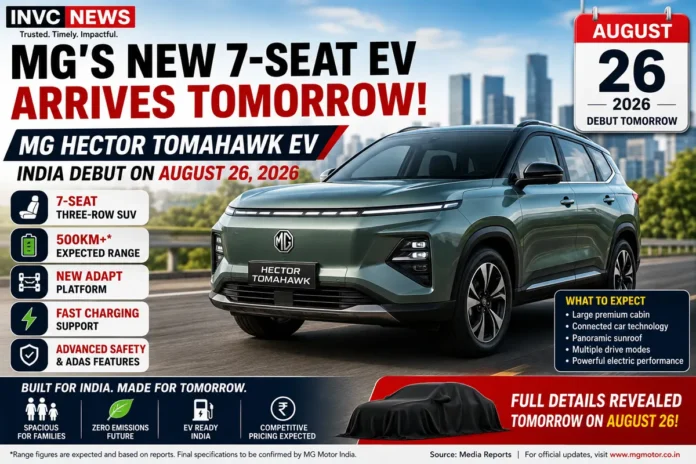
The upcoming MG electric SUV is scheduled to make its India debut on August 26, 2026.
Pre-launch information points toward a large three-row vehicle targeting buyers who want electric mobility without giving up the flexibility of seven seats.
The main expected highlights include:
- Three-row seating
- Seven-seat configuration
- Fully electric powertrain
- New ADAPT architecture
- Potential 500km-plus claimed driving range
- Large touchscreen-based cabin
- Connected-car technology
- Advanced safety systems
- Positioning above the current Hector range
MG is expected to confirm the final India specifications at the unveiling.
Until then, figures reported from international or related models should not automatically be treated as final India-spec numbers.
Why This Launch Matters for India’s EV Market
The timing could hardly be more interesting.
India’s electric passenger vehicle market is already expanding rapidly.
INVC recently reported that India’s electric passenger vehicle registrations surged nearly 90% in Q1 FY27, reflecting growing consumer acceptance of battery-powered cars.
That growth is important for MG.
Until recently, electric cars in India were concentrated heavily around compact and five-seat products.
The market is now gradually moving toward larger SUVs with more range, better charging performance and increasingly sophisticated interiors.
A seven-seat electric SUV could therefore address an important gap for larger families.
The Hector Tomahawk Could Target Family EV Buyers
Three-row SUVs remain extremely popular in India because buyers often want one vehicle capable of handling daily commuting, family travel and long-distance journeys.
Electric vehicles, however, introduce a different set of considerations.
A larger SUV needs a bigger battery.
A bigger battery can increase vehicle weight.
More passengers and luggage can affect real-world efficiency.
Long-distance users also need fast and reliable charging.
MG therefore has to deliver more than simply seven seats.
The upcoming SUV needs to balance space, range, charging speed, efficiency and price.
Is It Definitely Called MG Hector Tomahawk?
The name deserves careful treatment before launch.
The Hector Tomahawk name has been widely associated with MG’s upcoming three-row electric SUV, and trademark activity has strengthened that expectation.
However, the final production name should be regarded as confirmed only after JSW MG Motor India formally announces it.
That is why buyers should focus more on the underlying vehicle than the badge before August 26.
The important confirmed story is that MG is preparing a new three-row electrified product for India based on the ADAPT architecture.
This Is Not Simply an Electric Hector
Despite the expected Hector branding, the new vehicle is fundamentally different from the conventional Hector currently sold in India.
The existing Hector uses an internal-combustion platform and is offered as a conventional SUV.
The upcoming EV instead represents a new-generation architecture.
That distinction matters because a dedicated or highly electrification-focused architecture can influence:
- Battery packaging
- Cabin space
- Wheelbase utilization
- Floor design
- Weight distribution
- Motor placement
- Charging systems
- Electronic architecture
For buyers, these engineering details eventually translate into practical questions such as legroom, luggage capacity, efficiency and ride quality.
What Is MG’s ADAPT Platform?
ADAPT stands for Advanced Drive Architecture Platform Technology.
The architecture has been developed to support multiple electrified applications.
A flexible platform can allow an automaker to create more than one model while sharing underlying components and engineering.
This reduces development complexity and can also help manufacturers localize parts across multiple vehicles.
For India, the bigger significance is that MG could use this architecture for a broader future product strategy rather than a single SUV.
That would place the Tomahawk within the wider shift toward new EV platforms rather than treating it as a stand-alone electric experiment.
500km-Plus Range Could Be a Major Search Hook
Range is likely to become the most discussed specification after pricing.
International versions related to the upcoming SUV architecture have been associated with driving ranges exceeding 500km under certain test conditions.
That has led to expectations that the India-spec MG could offer 500km-plus claimed range, depending on battery capacity and certification.
However, buyers should wait for the official Indian figure.
Range numbers can differ depending on:
- Test cycle
- Battery configuration
- Wheel size
- Motor specification
- Vehicle weight
- Software calibration
- Climate conditions
A claimed 500km range also does not necessarily mean a driver will consistently achieve 500km in everyday use.
Real-World EV Range Depends on Much More Than Battery Size
For anyone considering a large electric SUV, claimed range should be treated as one part of the buying decision.
Actual range can change significantly depending on driving conditions.
Highway speed generally uses more energy than steady low-speed urban driving.
Air-conditioning can reduce available range.
Seven passengers and luggage add weight.
Very hot weather can affect energy consumption.
Driving aggressively can also substantially increase battery use.
That is why buyers should eventually compare independent real-world range tests rather than relying only on the official certification figure.
Charging Speed May Matter as Much as 500km Range
A large battery is useful only if it can be replenished conveniently.
Suppose an SUV can travel more than 500km but needs a very long DC charging stop.
Another vehicle with slightly less range but dramatically faster charging could actually be easier to use on road trips.
That makes peak DC charging speed one of the most important specifications to watch during the August 26 reveal.
Buyers should look for:
- Maximum DC charging rate
- 10–80% charging time
- AC home-charging speed
- Charger supplied with the vehicle
- Public charging-network compatibility
- Battery warranty
These figures can tell owners far more about long-distance convenience than battery capacity alone.
India’s Battery Ecosystem Is Changing Rapidly
The arrival of larger, longer-range electric SUVs also puts greater attention on battery technology.
India currently relies heavily on lithium-ion chemistry for passenger EVs, but researchers and manufacturers are exploring additional technologies to improve cost, supply-chain resilience and energy storage.
INVC recently examined how India’s sodium-ion battery technology reaching TRL-7 could create a potential alternative for selected EV and energy-storage applications.
INTERNAL LINK TO INSERT HERE: Link the sentence above to the live URL of your August 24 Sodium-Ion Battery article once its exact published URL is available.
Sodium-ion batteries are not expected to immediately replace lithium-ion cells in long-range SUVs such as the upcoming MG.
However, the development demonstrates how rapidly next-generation battery technology is evolving.
Future electric vehicles may increasingly use different battery chemistries depending on range, cost, weight and intended application.
Electric Scooters Show How Quickly EV Choices Are Expanding
India’s electric transition is not limited to passenger cars.
The two-wheeler market has become one of the most competitive EV segments in the country.
INVC’s 2026 electric scooter comparison covering TVS iQube, Ather Rizta, Bajaj Chetak and other models highlights how range, battery size, charging convenience and price have become mainstream consumer considerations.
Those same questions are now moving into larger vehicles.
The difference is scale.
A family SUV requires considerably more battery capacity and places greater emphasis on fast charging and highway range.
India EV Ecosystem Is Moving Beyond One Powertrain
Battery electric vehicles are not the only technology being developed for Indian consumers.
Plug-in hybrids are also gaining attention.
INVC previously reported on BYD’s DM-i hybrid technology in India, which combines electric-first driving with a claimed combined range exceeding 1,200km.
That illustrates how automakers are taking different routes toward electrification.
Some are betting heavily on pure battery EVs.
Others see plug-in hybrids as a bridge for customers concerned about charging availability.
For buyers, greater technological competition could ultimately improve choice.
Seven Seats Could Be the Tomahawk’s Biggest Advantage
Range will generate headlines, but seating could determine who actually buys the vehicle.
India’s family-car market places enormous value on versatility.
Parents often want additional seats for grandparents, children or extended family.
That makes a true three-row EV potentially attractive.
However, not all seven-seat SUVs provide a comfortable third row.
When the MG is unveiled, buyers should inspect:
Third-row legroom
Third-row headroom
Entry and exit
Rear AC vents
USB charging ports
Seat recline
Boot space with all seven seats raised
A large exterior does not automatically guarantee usable third-row accommodation.
Boot Space Will Matter to Family Buyers
Three-row SUVs face an unavoidable packaging challenge.
With all seats occupied, the third row consumes much of the luggage area.
That can make airport runs and family holidays difficult.
An EV platform can sometimes improve packaging because there is no conventional engine or transmission tunnel.
But battery placement introduces its own limitations.
The upcoming MG’s boot capacity with both the third row raised and folded will therefore be worth watching closely.
Interior Technology Could Be Another Major Attraction
MG has traditionally emphasized large screens and connected-car features in India.
The upcoming model is expected to continue that strategy.
Possible highlights may include:
- Large central touchscreen
- Digital instrument cluster
- Connected-car functions
- Wireless smartphone connectivity
- Voice control
- Panoramic sunroof
- Multiple USB-C ports
- Wireless charging
- Automatic climate control
- Powered seats
- 360-degree camera
The final India-spec feature list should be confirmed at launch.
Buyers should also check whether key features are available across variants or restricted to the most expensive trim.
Safety Should Matter More Than Screen Size
Large displays look impressive in showrooms, but family SUV buyers should prioritize safety equipment.
Important specifications to watch include:
- Six or more airbags
- Electronic stability control
- ABS and EBD
- Hill-hold assistance
- Tyre-pressure monitoring
- 360-degree camera
- Front and rear parking sensors
- ADAS
- Battery thermal-management system
ADAS capability may become a major marketing point, but buyers should understand exactly which assistance functions are offered.
ADAS Does Not Mean Autonomous Driving
If MG equips the SUV with Level 2 driver-assistance technology, owners should not interpret that as self-driving capability.
ADAS functions can assist with tasks such as:
Adaptive cruise control
Lane-keeping assistance
Forward-collision warning
Automatic emergency braking
Blind-spot monitoring
The driver remains responsible for controlling the vehicle and monitoring road conditions.
This distinction becomes increasingly important as more Indian cars adopt advanced driver-assistance features.
MG Hector Tomahawk Expected Price in India
MG has not officially announced pricing.
Pre-launch estimates have generally placed the vehicle somewhere in the broad ₹18 lakh to ₹25 lakh-plus territory, depending on battery size and equipment.
Those numbers remain speculative until MG announces the actual ex-showroom price.
For SEO and editorial accuracy, price estimates should therefore not be presented as confirmed facts.
The starting price may ultimately determine the entire competitive landscape.
An Aggressive Price Could Change the Segment
If MG manages to price the new SUV competitively, it could bring seven-seat EV ownership within reach of a wider group of Indian buyers.
Pricing will depend heavily on:
- Battery cost
- Localization
- Import content
- Motor specification
- Equipment
- Variant strategy
- Manufacturing scale
Battery packs remain one of the most expensive components of an electric vehicle.
That is why localization and India’s emerging battery ecosystem are becoming strategically important for automakers.
India’s EV Market Is Becoming More Competitive
MG will enter a market where established manufacturers are investing aggressively.
Tata Motors and Mahindra have already built significant momentum in the passenger EV segment.
India’s nearly 90% year-on-year Q1 FY27 EV registration growth shows that the market is no longer a niche experiment.
At the same time, conventional automakers are preparing additional electric SUVs across several price categories.
That means the Tomahawk will need more than novelty.
It will need a compelling combination of price, range, technology and ownership support.
Charging Infrastructure Remains a Buyer Concern
Public charging availability has improved, particularly in major cities and on selected highways.
But coverage remains inconsistent.
An owner who charges primarily at home may have a very different experience from someone living in an apartment without dedicated parking.
Potential buyers should therefore ask:
Can I install a home charger?
Is my housing society supportive?
Are reliable fast chargers available on my regular highway routes?
How much does public charging cost?
Does the manufacturer provide integrated charger navigation?
These practical questions can matter more than headline specifications.
EV Ownership Costs Go Beyond Electricity
Electric cars can have lower running costs than conventional petrol or diesel vehicles, but buyers should consider the full ownership equation.
That includes:
Insurance
Tyres
Service
Home charger installation
Public fast-charging tariffs
Battery warranty
Resale value
Financing cost
The purchase price remains only one part of the equation.
Upcoming Cars Are Increasing Buyer Choice
India’s automotive market is entering an unusually busy product cycle.
New electric cars, SUVs, hybrids and advanced internal-combustion models are arriving across multiple price segments.
The MG Hector Tomahawk therefore enters a market in which buyers have increasingly strong alternatives.
That competition should make specification comparisons more important than brand loyalty alone.
For anyone planning a large SUV purchase over the coming months, waiting for final details on the MG could provide another useful benchmark.
Should You Wait Until August 26 Before Buying Another EV?
If you are already considering a large electric SUV, waiting one more day to see MG’s final specifications could make sense.
That does not mean the Tomahawk will automatically become the best purchase.
But its unveiling could change comparisons involving:
- Price
- Range
- Seating
- Charging
- Warranty
- Equipment
- Safety
Once those numbers are official, buyers can make a more meaningful comparison.
Five Specifications That Will Decide the MG Hector Tomahawk Story
1. Final Price
An aggressive starting price could dramatically expand its target audience.
2. India-Certified Range
The final certified figure will determine whether the 500km-plus expectation is justified.
3. Battery and Charging
Battery size and DC charging speed will shape long-distance usability.
4. Third-Row Comfort
Seven seats mean little if adults cannot comfortably use the final row.
5. Safety and Warranty
Standard safety equipment and battery warranty will strongly influence family buyers.
Official MG Details Should Take Priority After Launch
Once the SUV is unveiled, specifications should be checked against official manufacturer information.
Readers can follow the latest product information directly through JSW MG Motor India’s official website.
Official data should take priority over pre-launch estimates regarding battery size, price, range, charging speed and variant availability.
What INVC Will Update After the August 26 Reveal
This article should remain the main INVC URL for the vehicle after its unveiling.
Rather than publishing a second near-duplicate preview, the page should be substantially updated with:
- Official production name
- India price
- Battery capacity
- Certified range
- Motor output
- Charging speed
- Variant list
- Safety equipment
- Features
- Booking information
- Delivery timeline
The headline should then be changed from “Debuts Tomorrow” to an official reveal headline.
This keeps the same page useful before and after launch while preventing unnecessary duplication.
MG Hector Tomahawk EV: The Bottom Line Before Tomorrow’s Debut
MG’s upcoming three-row electric SUV arrives at an important moment for India’s EV industry.
Passenger EV registrations are rising rapidly.
Battery technology is advancing.
Electric two-wheelers have become mainstream.
Automakers are experimenting with pure EVs, hybrids and new dedicated architectures.
Against that background, the expected MG Hector Tomahawk EV could bring another important ingredient to the market: a large, family-oriented electric SUV with seven seats and potentially more than 500km of claimed range.
But tomorrow’s official reveal needs to answer the questions that really matter.
What is the final price?
What battery does it use?
What is the certified range?
How fast can it charge?
Is the third row genuinely useful?
Those answers—not the pre-launch hype—will determine whether MG has created another interesting electric SUV or one of the more compelling family EVs in India.