NEW DELHI, INDIA | AUGUST 25, 2026 —
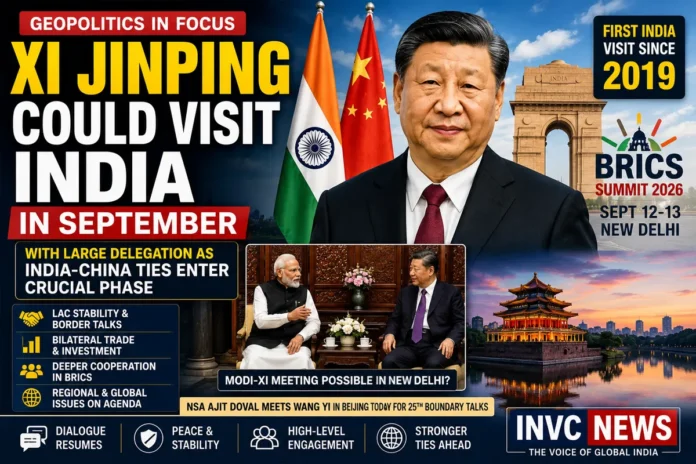
Xi Jinping India visit 2026 could emerge as one of September’s biggest geopolitical events, with the Chinese president likely to travel to New Delhi for the BRICS Summit as India and China cautiously deepen high-level engagement after years of border tensions.
Current preparations indicate that Xi is expected to attend the 18th BRICS Summit in New Delhi on September 12-13, 2026, potentially accompanied by a large Chinese delegation of around 400 officials.
However, Xi’s participation has not yet been formally confirmed by Beijing or New Delhi, and his travel plans are still being finalized.
If the visit goes ahead, it would be Xi’s first trip to India since October 2019, when Prime Minister Narendra Modi hosted him for the informal India-China summit in Mamallapuram, Tamil Nadu.
The timing is especially significant. National Security Advisor Ajit Doval and Chinese Foreign Minister Wang Yi are holding the latest round of India-China boundary talks in Beijing on August 25, putting the Line of Actual Control, border management and the future direction of bilateral ties back at the center of attention.
Is Xi Jinping Coming to India in September 2026?
For readers searching “Is Xi Jinping visiting India?”, the answer at this stage is:
The visit is likely, but it is not yet officially confirmed.
Preparations are underway for Xi’s expected participation in the BRICS gathering, but a final announcement from the Chinese government has not been made.
That distinction matters.
Until Beijing formally confirms the trip, the visit should be described as expected, likely or possible, rather than confirmed.
The BRICS Summit itself is officially scheduled for September 12-13 in New Delhi.
Why Xi Jinping’s India Visit Would Be a Major Diplomatic Event
Xi has not traveled to India since the Mamallapuram informal summit in October 2019.
Much has changed since then.
Relations deteriorated sharply following the 2020 military crisis along the disputed Himalayan boundary. The confrontation led to years of strained political relations and an expanded military presence along the Line of Actual Control.
A disengagement agreement in 2024 helped resolve remaining friction in areas including Depsang and Demchok, creating space for political engagement to gradually resume.
Prime Minister Modi and Xi subsequently met at the BRICS Summit in Kazan in October 2024.
They met again in Tianjin on August 31, 2025, during the Shanghai Cooperation Organisation summit.
At that meeting, both leaders welcomed what they described as positive momentum in relations and emphasized that India and China should view themselves as development partners rather than rivals.
A Xi visit to New Delhi would therefore represent the next major stage in that diplomatic process.
Doval-Wang Yi Border Talks Come at a Crucial Time
The potential Xi visit is closely connected to what is happening between India and China right now.
On August 25, National Security Advisor Ajit Doval and Wang Yi are holding the 25th round of Special Representatives’ talks on the India-China boundary question in Beijing.
The talks are expected to focus on:
- Peace and stability along the LAC
- Border management
- Boundary negotiations
- De-escalation
- Military and diplomatic communication
- Cross-border cooperation
- The wider India-China relationship
These talks matter because India has consistently linked stable bilateral relations with peace along the border.
A constructive outcome in Beijing could improve the atmosphere before the BRICS Summit.
INVC Cluster Link — India-China Economic Opening
Border diplomacy is unfolding at the same time that New Delhi is making selective changes to its investment regime.
INVC NEWS recently reported that India’s revised FDI policy has attracted about $511 million in proposals linked to the new neighboring-country investment framework.
The proposals span artificial intelligence, manufacturing, pharmaceuticals, data centers and transport services.
That makes the India-China story increasingly broader than border negotiations alone.
BRICS Summit 2026 Dates: September 12-13 in New Delhi
India will host the 18th BRICS Summit in New Delhi on September 12 and 13, 2026.
India’s BRICS chairship is being conducted under the theme:
Building for Resilience, Innovation, Cooperation and Sustainability.
The expanded BRICS grouping now represents a much larger share of the global economy and developing-world population than the original five-member format.
The summit is expected to cover a wide range of issues, including:
- Global economic cooperation
- Trade
- Finance
- Digital transformation
- Artificial intelligence
- Sustainable development
- Energy security
- Global governance reform
- Cooperation among developing economies
Xi’s attendance would automatically add another layer of geopolitical significance to the summit.
India and China Are Also Global Growth Engines
Despite their political differences, the economic scale of India and China gives their relationship enormous global importance.
Earlier this year, INVC NEWS reported that India and China together are expected to contribute about 43.6% of global real GDP growth in 2026, based on IMF projections.
That statistic helps explain why India-China relations matter well beyond Asia.
The two countries influence:
- Global manufacturing
- Technology supply chains
- Energy demand
- Commodity markets
- International trade
- Emerging-market investment
- Climate policy
- Global financial institutions
For New Delhi and Beijing, managing strategic rivalry while maintaining economic engagement remains one of the central diplomatic challenges.
Could Narendra Modi and Xi Jinping Meet in New Delhi?
That possibility will generate enormous interest if Xi’s attendance is confirmed.
However, no Modi-Xi bilateral meeting for the September summit has yet been formally announced.
A BRICS visit would naturally provide an opportunity for the two leaders to meet.
If such talks take place, the likely agenda could include:
- India-China border stability
- LAC management
- Bilateral trade
- Investment
- Market access
- Direct flights and connectivity
- Visas
- People-to-people exchanges
- BRICS cooperation
- Global trade tensions
- Regional security
The border issue would almost certainly remain central.
Modi and Xi Last Met in Tianjin in August 2025
An important point for readers is that Xi’s possible trip would be his first visit to India since 2019 — not the first time Modi and Xi have met since 2019.
The two leaders met in Kazan in October 2024 and again in Tianjin, China, on August 31, 2025.
During the Tianjin meeting, the two sides welcomed progress in bilateral relations and said differences should not become disputes.
Modi also emphasized that peace and tranquility along the border remained essential for continued improvement in the relationship.
That context makes New Delhi 2026 potentially the next important milestone.
India-China Trade and Investment Could Enter the Conversation
Economic engagement is another important element of the relationship.
China remains a major source of manufactured goods, industrial components and technology-linked imports for India.
At the same time, New Delhi is trying to increase domestic manufacturing, attract global investment and reduce dependence on concentrated supply chains.
India’s recent FDI changes show how the government is attempting to balance those competing priorities.
The policy allows certain limited, non-controlling foreign investments linked to neighboring countries to access a more flexible route while retaining scrutiny over strategically sensitive or controlling investments.
Readers tracking that shift can see INVC NEWS’s detailed analysis of how India’s new FDI rules are opening selected investment channels involving China-linked beneficial ownership.
Wider Global Trade Tensions Add Another Dimension
India-China diplomacy is also unfolding against a changing international trade environment.
China remains involved in a fragile trade accommodation with the United States following the severe tariff escalation of 2025.
For India, those global shifts create both opportunities and risks.
Companies seeking alternatives to Chinese production can increase investment in India, while lower tensions between major economies can reduce supply-chain disruptions.
At the same time, India must manage its own strategic and economic relationship with Beijing independently.
Could BRICS Help India and China Stabilize Relations?
BRICS provides New Delhi and Beijing with a platform where strategic competition does not prevent cooperation.
Both countries share interests in several areas, including:
- Reform of global institutions
- Greater representation for developing economies
- Multilateral development finance
- Climate cooperation
- Trade among emerging markets
- Technology and innovation
- Global South representation
However, cooperation within BRICS does not eliminate bilateral disputes.
The unresolved boundary remains a structural challenge.
Trade imbalances and market-access issues also remain significant.
A successful summit could therefore improve the diplomatic environment without necessarily producing a comprehensive India-China reset.
Why a 400-Member Chinese Delegation Would Matter
Current preparations indicate that Xi could travel with a delegation of roughly 400 officials.
If confirmed, that would underline the scale of China’s participation in India’s BRICS presidency.
Large presidential delegations can include officials working across:
- Foreign affairs
- Trade
- Finance
- Security
- Protocol
- Media
- Multilateral negotiations
- Economic policy
However, the reported delegation size remains subject to change until Beijing publishes final travel arrangements.
Xi Jinping’s Global Role Adds to the Search Interest
Xi remains one of the world’s most closely watched political leaders.
INVC NEWS previously examined Xi Jinping’s continued presence among the world’s most influential political figures in the TIME100 2026 list.
His possible trip to India therefore carries interest not only because of BRICS, but because it would bring the Chinese leader directly into one of the world’s most consequential bilateral relationships.
What Could Change Before the BRICS Summit?
The next two-and-a-half weeks will be important.
Several developments could determine whether Xi’s visit moves from “likely” to officially confirmed.
1. Outcome of India-China Border Talks
Progress from the Doval-Wang Yi dialogue could improve the political atmosphere.
2. Chinese Foreign Ministry Confirmation
Beijing will eventually need to announce who will represent China at the BRICS Summit.
3. Indian Government Announcement
New Delhi may provide additional details about attending leaders closer to September 12.
4. Possible Modi-Xi Meeting
Confirmation of a bilateral meeting would sharply increase international interest in the summit.
5. Developments Along the LAC
Any fresh border tension could quickly change the diplomatic environment.
What Would a Modi-Xi Meeting Mean for India-China Relations?
A meeting would not automatically resolve outstanding disputes.
However, leadership-level engagement can provide political direction for military, diplomatic and economic officials.
That was visible after the 2024 Kazan meeting, when both countries accelerated dialogue mechanisms.
A New Delhi meeting could similarly establish priorities for the next phase of relations.
The most meaningful signal would be progress that can be sustained after the summit — particularly on border stability and predictable political engagement.
Why This Story Matters for the Global Economy
India and China are not simply neighboring countries managing a territorial dispute.
They are two of the world’s largest economies and major centers of future consumption, manufacturing and technology.
As INVC NEWS noted in its 2026 global growth analysis, their combined contribution to global growth gives decisions made in New Delhi and Beijing international economic consequences.
A more stable bilateral relationship could help:
- Reduce geopolitical risk
- Improve investor confidence
- Support regional supply chains
- Facilitate trade
- Increase diplomatic predictability
Renewed confrontation, by contrast, could once again affect investment, defense deployments and regional politics.
FAQ: Xi Jinping India Visit 2026
Is Xi Jinping visiting India in September 2026?
Xi Jinping is currently expected or likely to attend the BRICS Summit in New Delhi, but Beijing has not yet formally confirmed the visit.
When is the BRICS Summit 2026?
The 18th BRICS Summit is scheduled for September 12-13, 2026, in New Delhi.
When did Xi Jinping last visit India?
Xi last visited India in October 2019 for the informal summit with Narendra Modi in Mamallapuram.
When did Modi and Xi last meet?
Their latest confirmed bilateral meeting was in Tianjin on August 31, 2025, on the sidelines of the SCO Summit.
Will Modi and Xi meet during BRICS 2026?
A bilateral meeting is possible if Xi attends, but no Modi-Xi meeting has yet been officially announced.
Why are Ajit Doval and Wang Yi meeting?
They are the Special Representatives designated to discuss the India-China boundary question and related border-management issues.
The Bottom Line
The Xi Jinping India visit 2026 could become a major test of whether the gradual stabilization of India-China relations can develop into sustained political engagement.
The BRICS Summit in New Delhi is confirmed for September 12-13.
Xi’s participation is likely, but not yet officially confirmed.
If he attends, it will be his first visit to India since 2019 and will come only weeks after another high-level round of India-China border negotiations.
The story therefore stretches far beyond a summit appearance.
It connects the LAC, Doval-Wang Yi negotiations, Modi-Xi diplomacy, BRICS cooperation, India-China trade, foreign investment and the changing global economic order.
For India and China, September could reveal whether years of crisis management are finally giving way to a more stable relationship — or whether the two countries remain locked in a relationship defined by cooperation, competition and unresolved strategic distrust.