New Delhi, India | August 21, 2026
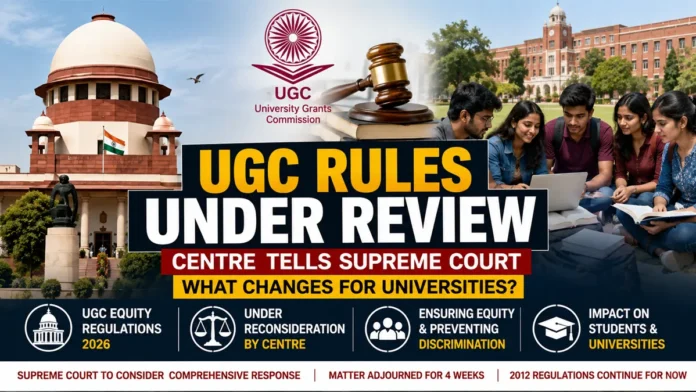
UGC Equity Regulations 2026 are under reconsideration, the Central Government has told the Supreme Court, signaling a potentially significant rethink of the controversial framework designed to address discrimination in India’s universities and colleges.
Solicitor General of India Tushar Mehta informed a Supreme Court bench headed by Chief Justice of India Surya Kant that the Union Government was reconsidering the University Grants Commission (Promotion of Equity in Higher Education Institutions) Regulations, 2026.
The development is significant for students, faculty members and higher education institutions across India because the regulations had proposed a stronger institutional mechanism to address discrimination on campuses.
The Supreme Court had already kept the 2026 regulations in abeyance in January after raising concerns about parts of the framework.
What Centre Told the Supreme Court
During the latest hearing, the Solicitor General informed the court that the regulations were being reconsidered.
The government sought time before the court proceeded further with determining the legal questions surrounding the regulations.
The Supreme Court was hearing a batch of petitions concerning the validity and implementation of the 2026 equity regulations.
The bench did not enter into the merits of the competing arguments during the latest hearing.
Instead, the matter has been adjourned for four weeks as the reconsideration process continues.
Supreme Court Had Put 2026 Regulations on Hold
The UGC notified the new equity regulations on January 13, 2026.
However, the Supreme Court intervened later that month and kept the framework in abeyance.
During its January 29 proceedings, the court raised concerns that aspects of the regulations appeared prima facie vague and could have sweeping consequences.
The court also expressed concern about the possibility of misuse.
As a result, the new 2026 framework has not replaced the earlier regulatory regime in practice.
2012 UGC Regulations Continue for Now
One of the most important points for universities and students is that the absence of the 2026 regulations does not mean there is currently no regulatory framework dealing with equity issues.
The UGC (Promotion of Equity in Higher Educational Institutions) Regulations, 2012 continue to operate until further orders from the Supreme Court.
Universities and colleges should therefore continue following the applicable existing regulatory requirements while the litigation and government’s reconsideration of the 2026 framework proceed.
Any revised rules would need to be considered in light of the legal issues currently before the court.
Why Were the 2026 Regulations Introduced?
The regulations were formulated to strengthen mechanisms for preventing discrimination in higher educational institutions.
The issue has been under judicial consideration following a 2019 petition filed by Radhika Vemula and Abeda Salim Tadvi, the mothers of Rohith Vemula and Payal Tadvi.
Their petition sought stronger institutional mechanisms to address caste-based discrimination and related concerns on university and college campuses.
The Supreme Court had previously emphasized the need for a robust mechanism capable of addressing such issues effectively.
The UGC subsequently developed the 2026 framework after receiving stakeholder suggestions.
Why Did the Regulations Become Controversial?
The regulations triggered a wider debate soon after their notification.
Supporters argued that stronger safeguards were necessary to protect students facing discrimination and to create clear institutional accountability.
Critics, however, raised concerns about the wording of certain provisions, the definition of caste-based discrimination and the possibility that some provisions could be applied unfairly or misused.
Those competing concerns eventually reached the Supreme Court through multiple petitions.
The legal debate therefore involves two important objectives: ensuring meaningful protection against discrimination while also ensuring that the regulatory mechanism is clear, fair and resistant to misuse.
What Could Change?
The Centre’s statement that the regulations are being reconsidered does not automatically mean they have been withdrawn.
It also does not establish what changes, if any, will ultimately be made.
The government and UGC could potentially revise disputed provisions, clarify definitions or propose other modifications after considering the concerns raised before the Supreme Court.
Until that process is completed, it would be premature to describe any specific amendment as final.
Students and universities should therefore wait for an official revised framework or further Supreme Court directions.
Supreme Court Seeks Comprehensive Response
The Supreme Court has sought a comprehensive response addressing the issues raised in the petitions.
This will be important because the court is dealing with challenges as well as arguments supporting stronger anti-discrimination safeguards.
Once the government’s reconsideration progresses and the required responses are filed, the court will be in a better position to examine the remaining legal and constitutional questions.
What Universities and Students Should Watch Next
The next four weeks could be important for India’s higher education sector.
Three developments will be particularly significant: whether the Centre proposes revisions to the 2026 regulations, what position the UGC takes in its comprehensive response, and how the Supreme Court proceeds after receiving those submissions.
Until then, the key position remains straightforward: the UGC Equity Regulations 2026 are under reconsideration, they remain in abeyance, and the earlier 2012 regulations continue to operate.