Mumbai, India | August 21, 2026
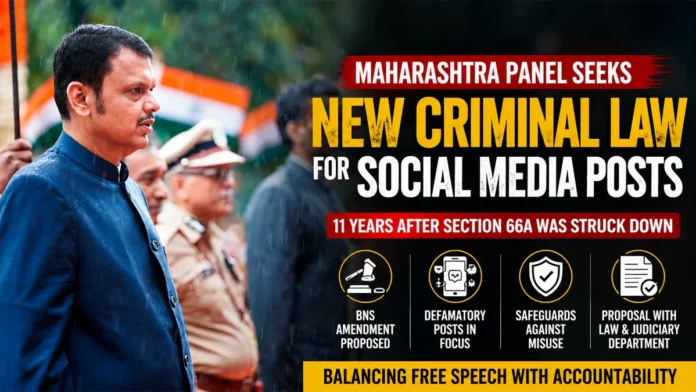
Maharashtra social media law: Eleven years after the Supreme Court struck down the controversial Section 66A of the Information Technology Act, a Maharashtra government-appointed committee has recommended a state amendment to the Bharatiya Nyaya Sanhita to specifically address defamatory content posted on social media.
The recommendation could reopen a major debate over how India should balance protection from online defamation with the constitutional right to freedom of speech and expression.
However, the proposal is still at an early stage. No new criminal law has yet taken effect, and several legislative and constitutional steps would be required before any amendment could become enforceable.
What Has the Maharashtra Committee Recommended?
The committee has recommended a state amendment to the Bharatiya Nyaya Sanhita, or BNS, to specifically address defamatory posts published through social-media platforms.
The proposal also envisages safeguards aimed at preventing misuse.
The recommendation has now been submitted to Maharashtra’s Law and Judiciary Department, which is expected to examine its legal implications before the matter moves further.
The state government would subsequently have to decide whether to formally pursue the proposed amendment.
Why Maharashtra Is Considering a BNS Amendment
The committee examined different legal options for dealing with defamatory online content.
Among the possibilities considered were amendments involving the Maharashtra Police Act and the Information Technology Act.
The BNS route was ultimately preferred.
Because criminal law falls within the Concurrent List under India’s constitutional framework, states can legislate in this area subject to constitutional requirements.
The Information Technology Act, by contrast, is a central law and cannot simply be amended by Maharashtra acting alone.
Proposal Would Require Multiple Approvals
Even if the Maharashtra government accepts the committee’s recommendation, the proposal would still have a long way to go before becoming law.
A state amendment would first need to pass through the Maharashtra legislature.
Because the proposal would involve a state amendment to central criminal legislation operating in a Concurrent List field, it would then require examination at the central level and ultimately Presidential assent before it could take effect.
That means social-media users should not interpret the committee’s recommendation as an immediate change in criminal law.
For now, it remains a proposal.
Why Section 66A Is Central to the Debate
The development is particularly significant because of the history of Section 66A of the Information Technology Act.
Section 66A criminalized certain categories of messages sent through computers and communication devices, including content described using broad terms such as “grossly offensive.”
The provision became highly controversial after arrests involving social-media posts, online comments and other forms of digital expression.
Critics argued that its language was vague and gave authorities excessive discretion to determine what constituted an offense.
Supreme Court Struck Down Section 66A in 2015
On March 24, 2015, the Supreme Court struck down Section 66A in the landmark Shreya Singhal v. Union of India judgment.
The court held that the provision violated the constitutional protection of freedom of speech and expression under Article 19(1)(a).
Among the central concerns was the breadth and vagueness of terms used in the law.
The judgment subsequently became one of India’s most important decisions involving online freedom of expression.
Any new criminal provision dealing specifically with social-media speech is therefore likely to face close scrutiny over whether its language is sufficiently precise and whether adequate safeguards exist against arbitrary enforcement.
What Does the BNS Already Say About Defamation?
The Bharatiya Nyaya Sanhita already contains provisions dealing with defamation.
Broadly, defamation involves making or publishing an imputation concerning another person while intending, knowing or having reason to believe that the statement will harm that person’s reputation, subject to statutory exceptions.
The Maharashtra committee’s proposal is significant because it seeks a provision that specifically addresses defamatory content in the social-media environment.
Exactly how any eventual amendment would be worded will be crucial.
The difference between a narrowly drafted online-defamation provision and a broadly worded restriction on digital speech could determine the scale of future constitutional debate.
Committee Was Formed in May 2026
The Maharashtra government constituted the committee in May 2026 to examine legal options for tackling defamatory content online.
The panel is headed by the state’s Director General of Police.
It also includes officials from the Law and Judiciary Department, Information Technology Department, Women and Child Development Department and Maharashtra Cyber.
The committee was tasked with studying existing legal provisions and considering whether legislative changes were needed following the Supreme Court’s Section 66A judgment.
Free Speech Safeguards Could Become Key Issue
Any attempt to create a new social-media-specific criminal provision is likely to revive questions raised during the Section 66A litigation.
A law can legitimately address conduct such as defamation, threats or other legally recognized offenses.
However, restrictions on speech must also satisfy constitutional standards.
That means lawmakers would need to ensure that any new provision is clearly defined, proportionate and accompanied by safeguards capable of preventing arbitrary or politically motivated enforcement.
The committee itself has reportedly recommended safeguards against misuse, but the final legislative language — if the proposal moves forward — will determine how those protections actually operate.
What Happens Next?
The immediate next step rests with Maharashtra’s Law and Judiciary Department.
It will examine the committee’s recommendations and provide its opinion.
The state government would then decide whether to proceed with legislation.
If it does, the proposal would have to pass through the state legislature before moving through the additional constitutional process required for the amendment to become effective.
The most important point for social-media users is therefore clear: Maharashtra has not brought back Section 66A, nor has a replacement law taken effect.
Instead, a government-appointed committee has recommended a new BNS amendment specifically addressing defamatory social-media content — setting the stage for a potentially significant debate over online speech, criminal law and constitutional safeguards in India.