Chengalpattu, India — August 20, 2026
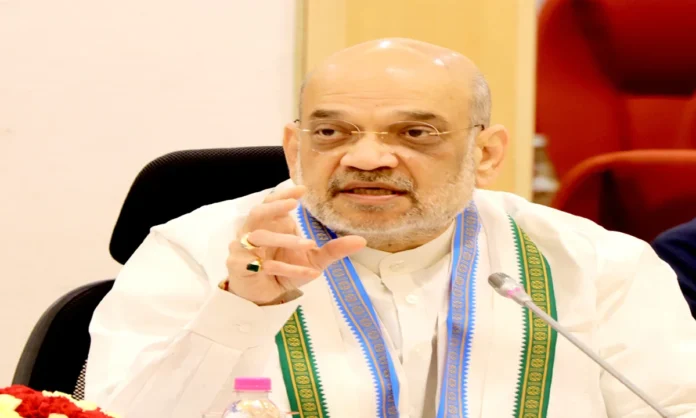
Amit Shah Vande Mataram Congress Row intensified on Thursday after Union Home Minister Amit Shah sharply criticized the Congress Working Committee for deciding to continue singing only the first two stanzas of the national song at party events, accusing the opposition party of reviving what he described as its historical politics of “appeasement.”
Shah argued that Congress was repeating a decision taken by its leadership in 1937 and claimed that the earlier move encouraged political divisions that eventually contributed to the Partition of India.
The Congress rejects that interpretation. Its leaders say the two-stanza rendition follows the position adopted during the freedom movement by a Congress leadership that included figures such as Jawaharlal Nehru, Sardar Vallabhbhai Patel and Maulana Abul Kalam Azad.
The dispute has now become a major political battle over the history, official rendition and legal protection of Vande Mataram.
Amit Shah Accuses Congress of ‘Extreme Appeasement’
Shah said Congress had returned to what he called an “extreme appeasement” policy by reaffirming its decision to sing only two stanzas.
The Congress Working Committee met on Wednesday and decided to maintain its longstanding practice based on the 1937 resolution.
Shah described the decision as “anti-national” and said the BJP would oppose it both before the public and in legislatures.
His remarks reflect the BJP’s political position and should not be treated as an established historical finding about the causes of Partition.
What Happened in 1937?
The historical background is more nuanced than the present political accusations suggest.
In October 1937, the Congress Working Committee considered objections to portions of Vande Mataram beyond its opening stanzas.
Jawaharlal Nehru, speaking at an AICC session on October 29, 1937, said the matter had been considered after extensive consultation.
He argued that the first two stanzas had broad national acceptance, while later portions contained religious imagery and allegory that some communities could sincerely object to in a song intended for all Indians.
The Congress therefore recommended the first two stanzas for use at national gatherings.
That historical decision is what the present-day Congress says it is continuing.
Shah Links 1937 Decision to Partition
Shah offered a sharply different interpretation.
He argued that restricting the rendition of Vande Mataram in 1937 strengthened communal politics and helped provide momentum to the two-nation theory.
According to Shah, the Congress decision laid what he described as part of the political foundation that eventually led to Partition and the creation of Pakistan.
This remains Shah’s political interpretation of history, rather than an uncontested historical conclusion.
The Partition of British India in 1947 resulted from a complex combination of communal politics, British colonial policy, constitutional disputes, the Muslim League’s demand for Pakistan and breakdowns in negotiations among political leaders.
Congress Sticks to Two-Stanza Tradition
The Congress Working Committee has nevertheless decided not to change its position.
Congress leaders maintain that the first two stanzas are the version historically associated with national use and the freedom struggle.
Party president Mallikarjun Kharge has defended that position by pointing out that the same version was accepted during the era of Gandhi, Nehru and Patel.
The Congress has also accused the BJP of politicizing national symbols for partisan purposes.
The latest CWC decision has now ensured that the disagreement will continue rather than end with this year’s 150th-anniversary commemorations of Vande Mataram.
Modi Government Introduced Full Six-Stanza Protocol in 2026
The Modi government significantly changed the official protocol surrounding the national song earlier this year.
The Ministry of Home Affairs issued fresh guidelines on January 28, 2026, recognizing an official six-stanza rendition lasting approximately 3 minutes and 10 seconds for specified official occasions.
Following those guidelines, Akashvani began broadcasting the full six-stanza version from March 26.
The government has presented the move as an effort to restore the complete composition during the year marking 150 years of Vande Mataram.
The full song was also incorporated prominently into the 80th Independence Day celebrations in August.
Parliament Also Gave Vande Mataram New Legal Protection
Another important development came this month.
Parliament passed the Prevention of Insults to National Honour (Amendment) Act, 2026, and presidential assent was granted on August 6.
The amendment extended to Vande Mataram the statutory protection previously given to the National Anthem under Section 3 of the 1971 law.
Under the amended provision, a person can face up to three years in prison, a fine, or both if that person intentionally:
- prevents the singing of the National Anthem or National Song; or
- disrupts an assembly engaged in singing either of them.
Does Singing Only Two Stanzas Violate the New Law?
This point requires an important legal distinction.
Shah described Congress’ decision as a violation of the law, but the text of the amended statute itself does not explicitly say that every private or political event must sing all six stanzas.
The law specifically criminalizes intentionally preventing the singing of the National Song or disturbing an assembly while it is being sung.
Separately, the government’s 2026 protocol establishes a full six-stanza official rendition for specified government and ceremonial contexts.
Whether Congress’ use of only two stanzas at its own party programs amounts to a legal violation would therefore depend on the application and interpretation of the relevant law and protocol; Shah’s statement is the government leader’s position, not a judicial ruling.
Why Vande Mataram Has Such a Powerful Political History
Written by Bankim Chandra Chattopadhyay, Vande Mataram became one of the defining songs of India’s freedom movement.
Its opening stanzas celebrate the motherland through imagery of nature, prosperity and beauty.
Later stanzas contain explicitly religious imagery, including references associated with Hindu goddesses.
That distinction was central to the Congress deliberations in 1937.
Nehru’s recorded remarks from that period said the party wanted a national song that could command acceptance across religious communities while preserving the enormous role Vande Mataram had already played in the nationalist movement.
What Status Does Vande Mataram Have Today?
On January 24, 1950, Constituent Assembly President Rajendra Prasad stated that Vande Mataram, which had played a historic role in the freedom struggle, should be honored equally with Jana Gana Mana.
Jana Gana Mana became India’s National Anthem, while Vande Mataram came to be recognized as the National Song.
The Modi government’s 2026 measures have now strengthened both its official protocol and statutory protection.
The new National Honour law specifically includes the National Song alongside the National Anthem for protection against intentional obstruction or disruption.
BJP Plans to Take the Issue to the Public
Shah said the BJP would not allow the Congress decision to pass without political opposition.
He urged citizens to oppose what he described as a revival of appeasement politics and said the BJP would raise the matter publicly as well as inside legislatures.
The party has increasingly used the issue to challenge Congress’ claims about its role in the freedom struggle and national identity.
With both parties hardening their positions, Vande Mataram is likely to remain a significant political issue in the weeks ahead.
Congress and BJP Offer Competing Versions of History
The central disagreement is now about more than how many stanzas should be sung.
The BJP argues that the 1937 decision represented an unnecessary concession to communal pressure and says the complete song should be restored to greater prominence.
Congress argues that its historic leadership consciously chose the first two stanzas because they could serve as an inclusive national expression acceptable across communities.
Historical records confirm that Congress debated the issue extensively in 1937 and settled on the first two stanzas for national gatherings.
Whether that decision contributed to Partition is a political and historical interpretation, not something established by the 1937 resolution itself.
Amit Shah Vande Mataram Congress Row: The Bottom Line
The Amit Shah Vande Mataram Congress Row has become the latest flashpoint between the BJP and Congress over nationalism, history and the interpretation of India’s freedom movement.
Shah says Congress is repeating a historic mistake by maintaining its two-stanza practice and accuses the party of appeasement.
Congress says it is preserving a decision taken during the freedom struggle after consultation among some of the most prominent leaders of the independence movement.
Meanwhile, the legal landscape has changed in 2026: the Modi government has introduced a full six-stanza official protocol, and Parliament has extended statutory protection to Vande Mataram.
But the new law specifically targets intentional obstruction or disruption of the National Song, making the legal implications of Congress’ two-stanza party practice more nuanced than the political rhetoric surrounding the controversy.