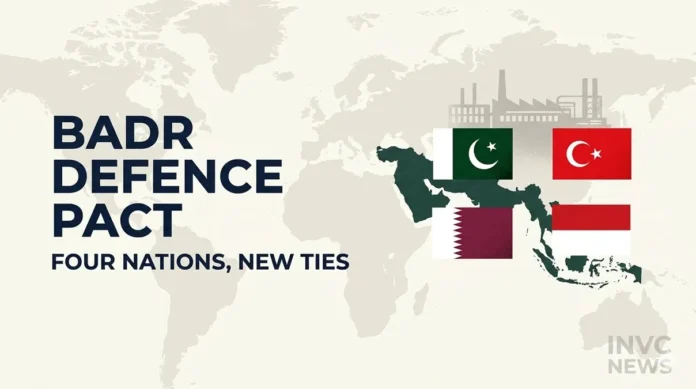
Doha, October 22, 2026: Pakistan, Turkey, Qatar and Indonesia have signed a multilateral defence cooperation agreement aimed at expanding military production, sharing technical expertise and strengthening research and development. Known as the Badr Memorandum of Understanding (MoU), the agreement was signed in Doha on October 21, bringing together four countries seeking to deepen their defence industrial partnerships.
The agreement focuses on defence manufacturing, technical training, research and development, and closer coordination between the participating countries’ defence industries. The signatories aim to combine their industrial capabilities to meet their own requirements and potentially serve the needs of friendly countries.
The timing is significant. Security concerns across the Middle East have intensified, while governments are exploring ways to diversify defence partnerships and strengthen domestic production. However, the Badr MoU is primarily an industrial and technological cooperation framework. It should not be confused with a mutual-defence treaty requiring the four countries to come to one another’s military aid.
What Is the Badr Agreement?
The Badr Memorandum of Understanding is a multilateral framework designed to strengthen cooperation among the defence establishments and defence industries of Pakistan, Turkey, Qatar and Indonesia.
The agreement brings together the four countries’ defence ministries and relevant defence industry authorities to explore opportunities for collaboration.
Its stated objectives include improving defence manufacturing capabilities, encouraging technical training and expanding cooperation in research and development. The initiative also seeks to combine the countries’ industrial strengths to develop capabilities suited to modern defence requirements.
The name Badr means “full moon” in Arabic. The name is associated with an important event in Islamic history, the Battle of Badr, fought between early Muslims and the Quraysh of Mecca. Qatar’s official explanation links the name to the idea that the participating countries complement one another through their respective capabilities.
Detailed information about specific joint projects, investment commitments, production targets and implementation schedules has not yet been publicly established.
Who Signed the Agreement?
The signing ceremony took place in Doha on Wednesday, October 21, 2026.
The participating officials included:
- Pakistan: Defence Minister Khawaja Muhammad Asif.
- Turkey: National Defence Minister Yaşar Güler.
- Qatar: Deputy Prime Minister and Minister of State for Defence Affairs Sheikh Saoud bin Abdulrahman bin Hassan Al-Thani.
- Indonesia: Deputy Minister of Defence Marshal Yusuf Jauhari.
Pakistan’s Federal Minister for Defence Production Muhammad Raza Hayat Harraj and Turkey’s defence industry chief, Professor Haluk Görgün, also attended the ceremony.
The agreement reflects an effort to move beyond individual defence purchases towards a more coordinated approach to manufacturing, technical expertise and industrial development.
Pakistan’s foreign ministry had not issued a separate public comment in the reporting available immediately after the signing. The agreement’s practical implications will become clearer as the participating governments announce further details.
Why Is the Agreement Important Now?
The Badr MoU comes amid heightened security concerns in the Middle East and wider uncertainty over regional defence arrangements.
Countries that rely heavily on overseas suppliers can face challenges involving delivery delays, technology restrictions, spare parts and disruptions to supply chains. Greater industrial cooperation can help participating governments broaden their options and develop more control over parts of their defence supply systems.
The agreement also reflects a wider strategic trend: governments are increasingly seeking partnerships that combine defence procurement with local manufacturing, training and technology development.
However, the signing alone does not demonstrate that the four countries are forming a unified military alliance or abandoning their existing international partnerships. The actual strategic significance will depend on how the agreement is implemented.
What Could Pakistan Gain?
For Pakistan, the agreement could create opportunities to expand defence production partnerships and gain access to additional technical expertise.
Pakistan has an established defence manufacturing sector and has pursued cooperation with international partners in areas such as military aviation, naval platforms and defence equipment. A multilateral framework could provide further opportunities for industrial collaboration, subject to the projects and terms agreed by the participating governments.
Potential areas of cooperation include:
- Joint research and development.
- Defence equipment manufacturing.
- Technical training and skills development.
- Technology transfer, where agreed and legally permitted.
- Greater integration between participating defence industries.
These are possible avenues under the cooperation framework, not a confirmed list of funded projects. The agreement’s practical value will depend on the technologies selected, the funding available and the terms negotiated for each initiative.
Turkey’s Defence Industry Could Play a Key Role
Turkey has developed a substantial domestic defence industry and expanded its international partnerships in defence manufacturing and technology.
Its cooperation with Qatar, Pakistan and Indonesia provides a foundation on which the four-country framework could build. Bringing these relationships together may create opportunities to coordinate industrial development and explore additional joint projects.
For Turkey, the agreement could broaden its defence industrial relationships and create opportunities to work with partners across the Gulf, South Asia and Southeast Asia.
However, a memorandum of understanding does not automatically guarantee technology transfers, production contracts or export orders. Such outcomes would require further agreements and implementation arrangements.
What Does Qatar Bring to the Partnership?
Qatar’s participation adds a Gulf-based partner with established international defence relationships and an interest in strengthening its defence capabilities.
Through the Badr framework, Qatar could explore industrial cooperation, technical training and research partnerships with the other signatories.
The agreement may also help connect defence manufacturing capabilities with the requirements of countries seeking equipment, expertise and industrial partnerships.
The scale of Qatar’s future contribution will depend on the projects it chooses to support and the financial and technical arrangements agreed with its partners.
Why Indonesia’s Role Matters
Indonesia gives the partnership an important Southeast Asian dimension.
Its participation could create opportunities to expand defence industrial cooperation beyond the Middle East and South Asia, particularly in training, research and manufacturing.
For Jakarta, a broader network of defence partners may offer additional avenues to evaluate technology, develop local industrial capabilities and diversify sources of cooperation.
That does not mean Indonesia will automatically change its existing defence relationships or cancel agreements with other countries. Any future effect on procurement or industrial partnerships will depend on the terms of specific projects.
Is the Badr MoU a Military Alliance?
The publicly described Badr MoU does not establish a mutual-defence commitment.
Its stated focus is defence manufacturing, technical training, research and development, and strengthening industrial capabilities. The publicly described terms do not establish a rule that an attack on one signatory must be treated as an attack on all four.
This distinction matters because defence industrial cooperation and collective military defence serve different purposes.
A manufacturing agreement can help countries develop equipment, share expertise and improve supply chains. A mutual-defence treaty, by contrast, may establish obligations concerning military assistance or responses to an armed attack.
The Badr MoU should therefore be assessed according to its announced industrial and technological objectives unless further treaty provisions are formally disclosed.
How Is It Different From the Pakistan-Turkey-Saudi Arabia Defence Agreement?
The Badr initiative comes against the backdrop of a separate defence arrangement involving Pakistan, Turkey and Saudi Arabia.
The three countries signed the Makkah Joint Defence Agreement in August 2026. Public reporting describes that arrangement as a mutual-defence commitment under which an armed attack on one signatory is treated as an attack on the others.
The Badr MoU has a different emphasis. Its stated objectives centre on defence industrial capacity, manufacturing, research and development, and technical training.
The two initiatives may be relevant to the wider evolution of regional defence cooperation, but they should not be treated as interchangeable agreements. One concerns a collective-defence commitment, while the other focuses on industrial and technological collaboration.
What Could It Mean for Global Power Dynamics?
The Badr agreement could contribute to a more interconnected network of defence industrial partnerships spanning the Gulf, South Asia and Southeast Asia.
If the signatories move from broad commitments to concrete projects, the framework could support joint production, develop technical expertise and create additional options for defence procurement.
It could also strengthen the participating countries’ ability to cooperate without relying exclusively on separate bilateral arrangements for every project.
For other countries, including India, the agreement is worth monitoring as part of the wider evolution of international defence partnerships. However, the signing itself does not establish that India’s existing defence relationships or contracts with any of the participating countries will be affected.
The agreement also does not, by itself, demonstrate a coordinated effort to oppose a particular country. Its practical and geopolitical implications will depend on the projects pursued, the technologies involved and the way the four governments manage their existing international commitments.
What Happens Next?
The next stage will be implementation.
The key questions are whether the four countries announce specific joint manufacturing projects, establish technology-sharing arrangements, commit investment, organise technical training programmes or create mechanisms to coordinate research.
Further clarity may also emerge over the possibility of other countries joining the framework. Any expansion will depend on the criteria and arrangements agreed by the founding members.
Until those details become available, the agreement’s long-term economic and military impact remains uncertain.
The Bottom Line
The Badr MoU brings Pakistan, Turkey, Qatar and Indonesia into a shared framework for defence industrial cooperation. It creates a platform for exploring manufacturing, technical training and research partnerships at a time of heightened regional security concerns.
But its significance should not be overstated. The agreement is not, on the information publicly announced, a four-country mutual-defence treaty. Its lasting impact will depend on whether the signatories translate their commitments into funded projects, meaningful technology cooperation and stronger domestic industrial capabilities.