Abu Dhabi, United Arab Emirates — August 20, 2026
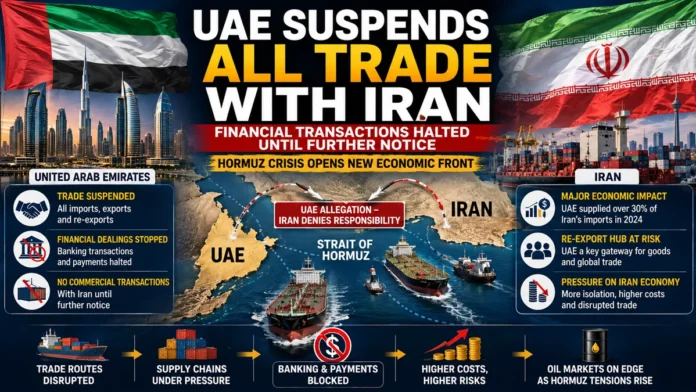
UAE Iran Trade Suspension has opened a major new front in the Gulf crisis, with the United Arab Emirates halting all trade and financial transactions with Iran until further notice after Abu Dhabi said two ballistic missiles were fired toward the country and appeared to target maritime traffic.
The decision, announced Wednesday, could significantly increase economic pressure on Tehran because the UAE has historically served as one of Iran’s most important trading partners and a major gateway for goods moving into the Iranian economy.
Iran has denied launching the missiles, creating sharply conflicting accounts of the incident that triggered the Emirati action. The missiles fell into the Persian Gulf without causing reported casualties, while the UAE said its assessment indicated maritime traffic was the intended target.
The escalation comes as the wider confrontation surrounding the Strait of Hormuz continues to disrupt shipping, energy markets and relations between Iran and several Gulf states.
UAE Halts Trade and Financial Transactions With Iran
The UAE said its measures would stop all trade and financial transactions with Iran “until further notice.”
The scope makes the decision considerably more significant than a conventional diplomatic protest.
It potentially affects commercial trade, banking transactions and the flow of goods through a country that has long been an important commercial hub for Iranian businesses.
Despite imposing the restrictions, the UAE said it remained committed to dialogue, cooperation and regional integration, indicating that Abu Dhabi has not closed the door entirely on diplomacy.
However, the economic action represents one of the sharpest Emirati measures against Tehran during the current crisis.
What Triggered the UAE Action?
The immediate trigger was an incident late Tuesday involving two ballistic missiles.
The UAE said the missiles were launched toward the Emirates but fell into the Persian Gulf.
Its Defense Ministry said assessments suggested the missiles were aimed at maritime traffic, although it was not immediately clear whether officials believed a specific ship or Emirati territorial waters were being targeted.
Iranian Foreign Ministry spokesman Esmail Baghaei denied that Tehran had fired missiles toward the UAE.
That denial is significant because it leaves the responsibility for the incident contested.
For that reason, the missile launch should be described as an Emirati allegation disputed by Iran, rather than as an independently established Iranian attack.
Why the UAE-Iran Trade Relationship Matters
The economic consequences could be substantial because the UAE has traditionally occupied an unusually important position in Iran’s trade network.
Even beyond direct trade between the two countries, Dubai has functioned as a major re-export center, allowing Iranian companies and consumers to access products originating in third countries.
According to the latest World Trade Organization figures cited in reporting on the measures, the UAE supplied more than 30% of Iran’s imports in 2024, worth roughly $21 billion.
The UAE was also the destination for nearly 13% of Iranian exports, worth around $7 billion.
That means a prolonged disruption would affect far more than bilateral trade.
It could complicate Iranian access to international commercial infrastructure, payment channels and re-exported goods.
UAE Has Been an Economic Lifeline for Iran
Iran already operates under extensive U.S. sanctions.
For years, trade links through the UAE have helped Iranian companies access regional supply chains despite those restrictions.
Dubai’s geographic proximity to Iran, advanced ports, financial sector and enormous re-export industry have made the Emirates particularly important.
A prolonged suspension could therefore tighten economic pressure at a time when Tehran is already dealing with sanctions, restricted shipping and serious domestic financial challenges.
The extent of the impact will depend on how strictly the UAE enforces the measure and how long it remains in place.
Strait of Hormuz Is at the Center of the Crisis
The dispute cannot be separated from the Strait of Hormuz, the narrow waterway connecting the Persian Gulf with the Gulf of Oman and international shipping routes.
During normal conditions, approximately one-fifth of globally traded oil and natural gas passes through or around this strategic corridor.
Iran’s geographical position gives it enormous leverage over maritime traffic through the strait.
Shipping has fallen dramatically during the current confrontation.
Only about 10 vessels reportedly transited the strait on Tuesday, less than one-tenth of typical pre-conflict traffic levels.
That disruption has made Hormuz one of the most important geopolitical risks facing global energy markets.
UAE Says Its Tankers Have Been Targeted
The UAE’s frustration with Tehran extends beyond the latest missile incident.
During the current conflict, Emirati-owned energy vessels have repeatedly faced attacks around the Strait of Hormuz.
According to the UAE-linked account cited in current reporting, nearly 20 vessels belonging to Abu Dhabi’s state energy company ADNOC have been targeted by missiles or drones since the conflict began.
Four ADNOC tankers were reportedly attacked in the past two weeks alone.
The wider series of incidents has caused casualties, including one death and injuries, according to reports documenting the UAE’s allegations.
Iran has repeatedly accused Gulf states allied with Washington of facilitating U.S. military operations against it.
Tehran Warns Gulf States Against Helping the US
Iran’s military leadership has issued warnings to countries along the southern shores of the Persian Gulf.
Iranian officials have argued that any logistical or operational assistance provided to U.S. forces could be regarded as participation in military action against Tehran.
That position places the UAE, Bahrain, Kuwait and other U.S. partners in a difficult strategic position.
They maintain deep security relationships with Washington but also have strong incentives to avoid becoming direct parties to a regional war.
The latest UAE economic action demonstrates how increasingly difficult that balancing act has become.
Why the UAE Had Tried to Maintain Relations With Iran
Despite being a close U.S. security partner, the UAE has spent years attempting to reduce tensions with Iran.
Abu Dhabi has generally favored economic engagement alongside deterrence, partly because any military conflict across the Gulf could directly threaten UAE ports, aviation, tourism, energy exports and financial markets.
The Emirates’ economic model depends heavily on its reputation as a stable center for trade, finance and investment.
A prolonged confrontation with Iran therefore creates risks for the UAE as well.
That helps explain why Abu Dhabi accompanied its economic measures with language emphasizing continued support for dialogue.
What Does the Trade Suspension Mean for Iran?
If fully enforced over an extended period, the suspension could affect several areas of Iran’s economy.
Imports Could Become More Difficult
Iran relies heavily on the UAE as a gateway for machinery, consumer goods, industrial inputs and products originating in other countries.
Closing that channel could increase costs and force traders to find alternative routes.
Financial Transactions Could Face Added Pressure
Restrictions on payments could complicate transactions already constrained by U.S. sanctions.
Businesses could face additional difficulties settling invoices, moving money or accessing regional financial services.
Re-Export Networks Could Be Disrupted
This may be the most important consequence.
The UAE’s role is not limited to goods made inside the Emirates. It also serves as a distribution center for products sourced globally and then shipped onward to Iran.
Tehran Could Become More Dependent on Other Partners
Iran may increasingly turn toward China, Russia and neighboring trading routes if UAE channels remain restricted.
But replacing the scale, proximity and logistics infrastructure offered by the UAE would not necessarily be easy.
Could the Move Push Iran Further Into Economic Isolation?
Potentially.
The UAE decision arrives as Washington is also preparing additional economic pressure on Tehran.
U.S. officials have signaled plans to intensify Iran’s economic isolation and maintain pressure on its ability to use ports and financial networks.
If major regional trading centers simultaneously reduce Iranian access, Tehran’s ability to navigate international restrictions could become substantially more difficult.
That could amplify pressure on Iran’s currency, inflation and availability of imported goods.
Iran’s Economy Already Faces Severe Pressure
Iran entered this latest escalation with serious economic vulnerabilities.
Years of sanctions have constrained foreign investment and access to global financial markets.
The current military conflict has added further pressure through damaged infrastructure, shipping restrictions and uncertainty.
International economic forecasts point to exceptionally high inflation and economic contraction this year.
The UAE trade suspension therefore arrives at a particularly sensitive moment for Tehran.
Could the UAE Also Pay an Economic Price?
Yes.
The measures are not without risk for Abu Dhabi.
Iran is geographically close to the UAE, and the two economies have longstanding commercial connections.
Dubai businesses involved in re-export trade could lose significant activity if the restrictions remain in place.
More importantly, continued military escalation could undermine regional investor confidence and raise insurance, shipping and security costs.
The UAE’s position as a tourism, logistics and financial hub depends heavily on stability.
That means Abu Dhabi has strong incentives to prevent the economic confrontation from becoming permanent.
What Could Happen to Oil Prices?
The direct effect of the UAE trade embargo on global oil prices may be smaller than the impact of developments in the Strait of Hormuz itself.
However, the measure increases the broader geopolitical risk surrounding Gulf energy supplies.
If tensions lead to more attacks on tankers or further restrictions on shipping, oil markets could react sharply.
The Strait of Hormuz remains critical because major producers including Saudi Arabia, Iraq, Kuwait, Qatar and the UAE depend on Gulf export infrastructure.
Even fears of interruption can push up freight costs, insurance premiums and crude prices.
Is the UAE Cutting Diplomatic Relations With Iran?
No such step has been announced.
The UAE Iran Trade Suspension involves trade and financial dealings.
It should not be described as a complete severing of diplomatic relations unless Abu Dhabi separately announces such a decision.
Indeed, the UAE’s emphasis on continued dialogue suggests it wants to preserve diplomatic channels even while using economic pressure.
That distinction is important for accurate reporting.
What Has Iran Said?
Iran denies responsibility for the missile launches that prompted the UAE’s decision.
Tehran has also accused regional countries of supporting or facilitating U.S. military operations.
The competing claims underline how rapidly the Gulf crisis has become a confrontation not only between Washington and Tehran but also between Iran and some of America’s Arab partners.
Without independent confirmation of responsibility for the missiles, the allegations remain contested.
Why This Is a Major Turning Point in the Gulf Crisis
The decision is significant because the UAE was not merely another Iranian trading partner.
It was one of Tehran’s largest and most strategically useful commercial gateways.
A prolonged suspension could therefore weaken a network that has helped connect Iranian businesses to international trade despite years of sanctions.
At the same time, the measure risks pushing the Gulf further toward economic fragmentation.
A crisis that began primarily around military confrontation and control of maritime routes is now moving deeper into trade, finance and regional economic relations.
What Happens Next?
Three developments will now be particularly important.
First, markets will watch whether Iran retaliates economically or militarily against the UAE.
Second, traders will assess how strictly Abu Dhabi enforces its ban on transactions and whether exemptions eventually emerge.
Third, attention will remain firmly focused on shipping through the Strait of Hormuz.
Any significant deterioration in maritime traffic could rapidly transform the crisis from a regional security confrontation into a much larger global energy shock.
For now, the UAE Iran Trade Suspension marks one of the most consequential economic escalations yet in the Gulf confrontation.
The UAE has moved beyond diplomatic condemnation and imposed direct commercial pressure on a neighboring country that once relied heavily on Emirati trade networks.
Whether the measure remains temporary or develops into a long-term economic rupture will depend largely on what happens next in the Strait of Hormuz.