Mumbai, India — August 20, 2026
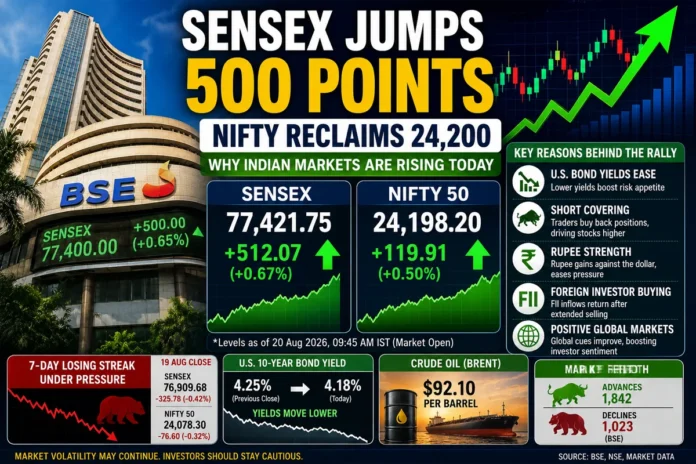
Indian Stock Market Today staged a sharp rebound in early Thursday trade, with the Sensex jumping around 500 points and the Nifty 50 moving above 24,200, as easing U.S. bond yields, a firmer rupee, short covering and positive global cues lifted investor sentiment after seven consecutive sessions of losses.
The recovery brought welcome relief to Dalal Street after sustained selling pressure driven by elevated crude oil prices, rising global bond yields and geopolitical uncertainty.
Early-market reports showed the Sensex gaining roughly 500 points, while the Nifty reclaimed the psychologically important 24,200 level. The rebound was supported by lower U.S. Treasury yields, short covering, foreign institutional buying and stronger global markets.
Sensex, Nifty Rebound After Seven Sessions of Losses
Thursday’s rise follows one of the market’s longest recent losing streaks.
On Wednesday, August 19, the Nifty 50 fell 76.60 points, or 0.32%, to close at 24,078.30, marking its seventh consecutive decline.
The Sensex fell 325.78 points, or 0.42%, to 76,909.68.
Over the seven-session period, the Nifty lost about 2.1%, while the Sensex fell in six of those seven sessions by a similar magnitude.
Thursday morning’s rebound therefore marks an important attempt by bulls to break that negative trend.
Why Is the Indian Stock Market Rising Today?
Several factors are supporting the recovery.
1. US Bond Yields Ease
One of the strongest triggers is the decline in U.S. bond yields.
Higher Treasury yields had recently made dollar-denominated fixed-income assets more attractive relative to emerging-market equities.
When those yields ease, risk appetite can improve and some capital may move back toward stocks.
That shift is helping Indian equities recover after several difficult sessions.
2. Short Covering Fuels the Rally
Short covering is also contributing to the sharp upward move.
After seven consecutive sessions of decline, traders holding bearish positions began buying shares to close those positions.
That creates additional demand and can accelerate a market rebound.
The effect tends to be particularly strong when markets have been oversold or heavily positioned for further declines.
3. Rupee Strength Supports Sentiment
A stronger Indian rupee has provided additional support.
Currency stability is important for foreign investors because sharp depreciation can reduce returns when Indian assets are converted back into dollars.
A firmer rupee can therefore improve sentiment toward domestic equities and reduce concern about imported inflation.
4. Foreign Institutional Buying Helps
Renewed buying interest from foreign institutional investors has also contributed to the improved mood.
Foreign flows remain an important driver of large-cap Indian stocks, particularly banking, financial services, technology and other index-heavy sectors.
A return of overseas buying following several sessions of weakness can quickly strengthen benchmark indices.
5. Positive Global Markets Lift Risk Appetite
Asian and other global markets showed a more constructive tone, giving Indian equities a supportive external backdrop.
Positive global cues often encourage domestic investors to increase risk exposure, particularly after a sustained correction.
The combination of easing yields and stronger international equity markets helped improve sentiment in early Thursday trade.
Oil Prices Still Remain a Major Risk
Despite Thursday’s recovery, crude oil remains one of the biggest risks facing Indian equities.
Brent crude has recently hovered around $92 per barrel amid continuing geopolitical uncertainty in West Asia and tensions surrounding the Strait of Hormuz.
India imports most of its crude requirements, so higher oil prices can increase the import bill, pressure the rupee and add to inflation.
That means the market recovery could remain vulnerable if energy prices climb further.
Why Did the Market Fall for Seven Days?
The previous decline was driven by a combination of external pressures.
High crude prices were a major concern, while rising U.S., German and Japanese bond yields increased the attractiveness of developed-market fixed-income assets.
Investors were also cautious because of continued geopolitical tensions and limited fresh domestic triggers after the end of the quarterly earnings season.
On August 19, 14 of the 16 major sectoral indices ended lower, reflecting the broad nature of the selling.
Financial stocks were among the notable laggards, while information technology shares showed relative strength.
Nifty’s Seven-Day Fall Was Longest in 11 Months
Wednesday’s decline gave the Nifty its longest losing streak in approximately 11 months.
That made Thursday’s rebound especially significant for traders watching technical levels.
After seven straight declines, the return above 24,200 suggests buyers are attempting to regain control.
However, one strong session alone does not confirm that the correction is over.
What Levels Should Investors Watch?
The 24,200 level on the Nifty has become an immediate reference point.
Sustained trading above it could strengthen the rebound, while renewed selling below recent lows would suggest that bearish pressure remains.
For the Sensex, maintaining gains above the 77,000 region would help improve short-term sentiment.
Market direction during the remainder of Thursday’s session will depend on whether early buying broadens across sectors.
Banks and Financial Stocks Could Be Important
Banking and financial shares are likely to play an important role in determining whether the rebound holds.
These sectors carry large weightings in both the Sensex and Nifty.
If financial stocks participate strongly, benchmark indices may be better positioned to sustain their gains.
However, weakness in heavyweight banks could quickly limit the upside.
Global Bond Yields Remain Crucial
Investors will continue watching international bond markets closely.
Recent increases in global yields were among the primary reasons emerging-market equities came under pressure.
If U.S. Treasury yields continue to ease, Indian equities may find additional support.
If yields resume their climb, foreign institutional flows could again come under pressure.
Crude Oil and Iran Tensions Remain Key Risks
Geopolitical developments in West Asia remain another major market variable.
The confrontation involving the United States and Iran has kept crude prices volatile and created uncertainty around shipping through the Strait of Hormuz.
Because the strait is one of the world’s key energy transit routes, any escalation could quickly affect oil prices and market sentiment.
Indian investors are therefore likely to remain sensitive to developments in the region.
What Should Investors Watch During Today’s Session?
Thursday’s early rally is encouraging, but investors should watch whether the gains survive through the afternoon.
Key indicators include:
- whether Nifty remains above 24,200;
- whether Sensex sustains its 500-point advance;
- movements in U.S. Treasury yields;
- crude oil prices;
- rupee-dollar movement;
- foreign institutional flows; and
- participation from banking and broader market stocks.
If those factors remain supportive, the market could consolidate its rebound.
Indian Stock Market Today: The Bottom Line
The Indian Stock Market Today has staged a strong comeback after seven consecutive sessions of weakness, with the Sensex gaining around 500 points and the Nifty moving above 24,200 in early Thursday trade.
Lower U.S. bond yields, short covering, foreign buying, rupee strength and supportive global markets have helped restore investor confidence.
However, crude oil prices and geopolitical uncertainty remain important risks.
Most importantly, these are intraday levels as of Thursday morning, not August 20 closing figures. The final Sensex and Nifty closing levels will only be known after the Indian market session concludes.