MUMBAI, August 18, 2026 —
Indian stock market today remained under pressure in early Tuesday trading as fading hopes of a Middle East peace breakthrough, rising crude oil prices and concerns over global interest rates pushed investors toward caution.
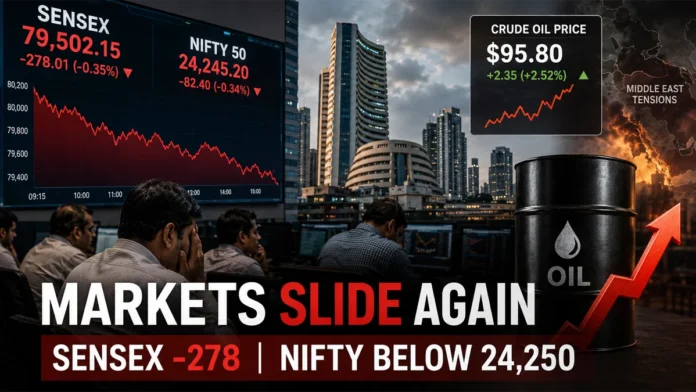
The BSE Sensex dropped 278.32 points to 77,450.64, while the NSE Nifty 50 fell 57.65 points to 24,230.45 in early trade, extending a losing streak that has weighed heavily on domestic market sentiment.
The Sensex was heading lower for a third consecutive session, while the Nifty extended losses for a sixth straight session, reflecting persistent investor nervousness over geopolitical risks and the potential impact of higher energy costs on the Indian economy.
Pressure was also visible in the currency market. The Indian rupee weakened by 7 paise to around 95.68 against the US dollar in early trading as crude oil climbed above $90 a barrel and global bond yields remained elevated.
Why Is the Indian Stock Market Falling Today?
The primary concern for investors is the renewed deterioration in the geopolitical outlook in the Middle East.
Expectations of a sustained easing in regional tensions have weakened, reviving fears of disruption to global oil supplies and shipping routes.
The Strait of Hormuz, one of the world’s most important energy transportation corridors, remains particularly important for markets because any prolonged disruption in the region could restrict oil flows and push crude prices significantly higher.
For India, which relies heavily on imported crude oil, a sharp increase in global energy prices can create several economic challenges at once.
Higher crude prices can increase the country’s import bill, put pressure on the rupee and potentially contribute to inflation. These concerns can also affect expectations for interest rates, corporate costs and consumer spending.
Crude Oil Above $90 Adds to Market Pressure
Oil has emerged as one of the biggest immediate risks for Indian equities.
Brent crude moved above $90 per barrel amid renewed geopolitical uncertainty, increasing concerns about the impact of higher energy costs on oil-importing economies.
Indian markets are particularly sensitive to sustained increases in crude because energy imports represent a major component of the country’s overseas purchases.
Higher oil prices can increase transportation and manufacturing costs and potentially reduce profit margins for companies that cannot pass those higher expenses on to consumers.
Oil-sensitive sectors can therefore experience increased volatility whenever international crude prices rise sharply.
Rising US Bond Yields Add Another Risk
Investors are also monitoring movements in US government bond yields.
Higher Treasury yields can make US fixed-income assets more attractive and potentially reduce investor appetite for riskier assets in emerging markets.
The rise in long-term US yields has therefore added another layer of uncertainty for equity markets worldwide.
Investors are also watching the outlook for the US Federal Reserve, with monetary policy expectations remaining an important driver for global stocks, bonds and currencies.
Any indication that interest rates could remain elevated for longer than previously expected may put additional pressure on equity valuations.
Rupee Weakens Against US Dollar
The Indian currency also came under pressure on Tuesday.
The rupee slipped about 7 paise to 95.68 against the US dollar in early trade as higher crude prices increased concerns about India’s import costs.
A weaker rupee can make imported commodities, particularly crude oil, more expensive in domestic currency terms.
The currency had already been facing pressure from strong importer demand for dollars and developments surrounding the Reserve Bank of India’s foreign-currency deposit swap facility.
As a result, foreign exchange movements are likely to remain an important indicator for equity investors in the coming sessions.
Asian Markets Trade Mostly Lower
Weakness was not limited to India, with several major Asian markets also trading lower as investors reacted to geopolitical and interest-rate concerns.
At the market snapshot referenced in early Asian trading, S&P 500 futures were down about 0.1%, while Japan-linked equity futures also pointed lower.
Japan’s Topix fell around 0.3%, while Hong Kong’s Hang Seng Index declined about 0.6%.
Broader Asian market indicators also showed weakening risk appetite as rising oil prices outweighed some of the optimism created by strong corporate earnings.
Australia and China Show More Resilience
Not every major Asian market was in negative territory.
Australia’s S&P/ASX 200 edged about 0.1% higher, while the Shanghai Composite showed relatively limited movement.
European market futures, however, indicated continued caution, with Euro Stoxx 50 futures down around 0.2% in the early market snapshot.
The mixed global performance suggests that investors are increasingly differentiating between markets based on their exposure to oil, interest rates and geopolitical risks.
What Should Investors Watch Next?
The direction of the Indian stock market will likely depend on several major factors in the near term.
The first is the situation in the Middle East. Any escalation threatening energy supplies or shipping through the Strait of Hormuz could send crude prices higher and put additional pressure on equities.
Oil prices themselves will therefore remain a major market trigger.
Investors will also closely monitor the rupee-dollar exchange rate, foreign institutional investor activity and movements in US Treasury yields.
Global central bank expectations will remain equally important because prolonged high interest rates can affect capital flows into emerging markets.
Can Sensex and Nifty Recover?
After multiple sessions of losses, traders may look for signs of stabilization, particularly if crude oil prices ease or geopolitical tensions show signs of de-escalation.
However, continued uncertainty could keep volatility elevated.
The Nifty’s fall below the 24,250 level has also attracted attention from market participants assessing short-term technical support and resistance zones.
For long-term investors, short-term market fluctuations do not necessarily change underlying investment fundamentals. However, geopolitical developments, oil prices, interest rates and company earnings will remain critical factors in determining the broader direction of Indian equities.
For now, the combination of rising crude oil prices, a weaker rupee, elevated global bond yields and renewed Middle East tensions is keeping both the Sensex and Nifty under pressure.