MUMBAI, INDIA — August 17, 2026
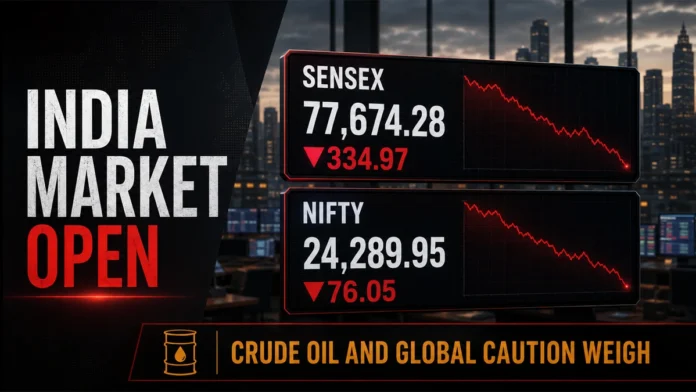
The Indian stock market today opened sharply lower, with the Sensex falling more than 300 points and the Nifty 50 slipping below 24,300 as elevated crude-oil prices and cautious global sentiment weighed on investors.
During early trading on Monday, the 30-share BSE Sensex dropped 334.97 points, or approximately 0.43%, to 77,674.28. The NSE Nifty 50 declined 76.05 points, or 0.31%, to 24,289.95.
Bajaj Finserv and Hindustan Unilever were among the prominent early laggards. Information-technology, public-sector and consumer shares also faced selling pressure, while selected pharmaceutical, healthcare and metal stocks displayed relative resilience.
The benchmarks remained volatile after opening and moved as fresh orders entered the market. All figures in this report represent an early-session snapshot rather than final closing levels.
Sensex and Nifty at the Opening
| Index | Early level | Change | Approximate decline |
|---|---|---|---|
| BSE Sensex | 77,674.28 | -334.97 points | -0.43% |
| NSE Nifty 50 | 24,289.95 | -76.05 points | -0.31% |
The weak opening extended the cautious trend seen at the end of the previous week.
On Friday, August 14, the Sensex closed 70.71 points, or 0.09%, lower at 78,009.25. The Nifty 50 ended 29.85 points, or 0.12%, down at 24,366.
Why Did the Indian Stock Market Fall?
Elevated crude-oil prices emerged as the leading concern for domestic investors.
Brent crude traded near $89 a barrel and briefly approached the psychologically important $90 level as geopolitical tensions continued to affect the energy market. Higher oil prices can create multiple risks for India because the country imports most of its crude requirements.
Expensive oil may:
- Increase India’s import bill
- Add pressure to the rupee
- Raise transportation and manufacturing costs
- Complicate the inflation outlook
- Reduce profit margins for energy-intensive companies
- Limit room for supportive monetary policy
Crude-price volatility linked to geopolitical developments remained a central market concern, while the lack of strong domestic triggers encouraged traders to remain cautious. Nine of 16 major sectoral indexes were lower during the early session. August 17 market update
Global Bond Yields Add to Investor Caution
Uncertainty surrounding global bond yields also influenced sentiment.
Rising yields can make government bonds more attractive compared with equities, particularly when stock valuations are elevated. Higher international yields may also affect foreign portfolio flows into emerging markets, including India.
Investors were consequently monitoring:
- Global crude prices
- U.S. bond yields
- Federal Reserve policy signals
- Middle East geopolitical developments
- Movements in the Indian rupee
- Foreign institutional investor activity
- Domestic corporate earnings
The absence of clarity on these variables contributed to selective profit-taking and reduced risk appetite.
Bajaj Finserv and HUL Among Early Laggards
Bajaj Finserv and Hindustan Unilever were among the significant early losers in the benchmark basket.
Weakness in Bajaj Finserv added pressure to financial-services stocks, while the decline in HUL weighed on the fast-moving consumer-goods segment.
Movements in individual stocks can change rapidly during an active session. Their early position among the leading losers does not necessarily indicate where they will close.
Which Sectors Faced Selling Pressure?
Selling was visible in areas including:
- Information technology
- Public-sector stocks
- Financial services
- Consumer goods
- Selected banking counters
Technology shares remained sensitive to movements in global yields, overseas demand expectations and international market sentiment.
Financial stocks were affected by broader risk aversion, while consumer companies faced concerns that higher input and transportation costs could pressure margins.
Pharma and Metal Shares Show Resilience
Not every sector traded lower.
Selected pharmaceutical, healthcare and metal shares showed relative strength shortly after the market opened. Defensive demand supported some healthcare counters, while stock-specific buying helped parts of the metal segment.
Auto and media shares also attracted selective interest, although gains were insufficient to reverse the weakness in the headline indexes.
The mixed sectoral performance suggested that investors were not exiting equities indiscriminately. Instead, capital was moving toward selected sectors and companies considered better positioned in the prevailing environment.
Broader Markets Remain Relatively Stable
Mid-cap and small-cap indexes were comparatively steady during the early session, even as the Sensex and Nifty declined.
That divergence indicated that the pressure was concentrated partly in heavyweight stocks with a greater influence on the benchmark indexes.
However, broader-market strength should be interpreted cautiously. If large-cap selling intensifies or crude prices move higher, weakness can spread to mid-sized and smaller companies.
Corporate Earnings Drive Stock-Specific Moves
Corporate results also produced sharp movements outside the benchmark indexes.
Orchid Pharma declined after weak earnings, while Dr. Reddy’s Laboratories came under pressure amid regulatory concerns. Ahluwalia Contracts fell following a steep decline in quarterly profit.
In contrast, PTC Industries gained after reporting stronger earnings, while Hindustan Aeronautics advanced following a defense-manufacturing agreement.
The contrasting moves reinforced the stock-specific nature of the broader market.
Important Levels for Investors to Monitor
The Nifty’s movement around the 24,300 level remained important for short-term sentiment. A sustained move below this zone could increase volatility, while a recovery above it may indicate that buyers are returning at lower levels.
The Sensex, meanwhile, was attempting to stabilize after falling below 77,700 in early trade.
Investors were also watching:
- Nifty support near 24,200
- Nifty resistance around 24,500
- Sensex movement around 77,500–78,000
- Brent crude near $90 a barrel
- India VIX for changes in expected volatility
- Foreign and domestic institutional flows
Technical levels are observational indicators and do not guarantee future market direction.
Market Outlook
Near-term market sentiment is likely to remain sensitive to crude oil, global yields and geopolitical developments. Any meaningful decline in oil prices could provide relief to Indian equities, while another rise may increase pressure on the rupee, inflation expectations and corporate margins.
The mixed performance across sectors also suggests that investors are adopting a selective approach rather than making broad market-wide bets.
Monday’s early decline should not be treated as the day’s closing outcome. Index levels, sector performance and the list of top gainers and losers may change significantly before trading ends.
This article is for news and informational purposes only. It does not constitute investment advice. Investors should conduct independent research or consult a SEBI-registered professional before making financial decisions.