ROME, August 14, 2026
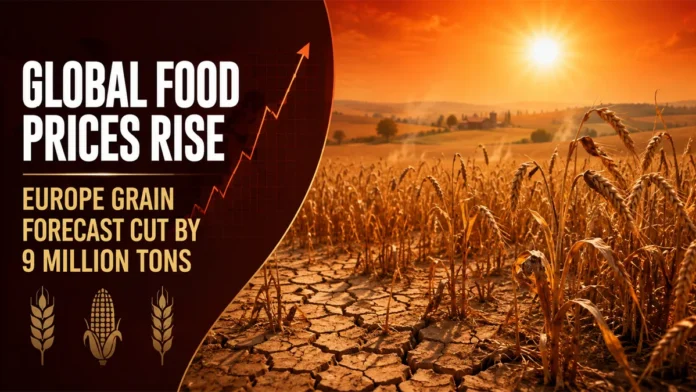
Global food prices have climbed to their highest level in approximately three and a half years as extreme heat, geopolitical conflicts, expensive agricultural inputs and a strengthening El Niño threaten food production and supply chains.
The United Nations Food and Agriculture Organization’s Food Price Index averaged 131.1 points in July 2026, up 0.6% from June and 1% from a year earlier. It was the index’s highest reading since January 2023, although it remained 18.2% below the record reached in March 2022.
Increases in cereal, sugar and vegetable oil prices outweighed declines in meat and dairy products, according to the FAO Food Price Index.
The latest increase has intensified concerns that food inflation could accelerate in the coming months, particularly if crop losses deepen or energy and fertilizer costs remain elevated.
Europe cuts grain forecast by 9 million tons
Record-breaking summer heat has forced a substantial reduction in Europe’s grain production outlook.
COCERAL, which represents European agricultural trade organizations, reduced its 2026 grain production forecast for the European Union and the United Kingdom to 286.6 million metric tons. That was approximately 9 million tons below its previous forecast of 295.5 million tons.
The reduction covers the overall production outlook for crops including wheat, barley, corn and oats. It should be understood as a downward forecast revision rather than confirmation that exactly 9 million tons of harvested grain has already been destroyed.
The revised COCERAL crop forecast reflects deteriorating growing conditions across several major agricultural regions.
Western Europe records its hottest June
June 2026 was the hottest June recorded in Western Europe, while Europe as a whole experienced its second-warmest June.
Western Europe’s average temperature reached 20.74 degrees Celsius, or 3.06 degrees above the 1991–2020 average. France and England recorded their warmest June, while Germany and the Netherlands experienced their second-warmest.
Monthly temperatures were 3 to 5 degrees above average across parts of France, Germany, Spain, Italy and the Benelux region. Daily maximum-temperature records were also broken in several countries, including Germany, Czechia, Poland and Hungary.
The prolonged heat was accompanied by dry conditions across large parts of Western, Central and Southern Europe. This combination reduced soil moisture and placed crops under stress during sensitive stages of development.
The Copernicus Climate Change Service said persistent high-pressure conditions increased drought risks and contributed to wildfire activity in parts of Europe.
Wheat, corn and sugar prices climb
The FAO’s cereal price index rose 3.4% in July. International wheat prices increased 5.8%, while corn prices advanced 3.6%.
Disruptions to Black Sea grain exports and attacks on export-related infrastructure added pressure to wheat prices. Meanwhile, expectations of hot and dry weather in the US Corn Belt contributed to the increase in corn prices.
Sugar prices rose 5.6%, while vegetable oil prices gained 2%.
These increases are particularly significant because grain, sugar and vegetable oils are used in a wide range of household and commercially manufactured food products. Higher commodity prices can eventually affect bread, flour, animal feed, cooking oil, processed foods and meat production costs.
However, international commodity-price increases do not pass through to consumers immediately or uniformly. The final effect depends on exchange rates, transportation costs, domestic production, government policies and existing inventories.
Why El Niño is a major concern
The World Food Programme has warned that the developing 2026–2027 El Niño could push at least 49 million additional people into acute food insecurity by the end of 2027.
WFP estimates that as many as 274 million people across 45 countries could face acute food insecurity by that point. The organization is preparing for possible droughts, floods, failed harvests and income losses in vulnerable regions.
El Niño changes global rainfall and temperature patterns. Its effects vary by location, but it can produce drought in some agricultural regions and severe flooding in others.
The 2015–2016 El Niño affected the food security of an estimated 60 million to 100 million people. WFP said early preparation would be essential to prevent the present cycle from causing a comparable humanitarian emergency.
The complete projection is available in the WFP’s El Niño assessment.
Expensive fertilizer creates a delayed risk
Food markets are also facing pressure from higher fertilizer and energy costs.
The Strait of Hormuz is a critical route for international energy shipments, with approximately one-quarter of global seaborne oil trade passing through the waterway under normal conditions. The surrounding region is also important to global fertilizer and natural gas supply chains.
During the recent escalation in regional conflict, international urea prices reportedly increased from around $400 per metric ton to more than $850 before retreating.
Even when fertilizer prices later decline, their impact on food production can appear with a delay. Farmers may reduce fertilizer use, switch crops or limit planted acreage when input costs become unaffordable.
The consequences may therefore become more visible during the next planting and harvesting cycles, potentially placing additional pressure on 2027 agricultural production.
Could weather become a bigger inflation driver than war?
Geopolitical conflicts remain a significant source of food-price volatility, particularly when they disrupt energy supplies, shipping routes or agricultural exports.
However, repeated heat waves, droughts and changing rainfall patterns are emerging as equally important risks. Weather disruptions can affect several major producing regions simultaneously, reducing yields even when international trade routes remain open.
Extreme weather also creates combined pressure across the food system. It can lower crop output, raise irrigation and energy costs, disrupt transportation and increase demand for animal feed.
Therefore, the immediate concern is not one isolated crop failure but the possibility that weather, conflict and expensive inputs could reinforce one another.
What happens next?
The food-price outlook will depend on several factors over the coming months:
- The strength and geographical impact of the 2026–2027 El Niño
- Wheat, corn and soybean conditions in Europe, North America and South America
- Black Sea grain-export availability
- Energy and fertilizer prices
- Shipping security around the Strait of Hormuz
- Currency movements in food-importing countries
- Government export restrictions and food-stock policies
Countries that depend heavily on imported food and fertilizer are likely to face the greatest risk. Low-income households are also more vulnerable because food represents a larger portion of their monthly spending.
The FAO index remains well below its 2022 record. Nevertheless, the combination of a reduced European harvest outlook, strengthening El Niño conditions and persistent geopolitical disruptions indicates that global food inflation risks have not disappeared.
Key Numbers
| Indicator | Latest figure |
|---|---|
| FAO Food Price Index, July 2026 | 131.1 points |
| Monthly increase | 0.6% |
| Increase from July 2025 | 1% |
| EU–UK grain forecast | 286.6 million tons |
| Reduction from previous forecast | About 9 million tons |
| Wheat price increase in July | 5.8% |
| Corn price increase in July | 3.6% |
| Sugar price increase in July | 5.6% |
| Additional people at risk from El Niño | At least 49 million |