SAN FRANCISCO, CALIFORNIA — August 17, 2026
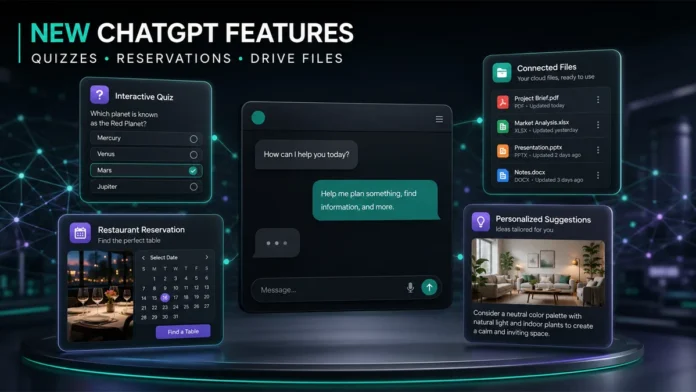
ChatGPT new features are expanding the AI assistant beyond conventional question-and-answer conversations, introducing interactive quizzes, natural-language restaurant searches, connected Google Drive files and improved suggestions for starting new tasks.
Adam Fry, OpenAI’s consumer product lead, outlined the latest additions in a social-media update. The changes are designed to make ChatGPT more useful for studying, planning activities and working with documents stored outside the platform.
Some capabilities are being introduced gradually and may not appear immediately for every account, region or device. Availability can depend on the user’s plan, workspace settings and whether a required plugin or connected service has been installed.
Meanwhile, reports of a possible expansion of advertising in India have prompted questions about which ChatGPT plans may display sponsored content. OpenAI has not announced a confirmed India launch date in its currently available official product documentation.
ChatGPT Can Create Interactive Quizzes
One of the most accessible additions allows users to ask ChatGPT to test their knowledge directly within a conversation.
A prompt as simple as “Quiz me on world history” can generate a series of questions on the requested subject. Users can answer one question at a time, receive feedback and ask for explanations when they make a mistake.
The quiz capability could be helpful for:
- Students preparing for examinations
- Professionals revising industry knowledge
- Language learners practicing vocabulary
- Readers reviewing a book or article
- Users exploring an unfamiliar subject
- Teachers creating informal practice questions
Users can also specify the difficulty, question format and number of rounds. For example, they could request a 10-question multiple-choice quiz for beginners or an advanced test that asks for written answers.
ChatGPT’s official prompting guidance says users do not need specialized syntax or a rigid format. They can describe the desired outcome in ordinary language and refine the response with follow-up instructions. Official ChatGPT prompting guide
Because AI-generated questions and answers can contain mistakes, users should verify important educational material against reliable textbooks, teachers or primary sources.
Restaurant Search Can Understand Natural Requests
ChatGPT is also moving toward more practical restaurant discovery and reservation workflows.
Instead of entering a tightly structured search query, a user could say:
Find a restaurant with good outdoor seating for two people next Saturday evening.
ChatGPT can interpret details such as the preferred date, time, party size, location, cuisine, seating arrangement and price range. It may then search for suitable options through available web or reservation services.
The system’s ability to complete an actual booking depends on the connected reservation provider and the permissions available to the user. In some cases, ChatGPT may only find and compare restaurants before directing the user to complete the reservation.
OpenAI provides a formal restaurant reservation specification for developers building compatible plugins. This supports structured information such as availability, dates, time slots and party sizes. The presence of that specification does not guarantee that direct booking is already available to every ChatGPT user or in every country.
Users should check the final restaurant, date, time, party size, cancellation policy and price before confirming any reservation.
Google Drive Files Can Be Used With ChatGPT
The new file workflow is intended to reduce repeated downloads and uploads for people who keep reports, spreadsheets, presentations and documents in Google Drive.
Where the feature is available, paid users may see an option to add a Drive file through the composer or Library interface. The reported workflow involves opening the plus menu, selecting Add from Library and choosing an eligible connected file.
Once a document becomes available to ChatGPT, a user could ask it to:
- Summarize a report
- Extract action items from meeting notes
- Compare two versions of a document
- Analyze figures in a spreadsheet
- Find specific information in a long file
- Convert source material into a presentation outline
- Draft questions based on study material
OpenAI’s documentation confirms that ChatGPT plugins can connect to services such as Google Drive. The official Google Drive plugin supports working across Drive, Docs, Sheets and Slides. Official ChatGPT plugin documentation
However, the exact Add from Library interface may be part of a phased product rollout. Users should not assume that it is available to every paid account immediately.
Connecting Drive Is Different From Uploading a File
A connected Google Drive service allows ChatGPT to access eligible files after the user authorizes the connection. A conventional upload, by contrast, creates a separate copy of the selected file inside a conversation or workspace.
The connected approach can make repeated work more convenient because users can point ChatGPT toward files stored in an external source. OpenAI’s current guidance says availability depends on the plan, workspace controls and individual plugin. Using connected tools in ChatGPT
Users should still review access permissions before connecting a Drive account. Business documents containing personal, financial, legal or confidential information should only be shared when organizational policy permits it.
Better Suggestions May Appear on the Home Page
OpenAI is also testing or rolling out improved suggestions on the ChatGPT home screen for paid users.
These prompts are intended to show people what they can ask ChatGPT to do and help them begin a conversation without writing a detailed instruction from scratch.
Suggestions may highlight tasks such as:
- Preparing or reviewing a document
- Learning a new topic
- Planning an activity
- Working with a connected file
- Creating a quiz
- Comparing available options
- Continuing an earlier project
Recommendations may vary between users because of device, account settings, feature availability and staged testing.
A home-page suggestion is only a starting point. Users can modify it, add constraints or ignore it and write their own prompt.
Will ChatGPT Introduce Ads in India?
The latest discussion has also drawn attention to a possible expansion of ChatGPT advertising in India.
Some users reportedly received emails describing forthcoming privacy-policy changes, advertising controls and how sponsored content could appear inside ChatGPT. However, OpenAI has not published an India-specific advertising launch date in the official product pages reviewed for this article.
OpenAI’s developer documentation shows that it is building infrastructure for advertisers, including campaign management, product feeds, measurement tools and an Ads API. That confirms broader work on advertising technology, but it does not independently establish when consumer ads will reach India or which accounts will see them.
Any claim that advertising has already launched nationwide should therefore be treated cautiously until OpenAI issues an India-specific announcement.
Which ChatGPT Plans Could Display Ads?
The reported model suggests that sponsored content may be shown on the Free and Go plans. Paid tiers such as Plus, Pro, Business, Enterprise and Education are reportedly expected to remain free from advertising.
However, official OpenAI documentation available at the time of publication does not clearly confirm this complete consumer plan-by-plan advertising policy.
| ChatGPT plan | Reported advertising status | Official India launch confirmed? |
|---|---|---|
| Free | Ads may appear | No |
| Go | Ads may appear | No |
| Plus | Reportedly ad-free | No India-specific policy found |
| Pro | Reportedly ad-free | No India-specific policy found |
| Business | Reportedly ad-free | No India-specific policy found |
| Enterprise | Reportedly ad-free | No India-specific policy found |
| Education | Reportedly ad-free | No India-specific policy found |
OpenAI’s current official pricing material confirms the existence of Free, Go, Plus, Pro, Business, Enterprise and Education offerings, but feature availability and limits can differ between plans. Official ChatGPT pricing information
How Sponsored Content Is Expected to Appear
If advertisements are introduced, the reported approach would label them clearly as Sponsored so that users can distinguish commercial material from a normal ChatGPT response.
Important transparency controls would include:
- A visible sponsored-content label
- Separation between advertising and the assistant’s answer
- Information about why an advertisement appeared
- Controls for personalization where available
- Clear disclosure of commercial links
- Privacy settings that users can review
The final format, targeting options and data controls may vary by country and could change before a wider release.
Availability Will Vary by Account
Not all users will receive the new features simultaneously. OpenAI frequently introduces product changes in stages while monitoring reliability and collecting feedback.
A feature may depend on:
- The ChatGPT plan
- Country or region
- Web, desktop or mobile access
- Application version
- Workspace administrator settings
- Availability of a required plugin
- Whether a connected service has been authorized
- Participation in a limited test
Users should check the plus menu, Library, Plugins section and account settings to see which options are currently enabled.
The updates show OpenAI’s effort to turn ChatGPT into a broader assistant for studying, document-based work and everyday planning. Still, users should distinguish between features officially documented for general use and capabilities announced as tests or phased rollouts.