Rome, Italy | July 17, 2026
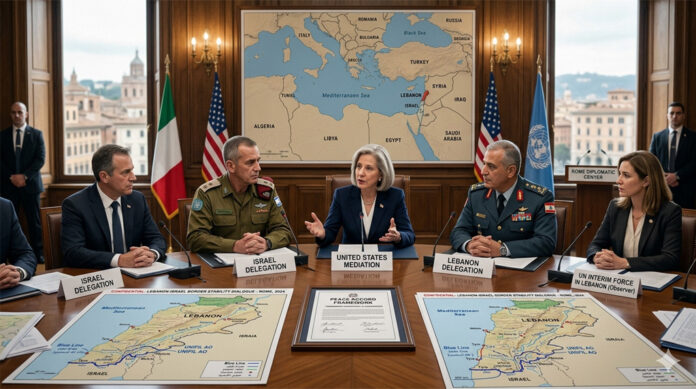
Israel Lebanon Peace Talks moved a step closer to a breakthrough after a new round of US-mediated negotiations in Rome, Italy, brought both countries closer to launching a pilot project that would gradually transfer control of selected areas in southern Lebanon from the Israeli military to the Lebanese Armed Forces (LAF).
The latest diplomatic discussions focused on implementing the ceasefire framework agreed upon earlier this year, with negotiators working to establish a practical roadmap for military withdrawal, security arrangements, and restoring Lebanese state authority in the border region.
The sixth round of negotiations, hosted at the US Embassy in Rome, ended with both sides agreeing to continue talks, although a date for the next meeting has not yet been announced.
Pilot Project Could Begin Israeli Military Withdrawal
According to sources familiar with the negotiations, Israel and Lebanon made meaningful progress on a mechanism that would allow the Israeli Defense Forces (IDF) to withdraw from the first two pilot zones in southern Lebanon.
Under the proposed arrangement, responsibility for security in these areas would gradually shift to the Lebanese Armed Forces, provided security conditions are met and the transition remains stable.
Officials described the discussions as constructive, emphasizing that the phased approach is intended to build confidence before expanding the process to additional areas.
Implementation of Washington Ceasefire Framework
Negotiators concentrated on implementing the framework agreement reached in Washington, D.C., USA, on June 26, which serves as the foundation for the ongoing peace process.
During the Rome discussions, representatives examined:
- The sequence for Israeli troop withdrawal.
- Deployment plans for the Lebanese Armed Forces.
- Measures to neutralize Hezbollah’s military capabilities.
- Mechanisms to restore effective Lebanese government control in southern Lebanon.
- Security verification procedures acceptable to both parties.
Diplomatic sources indicated that discussions were detailed and focused on ensuring that each phase of the agreement could be verified before moving to the next stage.
Security Guarantees Remain Central
One of the most sensitive issues during the negotiations remains the future security of southern Lebanon.
Israeli officials reportedly reiterated that any complete withdrawal of Israeli forces will depend on credible and verifiable guarantees that Hezbollah will not regain military control of territories evacuated by the IDF.
Israel also insists that the Lebanese Armed Forces must demonstrate their ability to establish effective security control while advancing efforts to dismantle unauthorized armed infrastructure.
Meanwhile, Lebanese officials continue to emphasize the importance of restoring national sovereignty without triggering domestic instability or renewed internal conflict.
Gradual Transition Expected
Sources close to the negotiations acknowledged that both governments understand the transition will require time.
Lebanon aims to re-establish full governmental authority across southern regions while carefully managing internal political and security challenges.
Israel, on the other hand, continues to prioritize long-term security assurances before agreeing to a broader military withdrawal.
The phased pilot project is therefore viewed as an opportunity to test the implementation process before expanding it to additional locations.
US Continues to Mediate Negotiations
The Rome meeting marked the sixth round of negotiations facilitated by the United States.
The previous round was held in Washington, D.C., late last month, where both sides agreed on the initial ceasefire implementation framework.
Diplomatic officials confirmed that both delegations have agreed in principle to hold another round of talks as efforts continue to reduce tensions along the Israel-Lebanon border.
No official timeline has yet been announced.
Italy Highlights Its Diplomatic Role
Italian Deputy Prime Minister and Foreign Minister Antonio Tajani welcomed the latest round of negotiations, describing Italy’s role in hosting the discussions as part of broader international efforts to promote peace and stability across the Middle East.
Italian officials said facilitating dialogue between regional stakeholders reflects Rome’s commitment to supporting diplomatic solutions to ongoing regional conflicts.
Regional Significance
The progress made during the latest Israel Lebanon Peace Talks is being closely monitored across the Middle East, where stability along the Israel-Lebanon border remains a major regional security concern.
A successful implementation of the pilot withdrawal project could reduce military tensions, strengthen Lebanese state institutions, and support broader international efforts aimed at preserving the existing ceasefire framework.
However, officials from both sides acknowledge that several complex security and political issues remain unresolved before any comprehensive agreement can be finalized.
What’s Next?
Negotiators are expected to continue refining the operational details of the pilot project before additional phases can move forward.
Future discussions are likely to focus on:
- Expanding Israeli military withdrawal zones.
- Increasing Lebanese Army deployment.
- Monitoring security compliance.
- Verifying Hezbollah disarmament measures.
- Maintaining long-term ceasefire arrangements.
Diplomatic observers believe sustained dialogue and international mediation will remain essential as both countries attempt to transform preliminary agreements into lasting stability along their shared border.