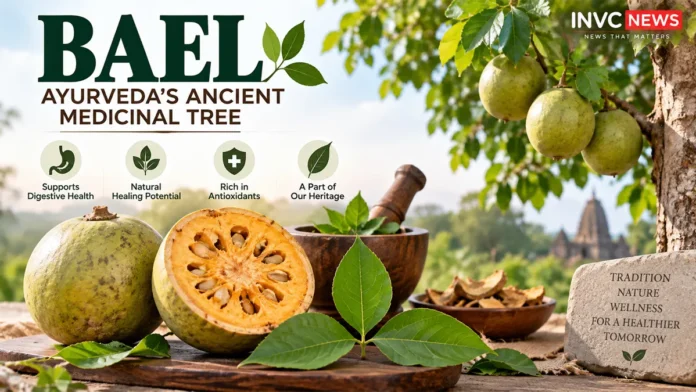
NEW DELHI, India | September 9, 2026 —
Bael Medicinal Benefits are back in focus after the National Medicinal Plants Board under the Ministry of AYUSH highlighted the traditional importance of one of India’s best-known medicinal trees.
Known as Bilva in Sanskrit and scientifically as Aegle marmelos, bael has occupied an important place in Indian traditional medicine, food culture and religious practice for centuries.
Its fruit, leaves and roots have all been used in traditional preparations, although the fruit has attracted particular attention for its association with digestive health.
Modern laboratory and animal research has also investigated bael extracts for antidiarrheal, antimicrobial, anti-inflammatory and antioxidant activity.
However, these findings should not be interpreted to mean that bael has been clinically proven to treat every condition traditionally associated with it. Evidence varies by preparation and health condition, and herbal remedies should not replace appropriate medical care.
What Is Bael?
Bael belongs to the Rutaceae, or citrus, family.
Its accepted botanical name is Aegle marmelos (L.) Corrêa.
The tree is native to the Indian subcontinent and is now grown or found across several other parts of Asia.
Bael is sometimes described in English as wood apple, stone apple, Bengal quince or Indian bael. However, “wood apple” can also refer to another species, Limonia acidissima, so using “bael” is generally more precise.
The tree is recognizable by its hard-shelled fruit and characteristic trifoliate leaves, meaning each leaf commonly consists of three leaflets.
Its fragrant flowers are generally greenish-white.
The hard outer shell of the fruit protects an aromatic pulp inside, which is consumed fresh or used to prepare traditional drinks, preserves, syrups and other foods.
Why Bael Is Important in Ayurveda
Bael has a long history in Ayurveda and other traditional systems of medicine.
Different parts of the plant have been incorporated into traditional preparations, including the fruit, leaves, bark and roots.
The unripe fruit is particularly associated with traditional remedies for diarrhea and digestive disturbances.
Published research has investigated this traditional use.
Studies involving bael fruit extracts have reported antidiarrheal activity in laboratory and animal models, while other experimental research has examined its effects on microbes associated with gastrointestinal illness.
Researchers believe several naturally occurring plant compounds may contribute to these biological activities.
However, much of this research remains preclinical, meaning it does not automatically establish the same benefit in people.
Bael Contains Several Plant Compounds
Scientific interest in bael is partly driven by its phytochemical profile.
Research reviews have identified compounds including alkaloids, flavonoids and phenolic acids in bael fruit.
These compounds are frequently studied because of their antioxidant and other biological properties.
Bael fruit also contains carbohydrates, minerals, vitamins and other nutrients.
Researchers have investigated different extracts of Aegle marmelos for a wide range of biological activities, including antimicrobial, anti-inflammatory, antioxidant and antidiarrheal effects.
Yet an important distinction remains.
Finding an effect in a laboratory experiment or animal model does not necessarily mean that eating bael fruit or taking a herbal preparation will produce an equivalent therapeutic effect in humans.
Bael and Digestive Health
Digestive health is arguably the area most strongly associated with bael in traditional medicine.
Unripe bael fruit has historically been used in preparations for diarrhea and dysentery.
A published study examining dried unripe bael fruit found evidence of activity against mechanisms involved in infectious diarrhea.
Other experimental studies have reported reductions in diarrhea in animal models.
This scientific work provides some support for why the fruit became prominent in traditional gastrointestinal remedies.
Still, diarrhea can have many causes, including infections, medication effects and underlying disease.
Persistent diarrhea, dehydration, blood in the stool, severe abdominal pain or illness in young children and older adults requires appropriate medical evaluation rather than self-treatment with herbal products.
What About Anti-Inflammatory and Antimicrobial Properties?
Research reviews of Aegle marmelos have also described anti-inflammatory and antimicrobial activity in experimental models.
Scientists have studied extracts prepared from different parts of the plant and using different extraction methods.
That matters because a laboratory extract can be far more concentrated than the amount of plant compounds someone would receive from consuming the fruit normally.
For this reason, terms such as “antimicrobial” should not be interpreted as meaning bael is a replacement for prescribed antibiotics.
Antibiotics have specific indications, doses and clinical evidence behind their use.
Bael should therefore be viewed as a medicinal plant with interesting traditional uses and research potential rather than a substitute for proven treatment.
Fruit Is Also Used as Food
Bael is not valued only as a medicinal plant.
Its ripe pulp is consumed as food and can be made into drinks, preserves, jams, syrups and other products.
Bael beverages are particularly popular during warmer months in parts of India.
Its hard shell gives the fruit a distinctive appearance and helps protect the soft pulp.
Traditional food use is different from taking concentrated herbal extracts or supplements, which may contain substantially different doses of active plant compounds.
Bael Has Deep Religious Significance
The importance of bael in India extends far beyond medicine and nutrition.
Bilva leaves, commonly known as bel patra, have a special place in the worship of Lord Shiva.
The characteristic three-leaf structure carries deep cultural and religious symbolism, and devotees frequently offer the leaves during Shiva worship.
Bael trees are therefore commonly associated with temples and sacred spaces.
This combination of spiritual importance, food value and traditional medicinal use has given Aegle marmelos a distinctive position in Indian culture.
National Medicinal Plants Board Recognizes Bael
The National Medicinal Plants Board lists Bael — Aegle marmelos among India’s medicinal plants and has historically included it among plants prioritized for medicinal-plant development and cultivation.
The Board works under the Ministry of AYUSH and promotes conservation, cultivation and sustainable use of medicinal-plant resources.
The renewed attention to bael also highlights a broader issue.
India possesses an enormous traditional medicinal-plant heritage, but modern health claims require careful scientific evaluation.
Traditional knowledge can help identify promising areas for research, while clinical studies are needed to establish effectiveness, appropriate doses and safety for specific conditions.
Should Everyone Use Bael as Medicine?
Not necessarily.
Using bael as a food is different from using concentrated extracts, powders or medicinal formulations.
People who take prescription medicines, have chronic health conditions, are pregnant or breastfeeding, or plan to give herbal preparations to children should discuss such products with a qualified healthcare professional.
The appropriate preparation and dose can also vary substantially.
Natural does not automatically mean risk-free.
Tradition Meets Modern Research
Bael represents an interesting meeting point between India’s ancient medicinal knowledge and modern scientific research.
Its traditional connection with digestive health has received some experimental support, while researchers continue investigating its phytochemicals and biological properties.
At the same time, responsible health reporting requires separating traditional use, preliminary scientific evidence and clinically proven treatment.
That distinction does not diminish bael’s importance.
Instead, it helps explain why Aegle marmelos, or Bilva, remains one of India’s most fascinating medicinal trees — valued as food, studied by scientists and revered in Indian spiritual tradition.