New York, United States, August 19, 2026
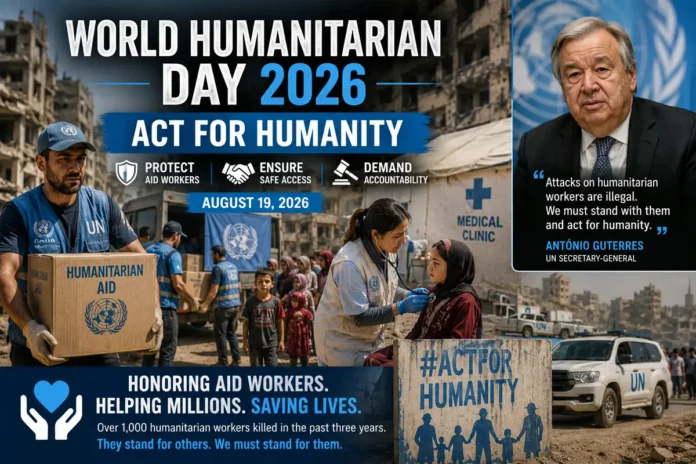
World Humanitarian Day 2026 is being observed worldwide on Wednesday, with UN Secretary-General Antonio Guterres calling on governments and the international community to stand with humanitarian workers facing growing risks while delivering life-saving assistance in conflict and disaster zones.
In his message marking the day, Guterres paid tribute to humanitarian personnel who help millions of people in need while warning that their work has become increasingly dangerous. He said attacks on aid workers are illegal and called for greater respect for international humanitarian law, safe humanitarian access, accountability for violations and adequate funding for relief operations.
The United Nations Office for the Coordination of Humanitarian Affairs is marking this year’s observance under the campaign #ActForHumanity, urging people and governments to demand stronger protection for civilians and humanitarian personnel.
Guterres Honors Humanitarian Workers
Guterres said World Humanitarian Day is an opportunity to honor people who dedicate themselves to delivering essential assistance to communities caught in emergencies.
Humanitarian personnel routinely provide food, medicine, shelter, water, protection and other life-saving services in some of the world’s most dangerous environments.
However, the Secretary-General warned that serving others has become increasingly hazardous.
According to his World Humanitarian Day message, more than 1,000 humanitarian workers have been killed over the past three years, with many of those killed being local personnel serving their own communities.
More Than 1,000 Aid Workers Killed in Three Years
The scale of the danger facing aid workers has become a central theme of World Humanitarian Day 2026.
UN humanitarian officials reported earlier this year that at least 326 humanitarian workers were killed across 21 countries in 2025, bringing the three-year death toll to more than 1,010.
OCHA’s World Humanitarian Day campaign page now records 350 aid workers killed in 2025, describing it as the second-highest annual toll ever recorded.
The campaign also states that most humanitarian workers affected by major security incidents are local staff working in or near their own communities.
Aid Workers Face Shooting, Bombing and Kidnapping
Guterres warned that humanitarian personnel are facing a range of threats while carrying out their work.
His message highlighted incidents involving gunfire, shelling, bombing, kidnapping and sexual violence.
He also pointed to attacks affecting civilian infrastructure, including schools and hospitals.
The growing use of armed drones and other emerging technologies is creating additional dangers for both civilians and humanitarian workers, according to the UN.
OCHA’s 2026 campaign similarly warns that changing technologies of warfare can increase risks when used without adequate safeguards.
Humanitarian Convoys Being Blocked
Physical violence is not the only challenge facing aid operations.
Guterres also highlighted restrictions on humanitarian access.
Aid convoys can be blocked from reaching populations in need, while humanitarian personnel may face threats, arrest or detention.
At the same time, misinformation and disinformation can weaken public trust in humanitarian organizations and make their work more dangerous.
When humanitarian access is restricted, civilians can be left without food, medicine, shelter or urgent medical care.
Humanitarian Funding Under Growing Pressure
Funding cuts are another serious concern.
Guterres warned that humanitarian financing is being reduced at a time when millions of people continue to depend on emergency assistance.
OCHA estimates that 239 million people require humanitarian assistance in 2026, while humanitarian organizations aim to assist 135 million people, with the immediate priority focused on reaching 87 million people facing the most severe needs.
Funding shortages can force aid organizations to reduce food assistance, health programs, shelter support and other emergency services.
‘Attacks on Humanitarian Workers Are Illegal’
One of the strongest elements of Guterres’ message was his reminder that humanitarian personnel are protected under international humanitarian law.
The Secretary-General said attacks against humanitarian workers are illegal and can have devastating consequences far beyond those directly targeted.
When aid workers are attacked or prevented from operating, families struggling to survive may lose access to assistance.
Children can be left waiting for food, while patients may be unable to obtain urgent medical treatment.
UN Calls for Accountability
Guterres said the international community must move from commitments to action.
His message emphasized four priorities:
- Respect the rules of war and international humanitarian law.
- Ensure humanitarian organizations have safe access to people in need.
- Investigate violations and hold perpetrators accountable.
- Provide humanitarian operations with sufficient resources.
The 2026 #ActForHumanity campaign delivers a similar message, arguing that the problem is not the absence of legal rules but the failure to uphold them.
What Is the World Humanitarian Day 2026 Theme?
The central campaign for World Humanitarian Day 2026 is:
#ActForHumanity
The campaign calls on individuals, governments and institutions to demand protection for civilians and humanitarian workers.
It also encourages the public to question leaders about how they are upholding international humanitarian law and ensuring accountability when violations occur.
The message is designed to turn public concern into action.
What Does ‘Act for Humanity’ Mean?
The UN is urging people to support humanitarian workers and defend the principles that allow humanitarian assistance to reach people in crisis.
That includes demanding safe access for humanitarian teams, opposing attacks on civilians and relief personnel, supporting credible investigations into alleged violations and calling for accountability when international humanitarian law is breached.
The campaign also encourages people to remember humanitarian workers who have been killed and stand with their families, colleagues and communities.
Why World Humanitarian Day Is Observed on August 19
World Humanitarian Day is observed every year on August 19.
The date commemorates the 2003 bombing of the Canal Hotel in Baghdad, Iraq, which killed 22 people, including UN Special Representative Sergio Vieira de Mello and other humanitarian personnel.
The UN General Assembly later designated August 19 as World Humanitarian Day.
The annual observance recognizes humanitarian workers and draws global attention to people affected by armed conflict, disaster and other emergencies.
Local Aid Workers Face the Greatest Risks
A particularly important element of the current humanitarian crisis is that many of those killed are not international personnel deployed from overseas.
They are local employees serving communities in their own countries.
These workers frequently remain in affected areas long after international attention has moved elsewhere.
Their local knowledge, language skills and community relationships often make them essential to humanitarian operations.
Yet those same factors can leave them exposed to prolonged insecurity.
Schools and Hospitals Remain Vulnerable
Guterres also highlighted the danger facing civilian institutions such as hospitals and schools.
International humanitarian law provides protections for civilians and civilian infrastructure during armed conflict.
Attacks or damage to hospitals can prevent communities from accessing medical treatment, while destruction of schools can affect children for years after fighting ends.
OCHA warns that damage to civilian infrastructure can have consequences lasting across generations.
New Technology Brings New Risks
Modern warfare is increasingly shaped by drones and other emerging technologies.
While technology can have legitimate uses, the UN warns that misuse can increase danger for civilians and humanitarian operations.
Aid organizations operating in conflict areas may face difficulties identifying threats or maintaining safe routes when warfare changes rapidly.
The World Humanitarian Day campaign therefore calls for existing humanitarian protections to be respected regardless of how military technology evolves.
World Humanitarian Day 2026 Carries an Urgent Message
The message of World Humanitarian Day 2026 is ultimately about protecting the people who help others survive the world’s most severe crises.
Humanitarian personnel often operate where governments, medical systems and basic services have been damaged or overwhelmed.
When they are attacked, detained or blocked from reaching civilians, the consequences extend far beyond the aid community itself.
Guterres’ message therefore calls for governments and armed actors to respect international law, guarantee safe humanitarian access and ensure that violations do not go unpunished.
Humanitarian workers, he said, stand up for people in need.
The international community must now stand up for them and act for humanity.