KYIV, Ukraine | September 6, 2026 —
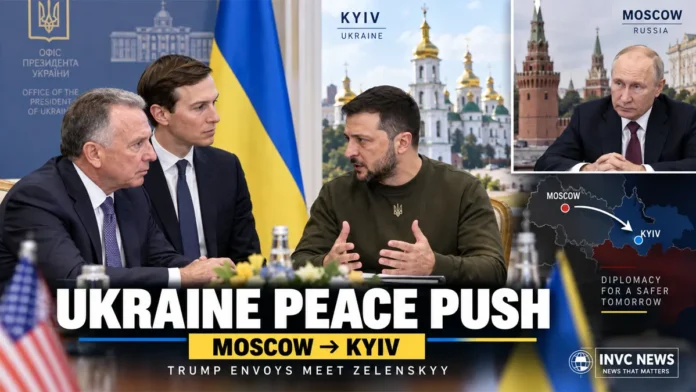
Witkoff Kushner Kyiv talks moved Donald Trump’s latest Ukraine peace initiative into a crucial new phase Sunday as U.S. envoys Steve Witkoff and Jared Kushner met Ukrainian President Volodymyr Zelenskyy in the capital just hours after holding more than three hours of discussions with Russian President Vladimir Putin in Moscow.
The visit marks Witkoff and Kushner’s first trip to Ukraine during Russia’s full-scale invasion and gives Washington’s negotiators a direct opportunity to test whether positions presented in Moscow can be reconciled with Kyiv’s demands.
Zelenskyy welcomed the two American envoys in central Kyiv and made Ukraine’s position clear before the talks: Kyiv wants an end to the war, credible security guarantees and what the Ukrainian president described as a dignified post-war peace.
Ukraine has also prepared proposals for the next phase of negotiations.
The diplomatic push comes after months in which U.S.-led efforts repeatedly struggled to bridge fundamental disagreements over territory, security arrangements and Ukraine’s future relationship with NATO.
Trump Envoys Arrive in Kyiv After Putin Meeting
Witkoff and Kushner travelled to Kyiv after meeting Putin at the Kremlin on Saturday.
The Moscow talks lasted more than three hours.
Russian and American officials described the discussions as substantive, but neither side announced a breakthrough.
The meeting focused on possible steps toward ending a war that has now continued for more than four and a half years.
Witkoff and Kushner then continued directly to Ukraine, giving the Trump administration an unusual opportunity to hear the positions of both Moscow and Kyiv within a short diplomatic window.
Their arrival in Kyiv therefore carries significance beyond the symbolism of a first visit.
The two envoys are attempting to determine whether enough common ground exists to restart serious negotiations.
Zelenskyy Demands Security Guarantees
Zelenskyy has made security guarantees one of Ukraine’s core requirements for any settlement.
Kyiv argues that a ceasefire alone cannot provide lasting peace if Russia retains the ability to restart a major offensive later.
Ukraine therefore wants any agreement to include mechanisms strong enough to deter another attack.
Zelenskyy also stressed that Ukraine expects a dignified settlement.
That wording reflects Kyiv’s determination to resist an agreement it believes would reward military aggression or leave Ukraine permanently vulnerable.
The Ukrainian leadership has repeatedly said it remains ready for diplomacy but will not accept terms that amount to capitulation.
Ukraine Says Its Peace Proposals Are Ready
Ahead of the meeting, Zelenskyy said Ukraine had prepared its proposals and wanted substantive negotiations.
That gives Witkoff and Kushner concrete positions to compare with the ideas discussed with Putin in Moscow.
Washington now faces the difficult task of determining where the two sides may be able to compromise.
The most difficult issues remain familiar.
Territory represents one of the largest obstacles.
Russia controls significant areas of eastern and southern Ukraine and continues to demand concessions that Kyiv rejects.
Ukraine maintains that Moscow cannot simply acquire internationally recognized Ukrainian territory through force.
Donbas Remains Major Sticking Point
The future of Donbas remains central to any possible settlement.
Russia has demanded control over territory it claims as part of the Russian Federation, including areas its military does not fully occupy.
Ukraine rejects surrendering territory that Russian forces have failed to capture on the battlefield.
That disagreement creates one of the hardest problems for any U.S.-brokered settlement.
Even if negotiators agree on a temporary ceasefire or reduction in strikes, a final territorial settlement could require substantially more diplomacy.
Neither Moscow nor Kyiv has publicly indicated that it is prepared to abandon its core position.
Moscow Talks Produced No Clear Breakthrough
Putin’s meeting with Witkoff and Kushner provided no obvious evidence that Russia had softened its demands.
The Kremlin said the talks were useful and substantive.
However, Putin continued to emphasize what Moscow describes as the “root causes” of the conflict.
Russia frequently uses that phrase when referring to demands involving Ukrainian neutrality, NATO aspirations and territorial arrangements.
Putin also expressed confidence in Russia’s military position.
Those statements reinforce doubts over whether Moscow currently sees enough incentive to make major concessions.
Temporary Pause Around Kyiv and Moscow
One unusual element surrounding the diplomatic mission has been a limited pause in attacks on the two capitals.
Russia and Ukraine indicated they would refrain from strikes on Kyiv and Moscow during the U.S. delegation’s travel.
The arrangement helped create safer conditions for the American negotiators.
However, it does not amount to a nationwide ceasefire.
Military operations and long-range attacks have continued elsewhere.
That distinction remains important because active fighting could rapidly undermine diplomatic momentum if either side suffers a major battlefield or civilian loss during negotiations.
War Continues Despite Diplomacy
The renewed peace effort is unfolding while heavy military operations continue.
Russia continues launching drones and missiles against Ukrainian targets.
Ukraine has also expanded long-range strikes against Russian infrastructure, including facilities linked to Moscow’s energy and military capacity.
Both governments believe battlefield developments can strengthen their negotiating position.
That creates an inherent contradiction in the peace process.
Diplomats are attempting to reduce the conflict while military commanders continue trying to change conditions on the ground.
European Security Advisers Join Kyiv Discussions
Senior security representatives from key European countries were also expected in Kyiv as diplomatic activity intensified.
Europe has a major stake in the outcome of any settlement because a peace agreement could reshape the continent’s security architecture for decades.
European governments have repeatedly argued that Ukraine must receive credible long-term security assurances.
They also want to ensure that any agreement does not create incentives for future military aggression elsewhere in Europe.
The presence of European security officials therefore adds another layer to negotiations already involving Washington, Moscow and Kyiv.
Trump Pushes to Restart Stalled Peace Process
President Donald Trump has repeatedly presented himself as determined to bring the Russia-Ukraine war to an end.
His administration has used Witkoff and Kushner as key diplomatic intermediaries.
Both men have held repeated discussions with Russian officials, but their arrival in Kyiv marks an important change in the process.
For the first time, they can directly assess Ukrainian political and security priorities on the ground.
Washington will now have to decide whether Moscow’s and Kyiv’s positions are close enough to justify another formal negotiating round.
Can the Kyiv Meeting Produce a Breakthrough?
Expectations remain cautious.
The central disputes that stalled previous talks have not disappeared.
Russia wants major territorial and strategic concessions.
Ukraine wants security guarantees and rejects a settlement that legitimizes forced territorial changes.
Washington wants to identify a formula both sides could accept.
Those objectives remain difficult to reconcile.
Still, the sequence of meetings matters.
Witkoff and Kushner have now spoken directly with Putin in Moscow and Zelenskyy in Kyiv within roughly a day.
That gives the Trump administration its clearest recent comparison of the two sides’ current positions.
What Happens Next
The next signal will come from Washington.
A White House official has indicated that further steps will be announced after the consultations.
Attention will focus on whether the United States proposes another negotiating session, a broader ceasefire framework or new ideas involving security guarantees and disputed territory.
Any announcement involving Putin and Zelenskyy directly would immediately raise the stakes.
For now, however, no final agreement has emerged.
The significance of Sunday’s Kyiv meeting lies in the revival of direct, high-level shuttle diplomacy between the two capitals.
After three hours with Putin in Moscow, Witkoff and Kushner are now hearing Zelenskyy’s terms in Kyiv.
Whether those two sets of demands can be turned into a workable peace plan will determine whether Donald Trump’s renewed diplomatic push becomes a genuine negotiating process—or another attempt that collides with the fundamental differences that have kept the war going.