Washington, United States, August 19, 2026
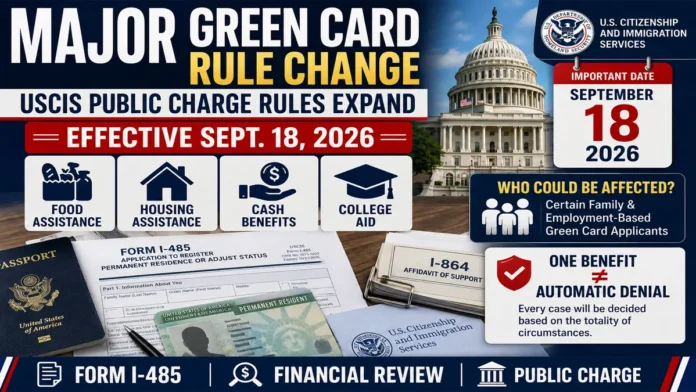
USCIS Public Charge Rule 2026 is set to bring one of the most consequential changes this year for certain immigrants seeking permanent residence in the United States, with a new public-charge framework taking effect on September 18, 2026.
U.S. Citizenship and Immigration Services has issued updated guidance allowing immigration officers to take a broader look at an applicant’s financial condition, ability to support themselves and use of certain means-tested government benefits when deciding whether the person is likely at any time to become a public charge.
The change could directly affect many family-based and employment-based applicants filing Form I-485, Application to Register Permanent Residence or Adjust Status, although major humanitarian and other protected immigration categories remain exempt.
USCIS says the policy applies to covered Form I-485 applications postmarked or electronically submitted on or after September 18, 2026.
The date creates a clear dividing line for applicants and could make September 18 one of the most closely watched immigration deadlines of 2026.
Why This USCIS Change Is a Major Immigration Development
The new guidance significantly broadens the range of information immigration officers may consider compared with the framework that has applied under the Biden-era 2022 public-charge regulation.
The Department of Homeland Security announced on July 16 that it was rescinding the 2022 rule. The rescission takes effect September 18, clearing the way for the updated USCIS adjudication framework.
Under the new guidance, officers will again exercise broader discretion while reviewing whether certain applicants seeking lawful permanent residence could become dependent on public assistance.
USCIS says the policy reflects Congress’s emphasis on immigrant self-sufficiency.
But critically, receiving a public benefit does not automatically mean a green card application will be denied.
Each case must be evaluated individually based on the totality of the applicant’s circumstances.
September 18 Is the Date Green Card Applicants Need to Watch
The most important date in the entire policy change is:
September 18, 2026
The updated guidance applies to covered adjustment-of-status applications filed on or after that date.
That means the timing of an application could matter because USCIS has established different rules for evaluating public benefits received before and after September 18.
Applicants should not assume that filing earlier automatically guarantees a particular immigration outcome, however. Eligibility and filing strategy depend on individual circumstances and applicable immigration law.
Public Benefits Received After Sept. 18 Could Receive Greater Scrutiny
One of the biggest changes involves means-tested public benefits.
For benefits received before September 18, 2026, USCIS says officers will generally consider only:
- Public cash assistance for income maintenance
- Long-term institutionalization at government expense
For means-tested benefits received on or after September 18, USCIS says officers may consider a substantially broader range of assistance.
Examples identified in the agency’s guidance include:
- Cash assistance for income maintenance
- Housing assistance
- Food stamps
- Financial aid for college
- Other similar means-tested benefits
The updated USCIS Policy Manual explains how officers are expected to incorporate such information into their public-charge analysis.
Does Receiving Food Stamps Mean Your Green Card Will Be Denied?
No.
This is one of the most important points for applicants to understand.
The new policy does not establish an automatic rule under which receiving food assistance, housing support or another public benefit immediately results in green-card denial.
Benefit use can instead become one element of a much broader assessment.
USCIS officers must examine the applicant’s overall circumstances before making a decision.
That broader review can include employment prospects, income, assets, education, health, household circumstances and financial sponsorship.
Five Major Factors USCIS Officers Must Review
Federal immigration law requires officers making a public-charge determination to consider five statutory factors.
1. Age
USCIS may consider whether an applicant’s age affects the person’s potential ability to work and remain financially self-sufficient.
2. Health
An applicant’s health can form part of the overall assessment.
A health condition alone does not automatically make someone inadmissible on public-charge grounds.
3. Family Status
Family size, household responsibilities and available support can be relevant.
4. Assets, Resources and Financial Status
USCIS can examine income, financial resources, assets and other indicators of economic stability.
5. Education and Skills
Education, training, professional qualifications and employment skills can help officers assess a person’s potential ability to support themselves.
USCIS says these factors must be considered together rather than treating a single factor as automatically decisive.
Form I-864 Could Become Especially Important
For many family-sponsored green card applicants, Form I-864, Affidavit of Support, is already a major component of the immigration process.
The document generally involves a qualifying sponsor agreeing to provide financial support to the immigrant.
USCIS officers may consider an applicable Form I-864 alongside the other circumstances in the public-charge assessment.
The new policy therefore makes accurate financial documentation particularly important for applicants who are legally subject to the public-charge ground.
Who Could Be Subject to the New Public Charge Review?
Many immigrants seeking adjustment of status may be subject to public-charge inadmissibility unless a statutory exemption applies.
Potentially affected family-based categories include certain:
- Spouses of U.S. citizens
- Children and parents of U.S. citizens
- Adult sons and daughters of U.S. citizens
- Spouses and children of lawful permanent residents
- Brothers and sisters of U.S. citizens
- Fiancé(e)s of U.S. citizens
Employment-based categories can also be subject to the public-charge provision.
They include certain:
- Priority workers
- Advanced-degree professionals
- Individuals of exceptional ability
- Skilled workers
- Other workers
- Investors
- Religious workers
The precise immigration category matters, and applicants should not assume that the rule applies identically to every person seeking permanent residence.
Who Is Exempt From the Public Charge Ground?
A major portion of the immigrant population covered by humanitarian protections is exempt.
USCIS lists categories including:
- Refugees
- Asylees
- Certain Afghan and Iraqi special immigrants
- Special Immigrant Juveniles
- T nonimmigrants who are trafficking victims
- U nonimmigrants who are victims of qualifying crimes
- Certain Violence Against Women Act self-petitioners
- Certain battered immigrants
- Applicants in specified Cuban and Haitian categories
- Certain qualifying Central American applicants
- Some military-family survivors
- Certain other congressionally protected groups
That means headlines suggesting the new policy applies to every immigrant or every green card applicant would be inaccurate.
Public Charge Bond Could Offer a Path in Some Cases
The updated rules also revive attention on another immigration mechanism: the public charge bond.
If a USCIS officer determines that an applicant is inadmissible only because the applicant is likely to become a public charge, the officer may provide an opportunity to post a bond.
The bond acts as a financial guarantee tied to the applicant’s future public-charge obligations.
USCIS maintains Form I-945, Public Charge Bond, for this process.
How Much Could a Public Charge Bond Be?
There is no universal amount that applies to everyone.
Under the updated guidance, the officer may consider the amount of government assistance an applicant could potentially become eligible to receive during the following five years when determining an appropriate bond.
That means bond amounts could differ substantially between cases depending on the individual’s circumstances.
Applicants Cannot Simply File a Bond on Their Own
This point is especially important.
An applicant should not simply submit Form I-945 voluntarily because they are concerned about public charge.
USCIS says the form may be submitted when the agency specifically provides the applicant an opportunity to post a public-charge bond.
The bond process is therefore controlled by USCIS rather than being a preventive filing applicants can automatically make on their own.
Why the Rule Could Affect Immigration Decisions Far Beyond Public Benefits
Although much attention is focused on food and housing assistance, the new policy is broader than public-benefit history.
An officer could consider whether the applicant has:
- Stable employment
- Sufficient income
- Financial assets
- Marketable job skills
- Strong educational qualifications
- Adequate financial sponsorship
- Family support
- Health circumstances affecting financial independence
The result is a highly individualized assessment.
Two applicants who received similar benefits could potentially have different outcomes because their wider financial and personal circumstances differ.
2022 Biden-Era Public Charge Regulation Is Being Rescinded
The policy change follows DHS’s decision to formally rescind the public-charge regulation issued during the Biden administration in 2022.
USCIS announced the rescission in July 2026 and said the previous framework unnecessarily restricted officers’ ability to consider information relevant to public-charge determinations.
The rescission and accompanying policy guidance mark a substantial Trump administration shift in immigration adjudication.
Why the Rule Is Likely to Draw National Attention
The public-charge issue has been one of the most politically and legally sensitive areas of U.S. immigration policy for years.
Changes can affect decisions made by immigrant families about:
- Applying for government assistance
- Sponsoring relatives
- Filing adjustment-of-status applications
- Preparing financial documents
- Seeking professional immigration advice
They can also create confusion because statutory exemptions mean different immigrant groups are treated differently.
USCIS’s September 18 implementation date now gives immigrants, attorneys and advocacy organizations a defined timeline for understanding the new framework.
A Broader Review Does Not Equal Automatic Rejection
For Google Discover readers and applicants alike, this distinction deserves emphasis:
Public benefit use is not automatically a green card disqualifier.
USCIS says officers will make individual determinations based on the totality of circumstances.
That means no single benefit, financial condition or personal characteristic should be interpreted in isolation as guaranteeing approval or denial.
Green Card Applicants May Need to Recheck Their Filing Plans
Applicants preparing Form I-485 filings around September 18 should carefully check the USCIS website for:
- Current Form I-485 editions
- Updated filing instructions
- Public-charge questions
- Required financial documentation
- Form I-864 requirements
- New Policy Manual guidance
Because immigration filing rules can change quickly, using outdated forms or relying on old public-charge information could create avoidable problems.
Applicants with complicated benefit histories or financial circumstances may also consider speaking with a qualified U.S. immigration attorney or DOJ-accredited representative before making filing decisions.
Key Dates: USCIS Public Charge Changes
July 16, 2026: DHS announces rescission of the 2022 public-charge regulation.
July 20, 2026: Final rule is formally published.
August 18, 2026: USCIS issues updated Policy Manual guidance.
September 18, 2026: New public-charge framework takes effect.
From September 18 onward: Covered Form I-485 applications postmarked or electronically submitted on or after the effective date are subject to the updated framework.
What This Means for Immigrants
For many green card applicants, the USCIS Public Charge Rule 2026 is not a minor procedural update.
It changes the framework officers will use when examining financial self-sufficiency and gives broader significance to certain means-tested public benefits received on or after September 18.
For applicants subject to public-charge inadmissibility, financial records, sponsorship evidence, employment, education, health and benefit history could all become part of a highly individualized review.
At the same time, refugees, asylees and numerous other protected categories remain exempt, and receipt of one public benefit does not automatically result in denial.
The central message is clear: September 18, 2026 marks a major change in U.S. green card adjudication, and applicants potentially covered by the public-charge ground should understand the new rules before filing.