WASHINGTON, D.C., United States | August 27, 2026 —
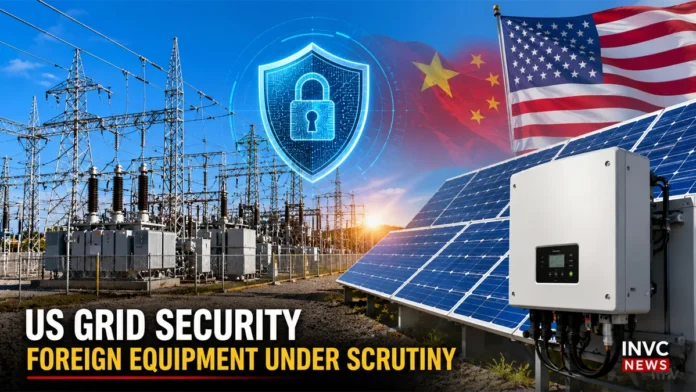
US power grid equipment ban has become a major cybersecurity and energy-security story after President Donald Trump declared a national emergency over risks linked to some foreign-produced equipment used in America’s bulk-power system.
The August 26 executive order creates a framework to prohibit the acquisition, import, transfer or installation of certain foreign-made electricity-grid equipment when U.S. authorities determine that the technology poses an unacceptable national-security, cybersecurity or supply-chain risk.
The order is broad enough to cover equipment including grid-connected inverters, battery energy-storage systems, transformers, generators, industrial-control systems, protective relays and associated software or remote-access capabilities.
However, one distinction is critical:
Trump has not imposed a blanket ban on Chinese solar panels or every foreign-made energy product.
The restrictions are risk-based and apply when the U.S. Energy Secretary determines that covered equipment is connected to a foreign entity of concern and presents an unacceptable threat.
What Did Trump’s Power Grid Order Actually Do?
Trump’s executive order declares foreign supply-chain vulnerabilities in the U.S. bulk-power system an “unusual and extraordinary threat” to national security, economic security and critical infrastructure.
The administration argues that modern electricity infrastructure increasingly depends on digitally connected equipment that can receive remote software updates, communicate over networks and control critical grid functions.
That creates a potential vulnerability if equipment is designed, manufactured or controlled by foreign entities considered hostile to U.S. interests.
Under the order, the government can restrict transactions involving equipment that poses risks such as:
- Unauthorized remote access
- Sabotage
- Malicious cyber activity
- Supply interruption
- Manipulation of grid operations
- Compromise of critical software or firmware
- Remote interference with infrastructure
Official White House executive order:
Which Power Equipment Is Covered?
The order provides an unusually detailed definition of equipment that can fall within the new security framework.
Examples include:
- Grid-connected power inverters
- Battery energy-storage systems
- Substation transformers
- High-voltage circuit breakers
- Large and small generators
- Backup generators
- Generation turbines
- Industrial-control systems
- Programmable logic controllers
- Protective relays
- Metering equipment
- Distributed-control systems
- Uninterruptible power systems supporting critical infrastructure
The government can also examine associated software, firmware, remote-access functions, maintenance systems and update mechanisms.
The bulk-power definition generally covers major transmission infrastructure, including transmission lines rated at 69 kilovolts or above.
Why Are Chinese Solar Inverters Getting Attention?
Solar inverters play a crucial role in renewable-energy infrastructure.
Solar panels produce direct-current electricity, while inverters convert it into alternating current that can be used by homes, businesses and electricity grids.
Modern inverters are increasingly connected to networks so operators can monitor performance, update software and remotely manage systems.
That connectivity creates significant operational advantages.
It can also create cybersecurity risks.
U.S. security concerns intensified after investigators examining some Chinese-manufactured solar inverters and batteries reportedly found undocumented communication components, including cellular radios that were not described in standard product documentation.
Security specialists warned that unauthorized communication channels could potentially bypass conventional network protections.
The number of affected devices was not publicly established, and the findings did not establish that every Chinese inverter posed such a risk.
Does Trump’s Executive Order Specifically Ban China?
No.
The text of the executive order does not announce a blanket prohibition on China or identify every Chinese manufacturer as banned.
Instead, it allows the Energy Secretary and other federal agencies to identify what the order calls Covered Foreign Entities.
The government can then determine which countries, companies, products or transactions require restrictions.
That means headlines saying:
“Trump bans all Chinese solar equipment”
would go beyond what the order currently says.
The more accurate description is:
Foreign-produced grid equipment that presents a national-security risk can now be prohibited or restricted, while Chinese-made inverters are among the technologies receiving heightened scrutiny.
Existing Equipment Could Also Face Restrictions
The order does not focus only on future purchases.
If authorities identify unacceptable risks in foreign-produced equipment already installed in the U.S. electricity system, the Energy Secretary can impose conditions on its continued operation.
Possible actions can include requirements to:
- Identify equipment
- Monitor it
- Isolate it
- Strengthen cybersecurity controls
- Restrict remote access
- Disconnect it
- Replace or remove it
However, before ordering isolation or removal, officials are instructed to consider power-grid reliability, safety, availability of replacement equipment and continuity of essential services.
That safeguard is important because suddenly removing large amounts of operating grid hardware could itself create an electricity-supply problem.
New Rules Are Due Within 120 Days
The executive order gives the Energy Secretary 120 days to publish implementing rules or regulations as needed.
Those rules could identify:
- Covered countries
- Covered companies
- High-risk equipment
- Security requirements
- Licensing procedures
- Exemptions
- Approved vendors
The government may also establish a list of equipment or suppliers that have been pre-qualified for future transactions.
That means the August 26 order creates the framework, while many of the practical details will emerge later.
Why Is the US Acting Now?
Electricity demand in the United States is rising rapidly.
The White House specifically points to growth in:
- Artificial intelligence
- Data centers
- Advanced manufacturing
- Defense production
All of those sectors require enormous amounts of reliable electricity.
A successful cyberattack or coordinated disruption affecting transformers, inverters, batteries or industrial controls could therefore cause significantly more economic damage than in the past.
The administration is also concerned about supply-chain dependence.
If critical components are sourced overwhelmingly from another country, geopolitical conflict or trade disruption could make replacements difficult to obtain.
AI Data Centers Make Grid Security More Important
The rapid expansion of artificial-intelligence infrastructure has turned power availability into one of the biggest constraints facing the global technology industry.
AI data centers consume enormous amounts of electricity and require extremely reliable power systems.
That means cybersecurity involving electricity networks is increasingly connected to AI policy and economic competitiveness.
Also Read – : India, US Deepen Semiconductor and AI Partnership in Washington Talks on Supply Chains and Critical Minerals
For Washington, securing the power grid is therefore becoming part of the wider competition over AI, semiconductor production and strategic manufacturing.
Could This Hurt the US Solar Industry?
Potentially.
Chinese companies are major manufacturers of solar, battery and power-electronics components.
If the U.S. excludes additional suppliers or equipment, utilities and renewable-energy developers may have fewer sourcing options.
That could create:
- Higher equipment costs
- Longer procurement timelines
- Pressure on project economics
- Demand for alternative suppliers
- Greater investment in U.S. manufacturing
But the effect will depend heavily on which products and vendors are ultimately restricted.
Because the executive order is risk-based rather than an immediate universal import ban, the full commercial impact cannot yet be calculated.
Is This About Solar Energy or Cybersecurity?
Primarily cybersecurity and national security.
The order does not prohibit solar power.
It does not say renewable energy itself is a security threat.
Instead, the administration is focusing on who controls the digital equipment connecting generation assets to the grid.
Solar inverters happen to be particularly important because they increasingly include sophisticated software, communications systems and remote-control capabilities.
Battery-storage systems present similar concerns.
Also Read – : Renewable Energy Stocks 2026: Adani Green, Tata Power and Suzlon Lead India’s 500 GW Clean Energy Push
Could India Benefit From the Supply-Chain Shift?
Potentially—but this remains a longer-term opportunity rather than an immediate consequence of the order.
If the United States increasingly demands trusted, diversified suppliers for grid hardware, manufacturers outside China could gain opportunities in areas such as:
- Power electronics
- Inverters
- Transformers
- Battery systems
- Electrical components
- Grid-control equipment
India is already trying to expand domestic manufacturing across renewable-energy, electronics and power-equipment supply chains.
However, gaining access to U.S. critical-infrastructure markets would require strong cybersecurity standards, trusted software architecture and compliance with future American procurement rules.
What Happens Next?
Three deadlines and decisions will now matter.
1. Energy Department Rules
Within 120 days, the administration is expected to begin defining how the restrictions will operate.
2. High-Risk Vendor and Equipment Identification
Authorities may identify specific products, suppliers or countries requiring greater scrutiny.
3. Federal Procurement Changes
The order directs the Energy Department to develop recommendations within 180 days for changes to federal procurement rules designed to prioritize secure and U.S.-manufactured energy infrastructure.
Those decisions will show whether the order produces targeted restrictions or develops into a much broader supply-chain shift.
What the Trump Power Grid Order Does — and Does Not Do
It does:
Allow the United States to block certain high-risk foreign grid equipment.
Cover grid-connected inverters and battery-storage systems.
Include software, firmware and remote-access capabilities.
Allow restrictions on some previously installed equipment.
Create a mechanism for approved or pre-qualified vendors.
Give the Energy Department authority to develop detailed implementation rules.
It does not:
Ban every foreign energy product automatically.
Ban all Chinese solar panels.
Prohibit solar-power generation.
Order immediate removal of every Chinese inverter.
Identify every foreign manufacturer as a security threat.
Why This Story Matters Beyond the United States
Electricity infrastructure is becoming digital infrastructure.
A modern inverter or battery system is no longer simply an electrical device.
It can contain software, wireless connectivity, remote administration and continuous communication with operators.
That means the global clean-energy transition is creating a new cybersecurity challenge:
Countries must decide not only where their electricity comes from, but who controls the technology connecting that electricity to the grid.
Trump’s new order makes that question a formal national-security issue for the United States.
And because China dominates large parts of the global solar and power-electronics supply chain, the biggest commercial and geopolitical consequences could eventually be felt far beyond America.