By Team INVC | INVC NEWS
GENEVA, Switzerland | September 18, 2026 —
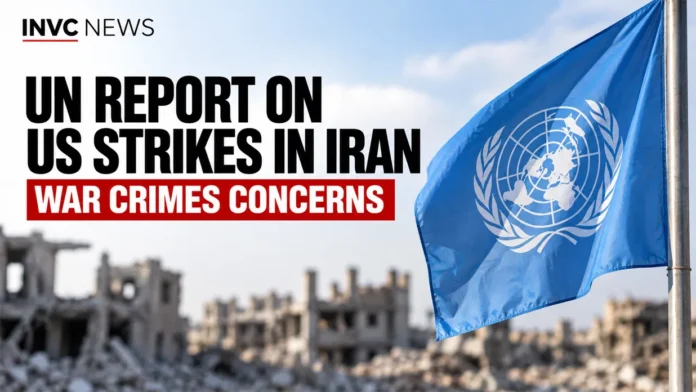
A United Nations-backed fact-finding mission has said there are “reasonable grounds to believe” that US forces committed war crimes in two February strikes in Iran, including an attack on a primary school in Minab and another on a sports complex and residential area in Lamerd.
The Independent International Fact-Finding Mission on Iran said the two attacks were indiscriminate and caused extensive civilian casualties. At least 178 civilians were killed across the two incidents, according to the mission’s findings and related reporting.
The same report also concluded that Iranian authorities committed crimes against humanity during their crackdown on anti-government protests, citing alleged unlawful killings, torture, arbitrary detention, enforced disappearances and other abuses.
The findings place both Washington and Tehran under renewed scrutiny ahead of their presentation to the UN Human Rights Council in Geneva.
Minab School Strike at the Centre of UN Findings
The most serious finding concerns the Shajareh Tayyebeh Primary School in Minab, southern Iran.
The mission said it had reasonable grounds to believe US forces were responsible for the February 28 strike.
More than 150 people were killed, including about 120 schoolchildren, according to figures cited in the UN investigation and Iranian official accounts.
Investigators described the school as a clearly identifiable civilian object and said they found no evidence that it was being used for military purposes.
The school stood near an Islamic Revolutionary Guard Corps naval complex, but the mission said US targeting information had not been adequately updated and the building’s status had not been sufficiently verified before the strike.
The report concluded that the failure went beyond simple negligence.
According to the mission, US forces proceeded despite a substantial risk that a civilian building would be struck.
UN Mission Says Attack Was Indiscriminate
Under international humanitarian law, parties to an armed conflict are required to distinguish between military targets and civilians or civilian objects.
The UN experts concluded that the Minab attack failed that standard and amounted to an indiscriminate attack causing civilian deaths and damage to civilian infrastructure.
On that basis, the mission said there were reasonable grounds to believe the strike constituted a war crime.
The mission’s finding is not a criminal conviction.
UN fact-finding missions are investigative bodies, not courts, and cannot themselves prosecute individuals.
Their evidence, however, can later be used by national courts or international judicial mechanisms where jurisdiction exists.
Second Strike in Lamerd Also Under Scrutiny
The report reached a similar conclusion over a strike in Lamerd, also on February 28.
Investigators said a US weapon hit a clearly identifiable sports complex and nearby residential area, damaging surrounding buildings and a school.
The mission said 22 civilians were killed or injured in the attack and concluded that the strike was indiscriminate.
US Central Command has previously denied that American forces carried out a strike in Lamerd on that day.
That disagreement is likely to become one of the central points of dispute when the report is examined at the Human Rights Council.
Pentagon Investigation Into Minab Has Not Been Made Public
The US government has not published final findings from its own investigation into the Minab school strike.
President Donald Trump said in June that the school had not been intentionally targeted.
Reuters previously reported that an initial US military inquiry indicated American forces were likely responsible for the strike, but the Pentagon subsequently elevated the investigation and has not publicly released its conclusions.
The Pentagon said its investigation remains ongoing.
White House Rejects UN Report
The White House strongly rejected the fact-finding mission’s conclusions.
White House spokesperson Anna Kelly criticised the UN Human Rights Council and said Iran was the party responsible for war crimes in the conflict.
The US State Department also rejected the credibility of the report and pointed to the Trump administration’s withdrawal from the Human Rights Council.
US officials have consistently maintained that American military operations are conducted in accordance with the law of armed conflict.
Report Also Accuses Iran of Crimes Against Humanity
The fact-finding mission did not limit its investigation to US military conduct.
It also examined the Iranian government’s response to nationwide protests that began in late 2025.
The mission said Iranian authorities carried out a widespread and systematic attack against civilians involving alleged unlawful killings, imprisonment, torture, arbitrary detention, enforced disappearances and severe restrictions on freedom of expression.
Investigators concluded that several of those acts amounted to crimes against humanity.
Iran has repeatedly rejected allegations that its security forces systematically violated human rights and has blamed foreign-backed groups and what it describes as terrorists and rioters for violence during the unrest.
UN Says Official Iranian Death Toll May Understate Protest Casualties
Iranian authorities have reported more than 3,000 deaths and about 25,000 injuries linked to the unrest.
The UN mission said it could not independently verify those figures and believed the actual number of people killed and injured may be significantly higher.
The report described the scale of killings and repression as a major escalation compared with previous crackdowns.
How the UN Investigation Was Conducted
The fact-finding mission was created by the UN Human Rights Council and is composed of independent experts.
Its latest report drew on interviews with 73 people, as well as satellite imagery, photographs, video, documents and information supplied by organisations and specialists.
Investigators said both access restrictions and limited cooperation complicated the inquiry.
The mission said requests for information sent to both Iran and the United States went unanswered in key areas.
What ‘Reasonable Grounds to Believe’ Means
The phrase used by the UN mission is important.
“Reasonable grounds to believe” is an evidentiary standard used by UN investigative bodies.
It means investigators believe the verified information available is sufficient for a reasonable observer to conclude that the alleged conduct likely occurred and meets the relevant legal elements.
It is not equivalent to a judgment by a criminal court.
A final legal determination of individual criminal responsibility would require a competent judicial body.
Why the Report Matters
The report adds a formal UN-backed legal assessment to disputes surrounding civilian casualties in the February war involving the United States, Israel and Iran.
The Minab strike is especially significant because of the large number of children killed and because investigators concluded the school itself was the intended point of impact rather than accidental collateral damage.
The United States rejects that conclusion, while its own military investigation remains unpublished.
The report therefore leaves a major legal and diplomatic dispute unresolved.
It does, however, establish a detailed record that could be cited in future accountability proceedings.
Findings Now Head to UN Human Rights Council
The mission is expected to formally present its findings to the UN Human Rights Council in Geneva.
Member states will then debate the report and the conduct of both the United States and Iran.
The fact-finding mission has called for violations to end and for victims to receive reparations.
Its central conclusion is stark: Iranian civilians were caught between alleged serious violations committed by their own government and unlawful attacks during the international conflict.
For Washington, the report raises new questions over targeting procedures and civilian protection.
For Tehran, it reinforces existing scrutiny over its treatment of protesters.
And for the families affected by the Minab and Lamerd strikes, the UN findings create an international record of allegations that may remain legally significant long after the current conflict ends.