WASHINGTON / OTTAWA | AUGUST 24, 2026
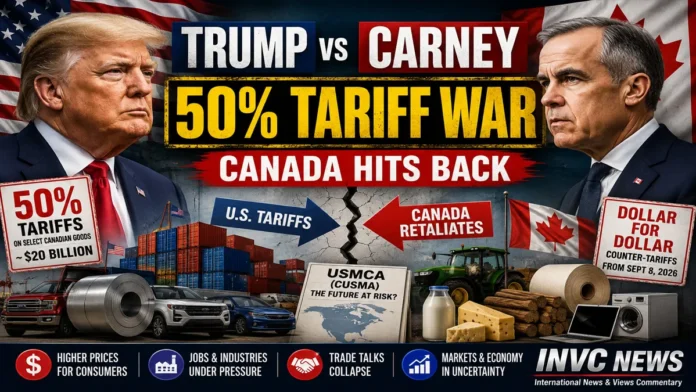
The US Canada trade war 2026 has entered a far more dangerous phase after President Donald Trump’s administration imposed additional 50% tariffs on roughly C$28 billion, or about US$20 billion, worth of selected Canadian goods following the collapse of intensive trade negotiations.
Canadian Prime Minister Mark Carney responded by suspending negotiations, ordering Canadian negotiators back to Ottawa and announcing that Canada would match Washington’s new duties dollar for dollar.
The Canadian counter-tariffs are expected to come into force on September 8, 2026, the Tuesday after Labour Day.
The confrontation is no longer just another disagreement over customs duties. It is becoming a major political test for both Trump and Carney while raising fresh questions about jobs, consumer prices, steel, automobiles, dairy, manufacturing and the future stability of North American trade.
However, one point needs to be clear: the United States has not imposed a blanket 50% tariff on every Canadian product.
The new duties apply to a selected group of imports worth roughly US$20 billion.
Why Did US-Canada Trade Talks Collapse?
Canada and the United States appeared close to a compromise only days before the negotiations broke down.
Washington had temporarily postponed implementation of the new 50% tariffs until the end of August 21 to give negotiators more time.
The discussions were aimed at reducing uncertainty across several strategically important sectors, including steel, aluminum and automobiles.
However, Carney said last-minute changes in Washington’s proposed terms made the agreement unacceptable to Canada.
He described the revised conditions as unfair and uneconomic and said they raised questions about whether any agreement reached under those conditions would provide sufficient stability.
Carney subsequently suspended the talks and called Canada’s negotiating team home.
That decision transformed what had been an intensive negotiation into a full-scale political and economic confrontation.
Which Canadian Goods Face the New 50% US Tariff?
The latest tariffs do not cover all Canadian exports to the United States.
They apply to a specified group of goods targeted under Section 338 of the U.S. Tariff Act of 1930.
Canadian officials have said the affected industries range from products such as:
- Hockey equipment
- Clothing
- Cement
- Beer
- Selected manufactured goods
- Other products included in the U.S. tariff action
The total value involved is roughly C$28 billion, equivalent to around US$20 billion.
This distinction matters because Canada and the United States have one of the largest trading relationships in the world.
The new 50% tariff is substantial, but it should not be described as a 50% tax on every Canadian export entering the United States.
Why Did Trump Target Canada?
The Trump administration argues that Canada has engaged in discriminatory trade practices against American exporters.
U.S. Trade Representative Jamieson Greer has specifically pointed to disputes involving American alcohol, dairy products and automobiles.
Washington argues that Canadian provinces restricted access for U.S. alcohol products, while American dairy producers face disadvantages compared with some European exporters.
The Trump administration has also objected to Canadian limits affecting U.S. vehicle exports.
Washington has framed the additional tariffs as part of President Trump’s broader strategy of seeking reciprocal and what the administration describes as fairer trading relationships.
That broader strategy is affecting countries far beyond Canada.
India, too, has been engaged in difficult tariff negotiations with Washington. INVC previously reported how India-US trade deal negotiations remain tied to securing better tariff advantages for Indian exporters.
The Canada dispute therefore fits into a much larger transformation of U.S. trade policy under Trump.
Mark Carney Announces Dollar-for-Dollar Retaliation
Canada is not preparing to absorb the new tariffs without responding.
Carney has announced that Ottawa will match Washington’s latest tariff action dollar for dollar.
The retaliatory measures are expected to focus on sectors including:
- Steel
- Dairy
- Household appliances
- Agricultural equipment
- Pulp and paper
- Electronics
- Products already affected by certain U.S. sectoral tariffs
Detailed product lists are expected separately.
The new Canadian counter-tariffs are scheduled to take effect on September 8.
Carney has acknowledged that retaliation carries economic costs.
Tariffs can increase prices and reduce consumer choice even when they are imposed as a response to another country’s trade restrictions.
Nevertheless, the Canadian government argues that retaliatory measures are necessary to defend domestic workers, farmers and businesses.
Who Actually Pays a Tariff?
This is one of the most misunderstood parts of any trade war.
When the United States imposes a tariff on goods entering the country, the foreign government does not normally write a check directly to Washington.
The tariff is generally collected from the importer bringing the product into the United States.
That importer then has several choices.
It can absorb the additional cost.
It can negotiate a lower price with its Canadian supplier.
It can switch to a different supplier.
Or it can pass some or all of the higher cost to businesses and consumers.
This is why tariffs can ultimately affect prices inside the country imposing them.
The same principle applies to Canadian retaliatory tariffs on U.S. products.
Will American Consumers Pay More?
Potentially, yes.
The extent of the impact will depend on the product and whether alternative suppliers are available.
A 50% additional tariff creates a major cost increase at the border.
Businesses that rely on specialized Canadian products may not be able to replace those suppliers immediately.
Therefore, some industries could face higher input costs.
Those costs can eventually influence retail prices.
However, the consumer impact will vary greatly by product.
Products with abundant domestic or foreign alternatives may see less pressure than specialized goods that depend heavily on integrated U.S.-Canadian supply chains.
Why Steel and Aluminum Are So Important
Steel and aluminum have been among the most politically sensitive sectors throughout the Trump-Carney negotiations.
The two economies have deeply integrated industrial supply chains.
Materials and components can cross the border multiple times before a finished product reaches a consumer.
As a result, tariffs imposed at one stage of production can raise costs elsewhere in the manufacturing chain.
Automobiles are a particularly clear example.
A vehicle assembled in the United States may contain components made in Canada, Mexico and the United States.
New trade barriers can therefore affect manufacturers on both sides of the border.
Could the US-Canada Trade War Hit Auto Prices?
The automobile industry is one of the biggest areas to watch.
During negotiations, the two sides discussed possible changes to existing tariffs affecting Canadian-built vehicles.
But the broader disagreement remained unresolved.
The North American auto sector operates through highly integrated supply chains.
Engines, transmissions, electronics, metals and other components often move across national borders during production.
Tariffs can therefore create costs at several points in the supply chain.
That increases pressure on manufacturers to absorb the expense, reorganize sourcing or eventually raise prices.
Is USMCA — or CUSMA — Now Dead?
No.
The current trade war does not mean the United States-Mexico-Canada Agreement has automatically ended.
The agreement is known as USMCA in the United States and CUSMA in Canada.
Canada says the agreement remains fully in force until 2036.
However, the relationship is under severe strain.
The first major joint review of the agreement took place in 2026, and trade officials have been discussing how to modernize the framework.
Issues include:
- Automobiles
- Steel and aluminum
- Agriculture
- Rules of origin
- Economic security
- Supply-chain resilience
- Digital trade
- Industrial competitiveness
The latest tariff confrontation could make those negotiations substantially more difficult.
Trump-Carney Showdown Becomes a Political Battle
For Mark Carney, the dispute has become much more than a technical trade negotiation.
He has increasingly framed Canada’s response in terms of economic independence and sovereignty.
Carney says Canada must reduce its vulnerability to a single market and accelerate efforts to build new international trade relationships.
Canada remains heavily dependent on the United States as an export destination.
That makes any sustained breakdown in the relationship a major domestic political challenge.
At the same time, confronting Trump could strengthen Carney politically if Canadian voters view the government as defending national interests.
The opposite risk is equally real.
If tariffs produce factory closures, job losses or substantially higher prices, political pressure on Ottawa could increase rapidly.
Trump’s Tariff Strategy Extends Far Beyond Canada
The dispute with Canada is part of a much larger restructuring of American trade policy.
Trump has repeatedly used tariffs as a negotiating instrument on issues ranging from industrial policy to national security.
China has been one of the most visible targets.
INVC’s analysis of the US-China trade war and the fragile Trump-Xi tariff truce shows how rapidly tariffs can rise before negotiations produce temporary relief.
Canada now faces a similar problem: companies must make long-term investment decisions even when tariff policies can change rapidly.
That uncertainty can itself become an economic cost.
Why Trade Wars Can Hurt Global Growth
The consequences are not confined to the countries directly imposing tariffs.
Trade wars can change investment decisions, redirect supply chains and increase business uncertainty globally.
Companies facing unpredictable tariffs may delay new factories or capital spending.
Importers may build larger inventories.
Manufacturers may search for suppliers in new countries.
Consumers can face higher prices.
Governments may then respond with subsidies or additional trade restrictions.
INVC previously reported on the OECD warning that escalating trade tensions could weaken global economic growth.
The latest U.S.-Canada confrontation adds another significant source of uncertainty to that outlook.
Can Canada Reduce Its Dependence on the US?
That is now at the center of Carney’s economic strategy.
Canada is trying to diversify export markets while accelerating major domestic infrastructure projects.
Carney argues that Canada has preferential trade access to roughly 1.5 billion consumers through existing agreements and wants to expand that reach further.
The government is also seeking to remove internal trade barriers between Canadian provinces and strengthen domestic supply chains.
However, replacing the U.S. market would be extraordinarily difficult.
Geography, infrastructure and decades of economic integration have made the United States Canada’s dominant trading partner.
Diversification can reduce risk, but it cannot rapidly recreate the scale of the U.S.-Canada commercial relationship.
Could India Benefit From the US-Canada Trade War?
There could be opportunities, but the outcome is not automatic.
When tariffs make products from one country more expensive, U.S. or Canadian importers may look for alternative suppliers.
That could potentially create openings for competitive exporters in countries such as India.
Possible areas worth watching include:
- Textiles and apparel
- Engineering goods
- Machinery
- Auto components
- Chemicals
- Electronics
- Selected agricultural products
However, Indian exporters would still need to meet pricing, quality, logistics and regulatory requirements.
Moreover, India is itself negotiating tariff issues with the Trump administration.
Therefore, New Delhi cannot assume that trade diversion from Canada will automatically translate into gains for Indian businesses.
Still, companies should watch changes in North American sourcing patterns closely.
Could This Trade War Cost Jobs?
Yes, particularly if it persists.
Industries most exposed to cross-border trade may face lower demand or higher costs.
That can affect employment in manufacturing communities.
Possible pressure points include:
- Steel mills
- Auto plants
- Agricultural businesses
- Beverage producers
- Logistics companies
- Machinery manufacturers
- Retailers dependent on imported products
The final employment impact will depend on how long the tariffs remain in place and whether businesses can redirect sales or suppliers.
A short dispute followed by negotiations would have a very different economic effect from a multi-year trade war.
What Happens Next?
Four developments now matter most.
1. Canada’s Final Retaliatory Tariff List
Ottawa is expected to provide further details on the U.S. products that will face counter-tariffs.
Those duties are scheduled to begin September 8.
2. Whether Trump and Carney Restart Negotiations
Carney has suspended talks, but suspension does not necessarily mean negotiations are permanently over.
Economic pressure on businesses in both countries could eventually push the governments back to the negotiating table.
3. Steel, Autos and Aluminum
These strategic sectors remain central to any potential future agreement.
Progress here could significantly reduce broader trade tensions.
4. The Future of USMCA/CUSMA
The trade agreement remains in force.
However, the latest confrontation will test whether North America’s integrated trade system can continue functioning smoothly while its two largest economies exchange major tariffs.
US Canada Trade War 2026: What Consumers Should Watch
Consumers do not need to monitor every customs announcement.
A few indicators will reveal whether the dispute is becoming economically serious.
Watch for:
- Higher prices on tariffed goods
- New factory layoffs
- Automobile price changes
- Steel and aluminum costs
- Canadian dollar movements
- Changes in cross-border tourism and shopping
- Supply-chain disruptions
- Additional retaliatory tariffs
- A restart of formal negotiations
If tariffs expand beyond the current list, the economic impact could become much larger.
Are All Canadian Goods Facing a 50% Tariff?
No.
This is the most important fact for readers to understand.
The latest U.S. measure imposes an additional 50% tariff on a selected group of Canadian imports worth roughly US$20 billion.
It is not a blanket 50% tariff on every Canadian product entering the United States.
That distinction should remain clear as political rhetoric intensifies.
When Do Canada’s Counter-Tariffs Start?
Canada has said its new dollar-for-dollar countermeasures will come into effect on September 8, 2026.
The detailed product list will determine which U.S. industries face the greatest exposure.
Is a New US-Canada Trade Deal Still Possible?
Yes.
Trade negotiations frequently collapse before restarting when economic or political pressure increases.
At present, however, Canada has suspended the talks and brought its negotiators home.
No new comprehensive agreement has been announced.
The next breakthrough would likely require movement on the most difficult issues, including automobiles, steel, aluminum and market-access rules.
US Canada Trade War 2026: The Bottom Line
The US Canada trade war 2026 has moved from negotiation to retaliation.
President Trump’s additional 50% tariffs on approximately US$20 billion of selected Canadian goods are now at the center of a rapidly escalating economic confrontation.
Prime Minister Mark Carney has responded by suspending negotiations and preparing dollar-for-dollar counter-tariffs beginning September 8.
Neither side can easily escape the economic consequences.
Canada depends heavily on access to the enormous U.S. market, while American manufacturers, retailers and consumers depend on deeply integrated Canadian supply chains.
The next question is therefore not simply whether Trump or Carney wins the political confrontation.
It is whether economic pressure eventually forces both countries back to the negotiating table — or pushes North America into a longer and more expensive trade war.