By Team INVC | INVC NEWS
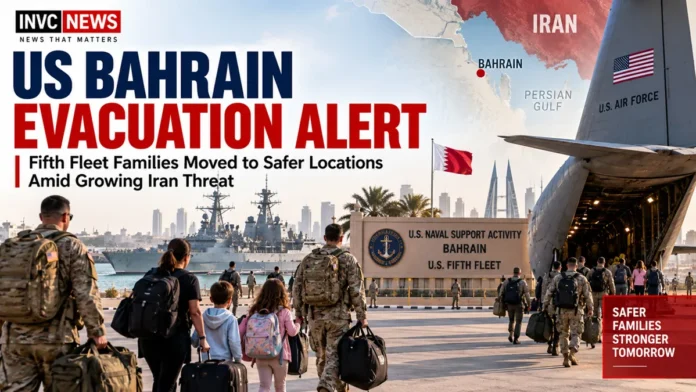
MANAMA, Bahrain | September 19, 2026 — Security concerns around America’s strategically vital military presence in Bahrain remain high as U.S. authorities continue emergency relocation and support arrangements for families linked to government and military personnel stationed near the headquarters of the U.S. Navy’s Fifth Fleet.
The situation should not be described simply as a brand-new Pentagon evacuation plan.
The United States had already ordered non-emergency government personnel and eligible family members to leave Bahrain in March 2026 after the conflict with Iran sharply increased the risk of drone and missile attacks across the Gulf. Around 1,300 dependents connected with Naval Support Activity Bahrain were subsequently evacuated, and many have still not been cleared to return because of continuing security concerns.
Why Bahrain Matters to the United States
Bahrain hosts Naval Support Activity Bahrain, home to U.S. Naval Forces Central Command and the U.S. Fifth Fleet.
The Fifth Fleet oversees American naval operations across a vast strategic area that includes the Arabian Gulf, Gulf of Oman, Red Sea, Arabian Sea and some of the world’s most important maritime chokepoints, including the Strait of Hormuz and Bab al-Mandeb.
That makes Bahrain one of America’s most important military hubs in the Middle East.
Any deterioration in the security situation around Manama therefore has implications far beyond Bahrain itself.
Families Were Already Ordered Out in March
The U.S. State Department ordered non-emergency government employees and family members of government personnel to leave Bahrain on March 2, 2026.
The decision followed the outbreak of direct hostilities between the United States and Iran and growing concern about Iranian missile and drone strikes against American interests in the region.
The State Department currently maintains a Level 3 — Reconsider Travel advisory for Bahrain because of terrorism and armed conflict.
The advisory specifically warns of an ongoing threat of Iranian drone and missile attacks.
Around 1,300 Navy Dependents Were Evacuated
The evacuation also affected families connected with the U.S. Navy’s major Bahrain installation.
Military Times reported in September that approximately 1,300 dependents had been evacuated from Naval Support Activity Bahrain.
More than six months later, some families remained unable to return to collect belongings, vehicles and other personal property because military authorities continued to assess the security environment as unsafe for unrestricted return.
That shows the evacuation was not merely a short-term precaution.
Its effects are still being felt months later.
Pentagon Issued New Support Guidance
The Pentagon has continued updating relocation and support arrangements for military families affected by the Bahrain evacuation.
An August 27 memorandum issued by senior Defense Department officials provided new guidance on planning, logistics, relocation options and government assistance for families who had been forced to leave Bahrain earlier in the year.
The memo reflected the continuing consequences of the evacuation rather than the launch of an entirely new departure order.
That distinction is important for accurate reporting.
Iran Has Already Hit U.S. Facilities in Bahrain
Security concerns are not hypothetical.
A recent U.S. government watchdog report found that Iranian strikes damaged or destroyed hundreds of buildings and structures at American military facilities across the Middle East, including in Bahrain.
The conflict also caused substantial damage to U.S. diplomatic facilities and forced Washington to spend heavily on emergency response and evacuations.
The same regional confrontation has pushed U.S. military planners to reconsider supply routes, force protection and the safety of personnel stationed near Iranian strike capability.
Fifth Fleet Headquarters Is Strategically Critical
The U.S. Fifth Fleet headquarters in Bahrain coordinates naval operations across approximately 2.5 million square miles of water.
Its area of responsibility includes three of the most strategically important maritime routes in the world: the Strait of Hormuz, the Suez Canal and Bab al-Mandeb.
Those waterways are critical for global oil, LNG and commercial shipping.
That makes Bahrain especially sensitive during any confrontation involving Iran.
An attack on U.S. military infrastructure there could affect both regional security and global energy markets.
American Families Still Face Restrictions
Although the State Department began easing some embassy staffing restrictions in several Middle Eastern countries in late August, the process has been gradual.
AP reported that U.S. diplomats and some family members were only slowly beginning to return to posts including Bahrain, with staffing remaining below normal levels.
The current U.S. travel advisory also restricts family access.
Only family members aged 18 or older may currently accompany U.S. government employees serving in Bahrain, according to the State Department.
US Embassy Warns of Possible Escalation
The U.S. Embassy in Manama has continued warning American citizens that the regional security environment remains unpredictable.
A September security alert reminded Americans that Iran had previously targeted civilian infrastructure in Bahrain and warned about potential flight cancellations, airspace closures and other travel disruptions.
Washington continues to advise citizens in the Middle East to maintain contingency plans and monitor official security alerts.
Why This Matters Now
The Bahrain situation is important because U.S. officials remain concerned about Iran’s ability to target American military assets in Gulf countries.
Iran has already demonstrated that bases hosting U.S. forces are potential targets during the conflict.
Bahrain’s role as the headquarters of the Fifth Fleet makes it especially important to American regional military strategy.
That means the continued restrictions on military and diplomatic families provide a clear indication that Washington still considers the security environment serious.
Is a New Mass Evacuation Underway?
At present, there is no reliable evidence that Washington issued a completely new mass-evacuation order for Bahrain on September 19.
The verified situation is more nuanced.
The United States carried out an ordered departure earlier in 2026, evacuated large numbers of dependents, continues to restrict some returns, and has maintained relocation and emergency-support arrangements because the threat from the Iran conflict has not disappeared.
That is still a significant development.
But describing it as a newly activated evacuation of all American citizens would go beyond the available evidence.
Bahrain Remains a Key Flashpoint
For Washington, Bahrain presents a difficult balance.
The United States needs the Fifth Fleet headquarters to maintain maritime operations across the Gulf and surrounding waters.
At the same time, the presence of thousands of military personnel, government employees and their families creates a major protection challenge during an active conflict with Iran.
For now, the message from U.S. authorities remains clear: Bahrain continues to be a strategically essential base—but also a location where the security threat is serious enough to keep family movements and government staffing under tight restrictions.