Dateline: New Delhi, India — August 20, 2026
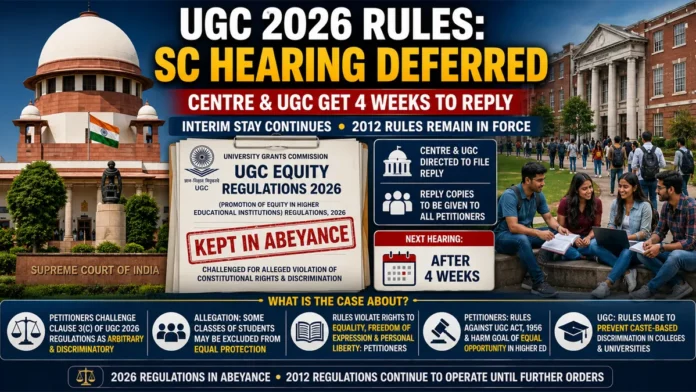
UGC Equity Regulations 2026 will remain under judicial scrutiny after the Supreme Court on Thursday deferred further hearing on petitions challenging the new anti-discrimination framework for higher educational institutions and directed the Centre and the University Grants Commission to submit their responses.
The court also directed that copies of the responses be supplied to all petitioners after lawyers complained that they had not received the Centre and UGC’s replies. The matter is expected to come up again after four weeks.
The development means the legal uncertainty surrounding the University Grants Commission (Promotion of Equity in Higher Education Institutions) Regulations, 2026 continues. The Supreme Court had earlier directed that the regulations be kept in abeyance, while allowing the previous 2012 framework to remain operational until further orders.
Supreme Court Seeks Centre and UGC Responses
During Thursday’s proceedings, petitioners told the Supreme Court that copies of responses filed or proposed to be filed by the Centre and UGC had not been made available to them.
The court directed the respondents to complete the process and ensure that their replies are served on all parties.
With pleadings still requiring completion, the bench deferred substantive consideration of the constitutional challenge and scheduled the case for further hearing after four weeks.
The petitions concern the validity of provisions in the UGC Equity Regulations 2026, particularly the definition of caste-based discrimination.
What Are the UGC Equity Regulations 2026?
The University Grants Commission officially notified the University Grants Commission (Promotion of Equity in Higher Education Institutions) Regulations, 2026 on January 13, 2026.
According to the UGC, the rules were designed to combat discrimination in colleges and universities and promote equity and inclusion among students, faculty and other stakeholders.
The regulations apply to higher educational institutions across India and address discrimination based on factors including religion, race, gender, place of birth, caste and disability.
The official regulations are listed on the UGC website:
UGC Regulations — Official Website
Why Has Clause 3(c) Been Challenged?
Much of the legal controversy centers on Clause 3(c), which defines “caste-based discrimination.”
The petitioners argue that the definition is restrictive and exclusionary because it specifically addresses caste or tribe-based discrimination against members of the Scheduled Castes, Scheduled Tribes and Other Backward Classes.
Their case is that people belonging to non-reserved or general categories could be left without the same specific statutory remedy even if they allege caste-based discrimination or institutional bias.
In its January 29, 2026 order, the Supreme Court recorded this argument while identifying several constitutional questions requiring detailed examination.
The court observed at the preliminary stage that some provisions contained ambiguities and that the possibility of misuse required examination.
Supreme Court Had Put 2026 Regulations on Hold
The Supreme Court’s earlier intervention remains critical to the current case.
On January 29, the court directed that the entire UGC Equity Regulations 2026 be kept in abeyance while their constitutional validity is examined.
The court simultaneously invoked its powers under Article 142 of the Constitution to ensure that the older UGC (Promotion of Equity in Higher Educational Institutions) Regulations, 2012 remain operational.
That means universities and colleges have not been left without an anti-discrimination framework while the 2026 regulations are under judicial review.
What Questions Did the Supreme Court Raise?
The Supreme Court identified several issues that require closer examination.
One concerns whether Clause 3(c)’s definition of caste-based discrimination has a rational connection with the wider objectives of the regulations.
Another involves whether the regulations provide adequate safeguards for different groups within Scheduled Castes, Scheduled Tribes and Other Backward Classes.
The court also questioned provisions concerning segregation in hostels, classrooms, mentorship groups and other academic or residential arrangements.
A further issue relates to the omission of “ragging” as a specific category within the 2026 equity framework.
The court said these questions required detailed examination before the regulations could be allowed to operate.
Petitioners Raise Constitutional Concerns
The petitions challenge the rules on constitutional as well as statutory grounds.
Petitioners have argued that an anti-discrimination mechanism should not create an unequal system of protection between students.
Their case invokes constitutional guarantees involving equality and personal liberty and questions whether the challenged provisions provide equal access to institutional remedies.
The Supreme Court’s January order specifically identified potential questions under Articles 14, 15 and 21 of the Constitution, among other constitutional principles.
At this stage, these remain arguments and questions before the court. The Supreme Court has not delivered a final judgment on the constitutionality of the 2026 regulations.
Are the New UGC Rules Currently in Force?
No.
This is an important point for students and educational institutions.
The UGC Equity Regulations 2026 remain in abeyance because of the Supreme Court’s interim order.
The 2012 Promotion of Equity Regulations continue to operate until the court orders otherwise.
The Union government also confirmed this position in Parliament in February, stating that the 2026 regulations notified on January 13 had been kept in abeyance by the Supreme Court’s January 29 order.
Why Did UGC Introduce New Equity Rules?
The 2026 regulations emerged from a wider debate over discrimination and student welfare in Indian higher education.
Concerns have repeatedly been raised over alleged caste discrimination, social exclusion, harassment and unequal treatment on university and college campuses.
The Supreme Court has previously examined these issues in proceedings connected with a public-interest petition filed by the mothers of Rohith Vemula and Payal Tadvi.
The broader case has focused on whether existing institutional mechanisms are adequate to prevent discrimination and respond effectively to complaints.
UGC’s new rules were intended to strengthen that framework through institutional mechanisms aimed at promoting equality and addressing discrimination.
2026 Rules Were Meant to Strengthen Anti-Discrimination System
The regulations sought to establish a more structured equity framework across higher educational institutions.
Their stated objective is to eradicate discrimination and promote inclusion among stakeholders in universities and colleges.
The framework includes institutional responsibilities concerning equity, grievance mechanisms and preventive measures.
However, opponents argue that some of the wording may itself create unequal protections, particularly through the definition contained in Clause 3(c).
That conflict — between strengthening protection for historically disadvantaged communities and ensuring that the regulatory framework itself satisfies constitutional equality requirements — now lies at the center of the Supreme Court proceedings.
What Happens Next?
The Centre and UGC will now have time to place their detailed responses before the Supreme Court.
Copies must also be provided to the petitioners, allowing them to study the government’s and commission’s positions and respond where necessary.
The case will return for further consideration after approximately four weeks.
Until then, the Supreme Court’s earlier interim arrangement remains significant: the 2026 UGC regulations stay in abeyance and the 2012 regulations continue to operate.
Why This Case Matters for Universities and Students
The outcome could have significant implications for universities, colleges and millions of students across India.
A final judgment could determine:
- how caste-based discrimination is legally defined in higher educational institutions;
- which students are entitled to specific remedies;
- how universities investigate discrimination complaints;
- what safeguards institutions must establish;
- how equity mechanisms interact with constitutional equality guarantees; and
- whether the UGC must modify or completely reconsider parts of the 2026 framework.
For now, the UGC Equity Regulations 2026 remain suspended from operation while the Supreme Court examines these questions.
The next hearing will be important because responses from the Centre and UGC could clarify whether they intend to defend the existing language, propose modifications or place additional justification for the disputed provisions before the court.
Official Reference Links
University Grants Commission — 2026 Regulations:
UGC Official Regulations Page
Supreme Court of India — Case Proceedings:
Supreme Court of India
Case: Mritunjay Tiwari v. Union of India, W.P.(C) No. 101/2026, along with connected petitions and the earlier equity proceedings.
Current Legal Position: The 2026 regulations remain in abeyance, while the 2012 regulations continue in force until further orders.