By Team INVC | INVC NEWS
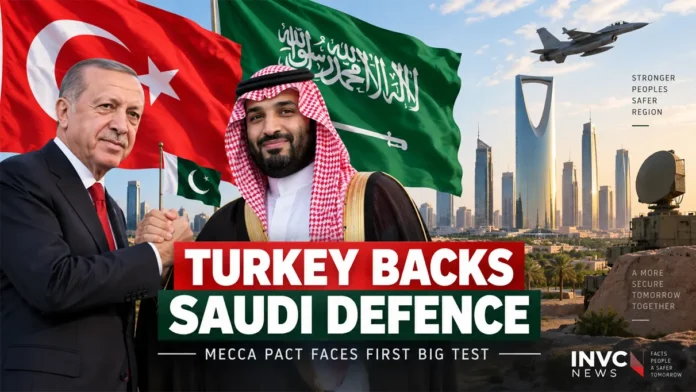
ANKARA, Turkey | September 20, 2026 — Turkey has said it is prepared to help meet Saudi Arabia’s military needs under a trilateral defence agreement with Riyadh and Pakistan, as escalating Houthi missile and drone attacks put growing pressure on Saudi security and critical infrastructure.
Turkish Foreign Minister Hakan Fidan said Saudi Arabia could require additional military support because of continuing attacks by Yemen’s Houthis and that Turkey was ready to provide assistance under the Mecca Joint Defence Agreement.
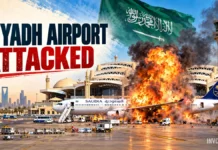
His comments came shortly after Saudi forces said they intercepted a ballistic missile launched toward Riyadh, while the Houthis claimed attacks on the Saudi capital and other locations.
The development puts one of the region’s newest defence arrangements under an early and significant test.
Turkey Says It Is Ready to Help Saudi Arabia
Fidan said Ankara stands in solidarity with Saudi Arabia and can help address Riyadh’s military requirements under the trilateral pact linking Turkey, Saudi Arabia and Pakistan.
The agreement treats an armed attack against one member as an attack against all three, according to Reuters.
However, Turkey has not announced the deployment of combat forces to Saudi Arabia.
Fidan’s statement signals readiness to assist rather than confirmation that Turkish forces have entered the conflict.
That distinction remains important as diplomatic efforts continue alongside military escalation.
What Is the Mecca Joint Defence Agreement?
The defence arrangement connects three major regional military powers: Saudi Arabia, Turkey and Pakistan.
The agreement creates a framework for collective defence and deeper military cooperation.
Its central principle resembles a mutual-defence commitment: an armed attack on one member can be treated as an attack on all members.
Representatives from the three countries held the first committee meeting under the agreement in Istanbul on August 31, 2026, involving senior foreign, defence and military officials.
The pact is now attracting greater attention because Houthi attacks have raised the possibility that Saudi Arabia could seek more direct support from its partners.
Riyadh Missile Attempt Raises Pressure
Turkey’s statement follows a sharp escalation involving Yemen’s Houthi movement.
Saudi Arabia said its forces intercepted a ballistic missile aimed at Riyadh on September 19.
The Houthis also claimed missile and drone attacks against what they described as sensitive locations in Riyadh and Saudi energy infrastructure.
Saudi authorities said several attempted attacks targeting Riyadh, Yanbu, Taif, Bish and Farasan were intercepted or thwarted.
Some individual Houthi claims about specific targets have not been independently verified.
The growing ability of the conflict to threaten Saudi cities and energy infrastructure has pushed regional defence cooperation back to the centre of attention.
Pakistan Has Taken a More Cautious Public Position
Pakistan is the third member of the trilateral defence arrangement.
Islamabad has said the Mecca agreement is operational and that Pakistan remains committed to fulfilling its obligations.
However, Pakistani officials previously said no immediate military response had been discussed under the pact in connection with Houthi attacks on Saudi Arabia.
That creates an important difference in public messaging.
Turkey is now openly saying it can help meet Saudi military requirements, while Pakistan has emphasised its treaty commitments without announcing direct participation in combat operations.
Saudi Arabia Faces Pressure on Multiple Fronts
The security challenge extends beyond missile attacks on Riyadh.
Houthi forces have advanced along parts of Yemen’s Red Sea coastline, increasing concerns around the strategically important Bab el-Mandeb Strait.
The Houthis have also targeted Saudi cities and energy infrastructure during the renewed fighting.
Saudi Arabia’s East-West oil infrastructure has become particularly important because it allows crude to move toward the Red Sea when shipping through the Persian Gulf faces disruption.
Attacks on these facilities can therefore carry consequences far beyond the battlefield.
They can affect oil exports, shipping costs and international energy markets.
Saudi Arabia Has Also Discussed Security With the US
Saudi Crown Prince Mohammed bin Salman met U.S. Central Command chief Admiral Brad Cooper in Jeddah earlier this month to discuss regional developments following the Houthi escalation.
Reuters reported that Washington was prepared to provide intelligence-sharing and targeting support, while President Donald Trump had not authorised direct U.S. strikes against the Houthis on Saudi Arabia’s behalf.
That position makes Saudi Arabia’s relationships with Turkey and Pakistan increasingly relevant.
If Riyadh seeks additional military capabilities without direct U.S. combat intervention, its regional defence partners could assume a larger role.
Turkey Brings Significant Military Capacity
Turkey has one of NATO’s largest armed forces and operates a substantial domestic defence industry covering drones, missiles, naval systems, armoured vehicles and electronic warfare.
That gives Ankara several possible ways to support Saudi Arabia without necessarily sending ground combat forces.
Assistance could potentially involve defence equipment, training, intelligence cooperation or other military capabilities, depending on what Riyadh formally requests and what the three governments agree.
Fidan did not publicly detail the precise form any Turkish assistance would take.
Diplomacy Is Still Running Alongside Military Escalation
Despite the growing defence activity, regional diplomatic efforts continue.
Iran says Qatar has transmitted Tehran’s conditions for ending its conflict with the United States.
U.S. officials have also held contacts with representatives of the Houthi movement in Oman, according to Reuters.
Sources familiar with those discussions said Houthi representatives indicated they would continue observing an earlier understanding concerning American and Israeli vessels while maintaining their confrontation with Saudi Arabia.
These parallel tracks illustrate the complexity of the current Middle East crisis: military alliances are becoming more active even as governments pursue backchannel negotiations.
The Mecca Pact Now Faces a Real-World Test
The central question is no longer whether Turkey, Saudi Arabia and Pakistan have a defence agreement.
The question is how that agreement will operate when one member faces continuing missile and drone attacks.
Turkey has now publicly signalled that it is prepared to provide assistance.
Pakistan says its commitments remain in force but has not announced direct military action.
Saudi Arabia, meanwhile, continues strengthening its defences as the Houthi conflict expands.
For the moment, no Turkish combat deployment has been announced.
But Ankara’s statement shows that the Saudi-Houthi conflict is increasingly testing the region’s emerging security alliances.