WASHINGTON, D.C., United States | September 6, 2026 —
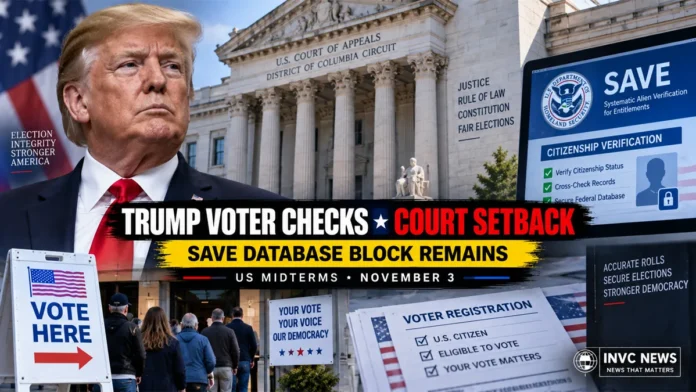
Trump Voter Citizenship Checks have suffered a major legal setback less than two months before the U.S. midterm elections after a federal appeals court refused to lift restrictions on the Trump administration’s use of a federal immigration database to verify citizenship information on state voter rolls.
The U.S. Court of Appeals for the District of Columbia Circuit ruled 2-1 on September 5 that the administration could not, for now, revive its planned use of the Department of Homeland Security’s Systematic Alien Verification for Entitlements database, widely known as SAVE, for the disputed voter-checking program.
The ruling does not prevent states from maintaining voter rolls or checking eligibility under existing election laws.
Instead, the dispute focuses specifically on the federal government’s expanded use of the SAVE system and the personal information involved in that process.
With the November 3 midterms approaching, the decision has become an important part of the wider political battle over election security, noncitizen voting claims, voter privacy and federal authority over elections.
Appeals Court Rules 2-1 Against Trump Administration
Chief Judge Sri Srinivasan and Circuit Judge Robert Wilkins formed the majority in the appeals-court decision.
Circuit Judge Gregory Katsas dissented.
The majority declined to suspend an earlier district-court order that blocked the administration from using the revamped SAVE database in the manner challenged by voting-rights groups.
That means the restriction remains in place while the broader legal dispute continues.
For the Trump administration, the timing matters.
Republicans are preparing to defend narrow congressional majorities in the November midterms, while President Donald Trump has repeatedly pushed election-security measures centered on citizenship verification and voter-roll accuracy.
What Is the SAVE Database?
SAVE stands for Systematic Alien Verification for Entitlements.
The Department of Homeland Security traditionally uses the system to help government agencies verify immigration or citizenship-related information when determining eligibility for certain public benefits and licenses.
The Trump administration expanded the system’s capabilities and promoted its use for checking voter-registration records.
Supporters argue that the database can help states identify people who may not meet citizenship requirements for voting.
Critics argue that the expanded system combines sensitive government data in ways that could create privacy problems and produce inaccurate matches.
Those competing concerns now sit at the heart of the court fight.
Judges Raise Privacy and Accuracy Concerns
The appeals-court majority supported the lower court’s conclusion that the disputed use of SAVE raised problems under the Social Security Act.
Judges also highlighted concerns involving access to personal information belonging to millions of Americans.
Accuracy represents another major issue.
If government databases contain outdated, incomplete or mismatched information, an eligible voter could potentially be flagged incorrectly.
That could force the individual to provide additional proof of citizenship or, in more serious circumstances, create a risk that an eligible registration is canceled.
The court did not rule that every citizenship verification effort is unlawful.
Its decision concerns the particular federal system and manner of use challenged in the case.
Trump Administration Says Checks Protect Elections
The administration has framed citizenship verification as an election-integrity measure.
Trump and his allies have repeatedly argued that states should do more to ensure that only U.S. citizens appear as eligible voters in federal elections.
Voting by noncitizens in federal elections is already illegal.
The political dispute centers on how widespread improper registration may be and what verification methods governments should use to identify potential cases without removing lawful voters.
Republican-led states have generally supported stronger citizenship-screening tools.
Democrats and voting-rights organizations warn that broad database matching can generate false positives and disproportionately affect naturalized citizens.
Lower Court Blocked SAVE Use in June
The current appeals ruling stems from a lower-court decision issued in June.
A federal judge blocked the administration’s revamped SAVE program from being used for broad voter-roll citizenship checks.
The court concluded that the system’s new design and use raised serious legal and privacy concerns.
The administration challenged that order and asked the appeals court to allow the system to operate while litigation continued.
The 2-1 ruling rejected that request.
As a result, the lower-court restriction remains effective heading toward the November election.
Florida Case Complicates Legal Landscape
The legal picture is not completely uniform.
A federal judge in Florida previously ordered the Department of Homeland Security to restore SAVE access to four Republican-led states after another court imposed the broader restriction.
That creates a complicated legal environment in which different courts are examining related questions involving federal databases, state election authority and voter eligibility.
Further appeals remain possible.
The dispute could therefore eventually reach the U.S. Supreme Court.
November 3 Midterms Raise Stakes
The court battle arrives at a politically sensitive moment.
All 435 seats in the U.S. House of Representatives will be contested on November 3, along with roughly one-third of Senate seats.
Republicans are defending control of Congress.
Democrats are trying to turn the midterms into a referendum on Trump’s presidency.
Election rules have consequently become one of the most contentious issues of the campaign.
Disputes involving mail ballots, congressional maps, voter identification, citizenship verification and access to voter databases are moving rapidly through courts across the country.
Noncitizen Voting Claims Drive Political Debate
Trump has repeatedly raised concerns about voting by noncitizens.
Republican lawmakers and officials argue that stronger verification protects public confidence in elections.
Voting-rights organizations respond that verified cases of noncitizen voting remain rare and warn that aggressive screening can accidentally affect lawful voters.
The distinction between voter fraud prevention and voter access has therefore become a defining political argument.
Both sides increasingly describe their position as essential to protecting democracy.
Naturalized Citizens at Center of Accuracy Concerns
One of the most sensitive issues involves naturalized American citizens.
Government databases created for immigration purposes can contain historical information dating from before a person became a U.S. citizen.
If databases fail to update correctly or officials interpret records incorrectly, a naturalized citizen could potentially appear as a noncitizen in an automated comparison.
Voting-rights advocates argue that such mistakes could create unnecessary hurdles for lawful voters.
The administration maintains that accurate federal data can help states identify genuine problems and improve voter-roll integrity.
The courts must now decide whether the government’s current system complies with federal law and privacy protections.
SAVE Ruling Adds to Trump’s Election-Law Battles
The administration is simultaneously fighting several other election-related court cases.
Trump has pushed changes involving mail voting, ballot rules and election administration.
Some measures have faced judicial blocks.
Others remain under appeal.
These cases could significantly influence how states administer the November election.
The SAVE dispute is therefore part of a much broader struggle over how much authority the federal government can exercise in a system traditionally administered largely by individual states.
Federal Versus State Power Remains Key Question
The U.S. Constitution gives states a substantial role in running elections.
Congress and the federal government also possess powers involving federal elections and voting rights.
That division has produced repeated legal disputes.
Trump’s administration has sought a stronger federal role in election-security measures.
Opponents argue that some initiatives exceed federal authority or conflict with privacy and voting-rights laws.
The SAVE case will help define where courts draw that line.
What Happens Next?
The administration can continue challenging the lower-court injunction.
It could also seek further appellate review or eventually ask the Supreme Court to intervene.
Meanwhile, election officials must prepare for November under the rules currently in effect.
The approaching calendar makes timing critical.
States will soon finalize voter rolls, distribute ballots and complete election procedures.
Major changes imposed close to Election Day can create administrative difficulties, which courts often consider when deciding election cases.
Court Ruling Becomes Midterm Political Issue
The legal fight is already spilling into campaign politics.
Republicans can portray the ruling as an obstacle to stronger citizenship verification.
Democrats and voting-rights organizations can present it as protection against the wrongful removal of eligible voters.
Both narratives will likely intensify as November 3 approaches.
For voters, however, the actual ruling is narrower than the political rhetoric surrounding it.
The appeals court has not prohibited citizenship requirements for voting.
It has not stopped states from maintaining accurate voter rolls.
Instead, the court has kept in place a restriction on the Trump administration’s disputed use of the DHS SAVE database for citizenship verification on state voter-registration records.
That distinction will remain critical as the case moves forward and the 2026 U.S. midterm elections draw closer.