By Team INVC | INVC NEWS
MUMBAI, India | September 13, 2026 —
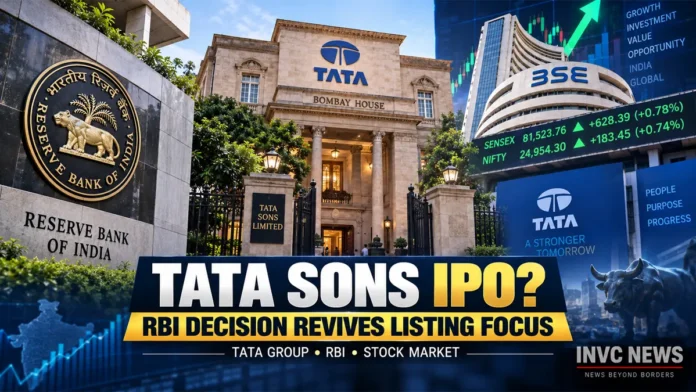
Tata Sons IPO speculation has returned to the center of India’s capital-market conversation after the Reserve Bank of India rejected Tata Sons’ request to surrender its registration as a Core Investment Company, increasing regulatory pressure on the Tata Group holding company to move toward a stock-market listing.
The development does not mean Tata Sons has announced an initial public offering.
No IPO date, price band, issue size or listing timetable has been announced.
However, the RBI decision is important because Tata Sons remains classified within the central bank’s Upper Layer regulatory framework for non-banking financial companies, where listing requirements can apply.
The outcome could eventually open one of India’s most closely watched corporate holdings to public investors.
What did RBI decide on Tata Sons?
The RBI rejected Tata Sons’ request to deregister as a Core Investment Company, according to people familiar with the matter cited in reports published over the weekend.
Tata Sons had sought to surrender its non-banking finance registration as part of an effort to remain privately held.
The rejection keeps Tata Sons under the enhanced regulatory framework that applies to certain large and systemically significant NBFCs.
That matters because RBI’s Scale Based Regulation framework requires an NBFC classified in the Upper Layer to list within three years of its identification, subject to the applicable regulatory process.
Therefore, the rejection has revived expectations that Tata Sons may ultimately need to pursue a public listing.
Tata Sons IPO is not confirmed yet
Investors should make an important distinction.
RBI has not announced a Tata Sons IPO.
Tata Sons has also not published a prospectus, draft red herring prospectus, price band, issue size or listing schedule.
The latest development concerns its regulatory status.
That status can increase pressure toward a listing, but several corporate, legal and regulatory steps would still be required before shares could be offered to public investors.
Any headline claiming that Tata Sons has already announced an IPO would therefore go beyond the currently established facts.
Why RBI’s Upper Layer rules matter
The RBI introduced its Scale Based Regulation framework to apply tougher standards to larger and more systemically important non-banking financial companies.
The framework divides NBFCs into different regulatory layers.
Companies placed in the Upper Layer face stronger governance, disclosure and supervisory requirements.
One of the most consequential provisions requires an Upper Layer NBFC to list within three years of being identified in that category.
Tata Sons has remained within that regulatory structure.
Its attempt to surrender its Core Investment Company registration therefore became central to the debate over whether the holding company could avoid a public listing.
Tata Sons controls some of India’s biggest companies
Tata Sons sits at the top of one of India’s largest corporate groups.
The holding company controls or holds significant interests across businesses including Tata Consultancy Services, Tata Motors, Tata Steel, Tata Consumer Products, Tata Power and Air India.
Several major Tata Group operating companies already trade publicly.
Tata Sons itself, however, remains privately held.
That distinction makes a potential Tata Sons IPO unusually significant.
A listing would give public investors direct exposure to the holding company sitting above a vast portfolio of businesses.
Tata Sons has substantial assets
Tata Sons’ standalone assets stood at about ₹1.75 trillion as of March 2025, according to reported financial information.
That scale is one reason regulatory treatment has attracted such close attention.
The company derives significant value from its holdings in listed Tata companies as well as its ownership interests in unlisted businesses.
Any future valuation of Tata Sons would therefore depend on multiple factors, including the value of its underlying investments, holding-company discounts, liabilities, governance structure and the form of any eventual public offering.
Investors should treat unofficial IPO valuation estimates cautiously until formal regulatory filings appear.
Tata Trusts remains the controlling shareholder
Tata Trusts controls approximately 66% of Tata Sons.
That ownership structure is fundamental to understanding the company.
The charitable trusts have historically played a central role in the Tata Group’s governance and long-term direction.
A stock-market listing would not automatically mean Tata Trusts loses control.
The final ownership structure would depend on how any future offering is designed and whether existing shareholders sell shares.
For now, no such offering structure has been formally announced.
Shapoorji Pallonji stake adds another dimension
The Shapoorji Pallonji Group is Tata Sons’ second-largest shareholder.
Its stake has long attracted attention because it represents one of the most valuable privately held corporate positions in India.
A Tata Sons listing could potentially create a transparent market value for that holding.
It could also provide greater liquidity compared with ownership in an unlisted company.
However, whether the SP Group would sell any stake in an eventual IPO remains unknown.
No official offer structure has been published.
Why investors are searching for Tata Sons IPO
The combination of the Tata brand, the scale of the group’s businesses and the rarity of an opportunity to own Tata Sons directly makes this a potentially enormous market event.
Tata Consultancy Services alone ranks among India’s most valuable listed companies.
Tata Motors, Tata Steel, Tata Power and Tata Consumer Products give the group exposure to automobiles, steel, energy, consumer goods and technology.
Air India adds aviation exposure.
As a result, a Tata Sons listing would not resemble a conventional single-business IPO.
Investors would effectively be evaluating a holding company whose value is linked to a broad portfolio of businesses.
Could Tata Sons become one of India’s biggest IPOs?
It is too early to answer that confidently.
No issue size has been announced.
No valuation has been formally established for an IPO.
Any estimate circulating before formal filings would rely heavily on assumptions about the value of Tata Sons’ investments and the discount investors might apply to a holding company.
The eventual IPO could involve a relatively small portion of the company rather than a large equity sale.
Consequently, the size of the offering cannot be determined simply from Tata Sons’ overall valuation.
What happens after RBI’s decision?
The immediate question is how Tata Sons responds.
The company could evaluate its legal and regulatory options.
It could also continue discussions with the RBI regarding compliance with the applicable NBFC framework.
If listing ultimately becomes unavoidable, Tata Sons would need to begin the extensive process required for a public issue.
That process could involve board approvals, shareholder decisions, appointment of investment bankers, preparation of financial disclosures and filings with the Securities and Exchange Board of India.
None of those steps should be assumed until officially disclosed.
Why this matters for Tata Group shareholders
A potential Tata Sons listing could also influence how investors value publicly traded Tata companies.
Tata Sons owns significant stakes across the group.
Greater disclosure at the holding-company level could provide investors with more visibility into capital allocation, investments and group-wide financial relationships.
However, a Tata Sons IPO would not directly convert shares of existing Tata companies into Tata Sons shares.
Investors holding TCS, Tata Motors or Tata Steel would continue to own those individual listed companies.
Tata Sons would be a separate security if it ultimately lists.
Tata Sons leadership transition adds to attention
The regulatory development comes during a period of increased attention on leadership and governance at Tata Sons.
Questions around the future leadership structure have added another layer to discussions surrounding the holding company.
For a business group of Tata’s scale, governance changes at Tata Sons can have consequences across dozens of companies and investments.
A possible listing would add public-market disclosure and shareholder scrutiny to that governance environment.
What investors should avoid believing
Three claims should be treated cautiously.
First, Tata Sons has not announced an IPO date.
Second, there is no official Tata Sons IPO price band.
Third, there is no confirmed Tata Sons IPO issue size.
Search interest around a potential listing can quickly produce speculative claims.
Investors should rely on formal announcements from Tata Sons, the RBI, SEBI or stock exchanges before treating any IPO timetable as confirmed.
Could Tata Sons still avoid listing?
That question remains important.
RBI’s rejection of the deregistration request narrows one path Tata Sons had pursued to remain private.
However, regulatory situations involving a company of this scale can involve additional discussions, restructuring options or legal considerations.
Therefore, it would be premature to describe a public issue as absolutely inevitable until the company or regulator provides a definitive listing path.
What has clearly changed is the level of pressure.
The RBI decision makes the listing question harder for Tata Sons to avoid.
Why the Tata Sons IPO story could stay active
The search value of this story is likely to extend well beyond a single day.
Future developments could include:
a formal Tata Sons response,
changes in regulatory status,
board decisions,
investment-bank appointments,
SEBI filings,
an IPO structure,
valuation discussions,
or an eventual listing timetable.
Each significant development should update this same master story rather than creating multiple pages targeting essentially the same Tata Sons IPO search intent.
For now, the central development is straightforward.
The RBI has rejected Tata Sons’ attempt to surrender its Core Investment Company registration.
That decision does not launch an IPO.
However, it puts Tata Sons IPO speculation firmly back in focus and brings one of India’s most valuable private corporate entities closer to a potential encounter with the public markets .