STOCKHOLM, Sweden | September 7, 2026 —
Sweden election 2026 has suddenly become a much tighter contest just days before voters choose a new parliament, after a fresh opinion poll showed Prime Minister Ulf Kristersson’s right-wing bloc closing the gap on the centre-left opposition and the struggling Liberal Party crossing the crucial 4% parliamentary threshold.
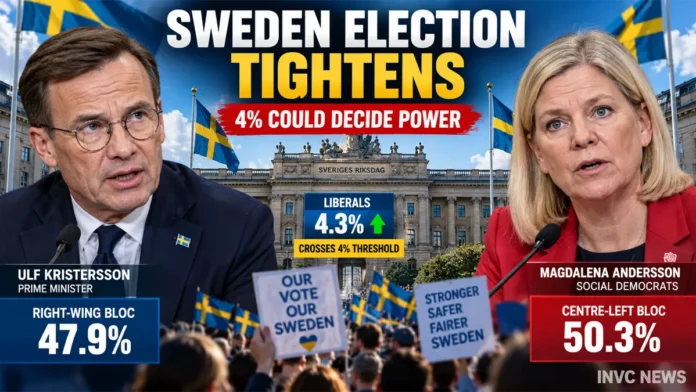
The latest Novus poll puts the centre-left bloc, led by former Prime Minister and Social Democratic leader Magdalena Andersson, at 50.3%, while Kristersson’s governing alliance and its Sweden Democrat allies stand at 47.9%.
The 2.4-point gap leaves the opposition ahead.
But the most politically significant number may be 4.3%.
That is the level of support recorded for the Liberals, one of the parties underpinning Kristersson’s government.
Swedish electoral rules normally require a party to win at least 4% nationally to enter parliament. Falling below that mark could remove a party from the Riksdag and dramatically alter the balance between Sweden’s competing political blocs.
For months, that danger threatened Kristersson’s chances of retaining power.
Now the equation has changed.
Liberals Suddenly Become the Party Everyone Is Watching
The Liberals had struggled for months below the parliamentary threshold.
A Novus poll released only days earlier put the party at 3.3%.
The newest survey shows it climbing to 4.3%, potentially preserving its parliamentary representation and giving the governing bloc a much stronger chance of surviving the September 13 election.
That one percentage-point movement could become one of the most consequential shifts of Sweden’s entire campaign.
In Sweden’s proportional electoral system, votes cast for parties that fail to clear the threshold generally do not translate into national parliamentary seats.
As a result, a relatively small party can decide which larger political bloc gains enough seats to govern.
The Liberals have therefore moved from being a junior partner to potentially becoming the kingmaker of the election.
Magdalena Andersson Still Leads — But Her Advantage Has Shrunk
Magdalena Andersson and the centre-left remain ahead.
However, the political picture looks very different from only a few weeks ago.
Earlier polling had shown the centre-left holding a lead of around 10 percentage points, creating the impression that Andersson was moving comfortably toward victory.
That advantage has now narrowed sharply.
The latest Novus figures put her bloc at 50.3% against 47.9% for the right.
The race has therefore moved from what once looked like a relatively clear opposition advantage into territory where small changes in turnout or support for minor parties could decide the result.
Andersson previously served as Sweden’s prime minister and remains one of the country’s most recognizable political figures.
A victory would return the Social Democrats to the center of government after four years in opposition.
But she now faces a revived right-wing bloc with less than a week remaining before Election Day.
Ulf Kristersson Gets a Late Political Lifeline
Prime Minister Ulf Kristersson took office after the 2022 election and formed a centre-right government involving the Moderates, Christian Democrats and Liberals.
His administration depends on parliamentary cooperation with the Sweden Democrats.
That arrangement marked an important political shift in Sweden.
The Sweden Democrats grew from a party long kept outside mainstream political cooperation into an influential force supporting government policy.
Kristersson now wants voters to give the same broad right-wing bloc another term.
His challenge has been keeping every component of that alliance above the parliamentary threshold.
The Liberals’ recovery gives him exactly the kind of late campaign boost he needed.
If their support holds, the right-wing bloc could convert significantly more of its national vote into seats.
Sweden Democrats Remain Central to the Battle for Power
The Sweden Democrats remain one of the most important forces in the campaign.
The party built much of its support around tougher immigration policies, crime, integration and Swedish identity.
It became the second-largest party in the 2022 election and has exerted considerable influence over government policy despite remaining outside the formal cabinet.
Kristersson has worked with the party through the political framework that supports his government.
The arrangement helped Sweden adopt tougher positions on immigration and citizenship while also placing security and law enforcement near the top of the government’s agenda.
The September election will reveal whether voters want that model to continue.
Immigration, Crime and Cost of Living Drive the Campaign
Sweden’s election is unfolding around several issues with resonance far beyond the Nordic country.
Immigration remains one of the most divisive.
The Kristersson government has tightened migration and citizenship policies and argued that Sweden must improve integration while reducing social problems connected with failed immigration policies.
Crime has also become a major issue following years of concern about shootings, gang violence and organized criminal networks.
Meanwhile, household finances remain equally important.
Cost-of-living pressure has shaped voter sentiment, forcing the government to emphasize tax relief and measures designed to reduce everyday expenses.
The government recently highlighted a reduction in food VAT as evidence that its economic policies were lowering grocery prices.
The centre-left argues that Sweden’s welfare system, public services and household security require stronger protection.
That has created a campaign combining traditional economic questions with some of Europe’s most contentious debates over immigration and security.
Sweden’s NATO Era Changes the Foreign Policy Debate
This election also carries an international dimension that did not exist during most previous Swedish campaigns.
Sweden is now a NATO member.
Russia’s war against Ukraine transformed Swedish security policy and ended the country’s long tradition of military non-alignment.
Defence spending, military preparedness and relations with NATO allies have therefore become increasingly important political questions.
Sweden continues to strengthen its armed forces and deepen cooperation with the United States and European partners.
The government announced another major defence move on Monday, approving plans to buy the US-made HIMARS artillery rocket system in a deal worth about $729 million.
National security is no longer a secondary issue in Swedish elections.
It sits close to the heart of the country’s political debate.
Why the 4% Rule Could Decide Sweden’s Next Government
Sweden has a 349-seat parliament known as the Riksdag.
Its proportional system means the national vote share matters enormously.
However, the 4% threshold creates a sharp dividing line.
A party that finishes just above it can win parliamentary representation and contribute seats to its political bloc.
A party that finishes just below it can lose national representation altogether.
That explains why the Liberals’ latest polling number matters so much.
The difference between 3.9% and 4.1% could influence far more than the future of one small party.
It could help determine whether Ulf Kristersson stays prime minister or Magdalena Andersson returns to power.
September 13 Is Now Too Close to Call
Swedish voters will elect the Riksdag on September 13, 2026, alongside regional and municipal elections.
Advance voting is already underway.
The official final result will come after votes are fully counted, but the political direction should become much clearer on election night.
Until recently, the centre-left looked comfortably positioned.
That is no longer the case.
Magdalena Andersson still holds the advantage.
Ulf Kristersson now has momentum.
And the Liberals—a party that appeared at risk of disappearing from parliament—may suddenly hold the key to who governs Sweden.
With only days left, one of Europe’s most closely watched elections has become a genuine political cliffhanger.