By Team INVC | INVC NEWS
STOCKHOLM, Sweden | September 14, 2026 —
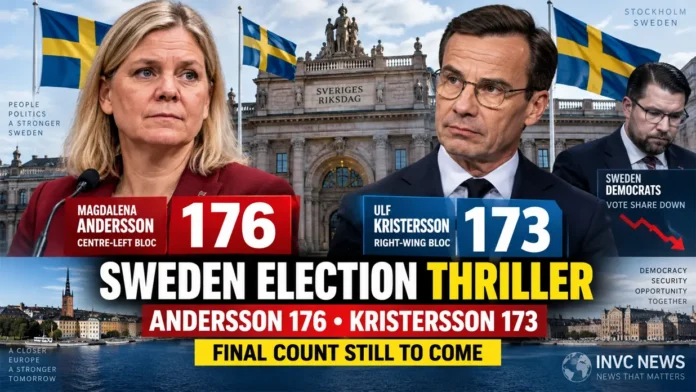
Sweden Election 2026 Results have produced a political cliffhanger, with former Prime Minister Magdalena Andersson’s center-left bloc holding a razor-thin three-seat advantage over Prime Minister Ulf Kristersson’s right-wing coalition — but neither side is ready to declare the battle over.
With most election districts counted, the center-left bloc is projected to secure 176 seats in Sweden’s 349-seat Riksdag, while Kristersson’s right bloc stands at 173 seats.
That gives Andersson the narrowest possible working advantage.
But Sweden does not yet have a final winner.
Late postal ballots, overseas votes and remaining ballots will continue to be counted, meaning the political drama could stretch into Wednesday and beyond.
Kristersson has refused to concede.
Andersson has stopped short of declaring victory.
And the Sweden Democrats — the party that hoped this election would finally open the cabinet door — appear to have suffered a major setback.
Sweden woke up Monday with one message:
The left is ahead, the right is still alive, and three seats could decide the country’s political future.
Andersson Leads — But the Champagne Must Wait
Magdalena Andersson has every reason to smile.
Her four-party center-left bloc currently leads the parliamentary race.
Yet the margin is so small that celebrating too early would be politically reckless.
Sweden’s final count includes ballots arriving from abroad and late advance votes.
In an election separated by only three seats, a relatively small number of ballots can matter.
That is why Andersson has struck a careful tone.
She can see the path back to the prime minister’s office.
She cannot yet walk through the door.
Kristersson Is Down — But Not Out
Prime Minister Ulf Kristersson faces the uncomfortable possibility of losing power after four years in office.
Still, he has not conceded.
And politically, that makes sense.
The current margin remains narrow enough for the right bloc to hope that the final count changes the seat distribution.
Kristersson has also indicated that he will speak with other party leaders once the result becomes clearer.
That suggests another layer of intrigue.
Even if the final numbers confirm Andersson’s lead, government formation may not follow the election-night map neatly.
Swedish politics thrives on coalition arithmetic.
And this election has delivered plenty of it.
Sweden Democrats Suffer the Night’s Biggest Blow
The most striking result may belong to a party that is not leading either bloc.
The Sweden Democrats entered the election hoping to make history.
Prime Minister Kristersson had opened the door to bringing the nationalist party directly into government for the first time.
Instead, Jimmie Åkesson’s party appears to have lost ground.
Its vote share has fallen to roughly 17.6%, down from 20.5% in 2022.
That drop pushed the Sweden Democrats behind the Moderates and cost the party its position as Sweden’s second-largest political force.
The symbolism is enormous.
For years, the Sweden Democrats moved steadily from the political fringe toward the center of power.
The 2026 election was supposed to be their breakthrough moment.
Instead, the party may emerge weaker.
Kristersson’s Far-Right Gamble Did Not Deliver the Expected Reward
Kristersson made one of the biggest strategic bets of his career before this election.
He signaled that he was prepared to let the Sweden Democrats enter government if the right bloc won.
That marked a dramatic shift.
The Sweden Democrats had supported Kristersson’s government from outside since 2022.
Cabinet seats would have moved the party from power broker to direct participant in executive government.
Kristersson gambled that voters would accept that step.
The preliminary result suggests the strategy failed to produce a majority.
If the right ultimately loses power, critics will ask whether embracing a deeper partnership with the Sweden Democrats mobilized opposition voters instead.
Andersson Wins the Bloc Race — But Her Own Party Has a Problem
There is a twist on the other side too.
Andersson may be leading the race to become prime minister, but her Social Democrats are not celebrating a dominant party result.
The party is running at roughly 28.1% of the vote, down from 2022.
That puts Sweden’s historically dominant political force on course for one of its weakest performances in more than a century.
So the election has produced an unusual contradiction:
Andersson’s bloc may win while the Social Democrats themselves weaken.
That matters because governing will require difficult compromises with smaller parties.
A weaker Social Democratic mandate could reduce Andersson’s leverage during coalition negotiations.
Winner Weak, Loser Alive — Sweden’s Political Paradox
This election does not offer a clean triumph.
Andersson leads, but her party has lost ground.
Kristersson trails, but remains within striking distance.
The Sweden Democrats have slipped, but still command a significant share of the electorate.
Smaller parties may now hold disproportionate influence.
That makes Sweden Election 2026 less a victory parade and more a political puzzle.
The voters have delivered numbers.
Now politicians must make them work.
Why 175 Seats Matter So Much
Sweden’s Riksdag has 349 seats.
That means 175 seats represent the crucial majority threshold.
Andersson’s bloc currently stands one seat above it.
Kristersson’s bloc stands two seats below.
That arithmetic explains why every outstanding ballot matters.
One seat moving from one bloc to another could dramatically alter negotiations.
Two could transform the result entirely.
This is why Sweden cannot treat the preliminary count as the final verdict.
What Happens to Kristersson if the Right Loses?
If the 176-173 split survives the final count, Kristersson will face intense pressure.
He has governed Sweden since 2022 through a center-right coalition supported by the Sweden Democrats.
His government tightened immigration policy, strengthened criminal penalties and pushed Sweden further toward a more restrictive political model.
A defeat would raise questions about whether voters have reached the limit of that shift.
It would also trigger debate inside the Moderate Party over Kristersson’s alliance strategy.
But Swedish coalition politics rarely rewards quick assumptions.
Kristersson could still search for alternative parliamentary arrangements.
That is why his refusal to concede matters.
Andersson’s Road Back to Power Is Not Simple
A numerical victory does not automatically produce a stable government.
Andersson’s possible governing bloc contains parties with major disagreements.
The Social Democrats, Greens, Left Party and Centre Party can cooperate against Kristersson’s right-wing bloc.
But they disagree on taxation, energy policy, economic policy and the role of the Left Party in government.
The Centre Party has previously resisted entering a government alongside the Left.
That creates a basic problem.
Andersson may have enough seats to remove Kristersson before she has a fully agreed coalition capable of replacing him.
Winning the election may therefore prove easier than building the government.
Immigration Remains at the Center of the Political Divide
Sweden’s political transformation over the past decade has revolved heavily around immigration.
The country once had some of Europe’s most liberal asylum policies.
That changed dramatically.
Kristersson’s government tightened immigration rules, reduced pathways to permanent residency and implemented tougher integration measures with Sweden Democrat support.
Asylum numbers fell sharply.
The right argued that the policies restored control.
The center-left argued that the Sweden Democrats pushed Sweden too far toward exclusionary politics.
The preliminary result suggests voters remain deeply divided.
Crime Also Reshaped the Election
Gang violence became another defining issue.
Sweden experienced years of shootings, bombings and organized-crime violence that shocked a country long associated with social stability.
Kristersson made tougher law enforcement central to his government.
His coalition increased police powers and penalties while targeting criminal networks.
The government points to falling shooting deaths as evidence of progress.
Andersson did not campaign on returning to a softer law-and-order approach.
That is important.
Even if the center-left returns to power, Sweden’s crime policy will not simply reset to where it stood a decade ago.
The political center itself has moved.
Sweden Democrats Still Hold Significant Power
A disappointing election does not make the Sweden Democrats irrelevant.
At around 17.6%, the party remains one of the largest forces in Swedish politics.
Jimmie Åkesson has spent more than two decades transforming the party from political outsider into a major parliamentary player.
That influence will not disappear because of one setback.
If Kristersson somehow retains power, Sweden Democrats could still influence negotiations.
If Andersson forms a government, the party becomes a powerful opposition force.
The larger story is therefore not the end of the Sweden Democrats.
It is the interruption of their seemingly unstoppable rise.
Europe Is Watching Closely
Sweden’s election carries significance far beyond Stockholm.
Nationalist and far-right parties have gained influence across Europe.
Some already sit in governments.
Others have become kingmakers.
Sweden appeared to be moving in the same direction when Kristersson opened the door to Sweden Democrats entering the cabinet.
The preliminary result complicates that narrative.
Swedish voters may have stopped that transition — at least for now.
That gives the election symbolic importance across Europe.
NATO and Ukraine Policy Are Unlikely to Change Dramatically
Not every issue divides the two blocs.
Sweden became a NATO member in 2024 after Russia’s invasion of Ukraine transformed the country’s security policy.
Both Andersson and Kristersson strongly support Sweden’s NATO membership.
Both also back continued support for Ukraine.
That means a change of government would not automatically produce a major foreign-policy reversal.
Sweden will remain a strategically important NATO country in Northern Europe and the Baltic region.
The bigger differences remain domestic: immigration, welfare, taxation, crime and political cooperation with the Sweden Democrats.
Final Result Will Take Time
Sweden’s Election Authority still has ballots to count.
Late postal votes and ballots cast abroad can affect the final allocation of seats.
The official count process continues during the week.
That means media projections remain provisional.
Readers should therefore be cautious with headlines declaring Andersson Sweden’s next prime minister.
She leads.
She has not yet secured the office.
Likewise, Kristersson trails.
He has not formally lost it.
What Happens If the 176-173 Result Holds?
If the current seat projection survives, Andersson will enter government negotiations from the stronger position.
The focus would then move rapidly from vote counting to coalition building.
She would need to secure enough parliamentary support to survive the prime-minister vote and pass budgets.
That could require difficult compromises among parties that agree on removing the current government but disagree on important economic issues.
Kristersson, meanwhile, would need to decide whether to remain opposition leader and how to manage relations with the Sweden Democrats after their setback.
Three Seats Now Separate Two Visions of Sweden
The extraordinary part of this election is not only how close it is.
It is what those three seats represent.
Kristersson’s bloc offers a continuation of Sweden’s shift toward tighter immigration, tougher law and order and greater Sweden Democrat influence.
Andersson’s bloc offers a return to center-left leadership, greater emphasis on welfare and a barrier against bringing the Sweden Democrats directly into government.
Voters have not delivered a landslide for either vision.
They have delivered a split country.
Sweden’s Election Thriller Is Not Over
Magdalena Andersson has the lead.
Ulf Kristersson still has hope.
Jimmie Åkesson has suffered a setback.
The Social Democrats themselves have weakened.
And the smallest parties could ultimately decide who governs.
That is the delicious political contradiction of Sweden Election 2026.
The apparent winner is wounded.
The apparent loser refuses to leave the battlefield.
And the party that expected to enter government may instead be wondering why its support slipped.
For now, 176-173 is the number Sweden — and Europe — is watching.
The final ballots will decide whether it becomes the result that returns Magdalena Andersson to power or simply another twist in one of Europe’s closest elections.