GANGTOK, India | September 7, 2026 —
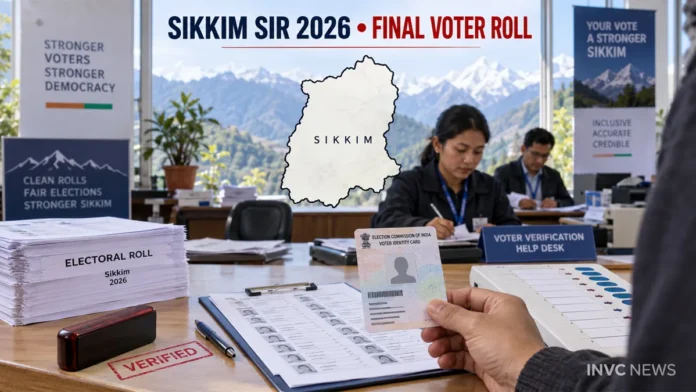
Sikkim SIR 2026 has reshaped the state’s electoral rolls, with election authorities publishing the final voter list containing 4,18,467 electors after completing the Special Intensive Revision exercise.
Official data show that 54,209 electors were excluded during different stages of the revision process, while the overall electorate declined from 4,71,018 before the exercise to 4,18,467 in the final roll.
The final list now includes 2,12,534 male electors, 2,05,931 female electors and two electors registered in the third-gender category.
The Office of the Chief Electoral Officer, Sikkim, published the final electoral roll on September 6 with July 1, 2026 as the qualifying date.
Sikkim SIR 2026: What Changed in Final Voter List?
Election authorities launched the intensive revision to verify voter records, identify duplicate or outdated entries and examine cases where electoral information required further scrutiny.
Before the exercise began, Sikkim had 4,71,018 registered electors.
Authorities distributed enumeration forms to those electors and received 4,33,242 forms, representing nearly 92 per cent of the total distributed.
The draft electoral roll, published on July 5, contained 4,33,294 electors.
After claims, objections, hearings and verification, the final count fell to 4,18,467 electors.
That represents a net decline of 14,827 electors, or 3.42 per cent, from the draft roll.
Compared with the pre-SIR electorate of 4,71,018, the final list has 52,551 fewer electors, a decline of about 11.16 per cent.
Why 54,209 Exclusions Do Not Equal the Net Fall
The distinction between exclusions and the final net decline is important.
Election authorities reported 54,209 exclusions during the SIR process. However, the final voter count does not simply equal the original electorate minus that figure because the revision also involved new inclusions, claims, corrections and subsequent decisions.
During the claims and objections period, authorities added 1,982 electors after accepting applications for inclusion.
They also processed deletion objections, address changes, corrections and cases identified during verification.
As a result, the final numerical change in the electorate differs from the headline figure for total exclusions recorded across the revision process.
For voters and political parties tracking the exercise, the clearest final figure is therefore 4,18,467 registered electors.
ASDD and Eligibility Checks Played Major Role
A large share of the exclusions came from cases grouped under the Absent, Shifted, Dead and Duplicate, or ASDD, category.
Election officials also examined electors whose records could not be mapped with earlier electoral data and voters whose records showed logical discrepancies.
Authorities issued more than 1.24 lakh notices to electors falling under unmapped or discrepancy categories and asked them to establish their eligibility through hearings and supporting documents.
Following scrutiny and hearings, 16,485 electors were found ineligible.
The verification process also identified thousands of cases involving deceased voters, permanently shifted electors, people who could not be traced at their recorded addresses and duplicate registrations.
Claims and Objections Process Completed Before Final Roll
The SIR process included a claims and objections window after publication of the draft list.
Election authorities received applications through the prescribed electoral forms for new inclusion, deletion, correction and address changes.
The process allowed eligible voters who were missing from the draft roll to seek inclusion, while officials also considered objections involving potentially invalid entries.
Authorities ultimately added 1,982 electors following claims for inclusion.
At the same time, 16,809 names were deleted during the claims-and-objections and verification stage, including cases found ineligible after hearings.
The final electoral roll reflects the outcome of those applications, hearings and verification exercises.
Number of Polling Stations Rises to 625
The revision has also changed Sikkim’s polling infrastructure.
The state had 572 polling stations before the SIR exercise.
Election authorities created 53 additional polling stations, taking the total to 625.
The increase could improve polling-station distribution as election officials prepare the updated rolls for future electoral exercises.
Voters Can Appeal Against Exclusion
Electors who believe their names were wrongly excluded from the final voter list still have a remedy available under the electoral process.
Affected voters can challenge the decision of the Electoral Registration Officer before the competent appellate authority within the prescribed period.
Voters should therefore verify their names and electoral details rather than assume that an older voter card automatically guarantees inclusion in the latest roll.
Checking the final electoral roll is particularly important for people who changed their address, remained away from their registered residence during verification or received a notice during the SIR process.
SIR Remains a Major National Political Issue
The Sikkim numbers arrive as electoral-roll revisions continue to draw political attention across India.
Questions over deletions, duplicate entries, deceased voters, migration and documentation have turned voter-list revision into a major election-related issue.
Supporters of intensive verification argue that accurate electoral rolls help prevent duplicate and outdated registrations.
At the same time, political parties and voters continue to scrutinize the process closely to ensure that eligible citizens do not lose their voting rights because of incorrect records or verification errors.
For Sikkim, the immediate result is now clear: the Sikkim SIR 2026 final electoral roll contains 4,18,467 electors, and voters can check or challenge their status through the procedures available under election law.