MUMBAI, India | August 21, 2026
The SEBI Copthall Mauritius case has put India’s newly introduced stock-market closing auction mechanism under intense scrutiny after the regulator barred JPMorgan Chase-owned Copthall Mauritius Investment and Mumbai-based Mansi Share and Stock Broking from the securities market over alleged manipulative trading.
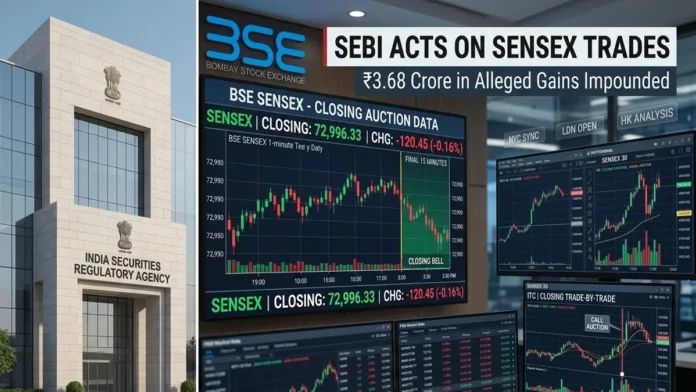
The Securities and Exchange Board of India issued an interim order after examining trading activity during the Closing Auction Session, or CAS, on August 13, when weekly derivatives contracts linked to the BSE Sensex were expiring.
SEBI alleged that trading patterns involving the two entities were prima facie manipulative and influenced the closing levels of Sensex constituent stocks in a manner that benefited derivatives positions.
The regulator has ordered approximately ₹3.68 crore in alleged wrongful gains to be impounded while its investigation continues.
Importantly, the findings are part of an interim regulatory proceeding and should not be treated as a final determination of wrongdoing.
What SEBI Alleges Against Copthall Mauritius
According to the regulator’s findings, Copthall Mauritius Investment placed aggressive buy orders across Sensex constituent stocks during the Closing Auction Session on August 13.
SEBI alleged that these orders helped push indicative prices higher during the auction.
The regulator examined the relationship between the cash-market orders and Copthall’s derivatives positions and concluded on a prima facie basis that the trading activity was designed to influence the Sensex closing level for gains in derivatives.
SEBI estimated Copthall’s prima facie wrongful gains at approximately ₹2.96 crore.
Copthall Mauritius is owned by JPMorgan Chase.
The financial group declined to comment on the regulatory action when approached following the order.
Mansi Broking Also Faces SEBI Action
SEBI’s order also covers Mansi Share and Stock Broking, a Mumbai-based market participant.
The regulator alleged that Mansi used large sell orders during the closing auction in a manner capable of influencing indicative prices.
According to the regulatory findings, substantial portions of the orders were subsequently canceled.
SEBI estimated Mansi’s prima facie wrongful gains at approximately ₹71.65 lakh.
Together, the amounts attributed to Copthall and Mansi come to roughly ₹3.68 crore.
The regulator ordered the amounts to be impounded while further proceedings continue.
Why August 13 Trading Drew Attention
The timing of the alleged activity is particularly significant.
August 13 was an expiry day for weekly derivatives contracts linked to the Sensex.
Index levels around derivatives expiry can have major financial consequences because the settlement value of options and other contracts can depend on the benchmark’s closing level.
Even relatively small movements in an index near expiry can therefore have a substantial effect on derivatives positions.
That is one reason regulators closely monitor unusual trading patterns around expiry sessions.
What Is the Closing Auction Session?
The case has attracted additional attention because India’s Closing Auction Session is a newly introduced mechanism.
The CAS was launched earlier in August as part of an effort to improve closing-price discovery and bring Indian market practices closer to systems used in several major international markets.
Under an auction-based mechanism, buy and sell orders are matched during a designated period to determine the official closing price.
The system differs from the earlier methodology in which closing prices were primarily derived using an average over a specified period near the end of normal trading.
Closing auctions are widely used internationally because they can concentrate liquidity and create a transparent mechanism for establishing end-of-day prices.
However, sufficient liquidity and effective surveillance are important because unusually large orders can potentially influence indicative prices during an auction.
SEBI’s First Major Test for the New System
The Copthall-Mansi case represents an important early enforcement test for India’s new closing auction framework.
SEBI’s intervention indicates that the regulator is closely monitoring trading behavior under the new mechanism rather than waiting for a long period of market experience before taking action.
The case could also lead exchanges and regulators to examine whether additional safeguards are needed around order cancellations, liquidity concentration and derivatives-expiry sessions.
That does not necessarily mean there is a fundamental flaw in closing auctions.
Instead, regulators globally routinely modify trading systems as new patterns of market behavior emerge.
Why Derivatives Positions Matter
The central issue in SEBI’s case is the alleged connection between activity in Sensex constituent stocks and positions in derivatives linked to the index.
A trader with a significant options position can potentially gain substantially if the underlying index moves in a favorable direction near expiry.
Attempting to artificially move the cash-market price to benefit a derivatives position, however, can raise serious market-manipulation concerns.
Regulators therefore analyze whether orders represent genuine buying or selling interest and whether trading patterns appear designed primarily to influence benchmark prices.
SEBI’s interim findings indicate that it believes the August 13 activity warrants further investigation and immediate preventive action.
What Action Has SEBI Taken?
SEBI has restrained the entities from accessing India’s securities market while the interim directions remain in force.
The regulator has also imposed restrictions connected with participation in the Closing Auction Session and ordered the impounding of the alleged wrongful gains.
The investigation is continuing.
Copthall has legal avenues available to challenge regulatory directions, including approaching the Securities Appellate Tribunal.
The final outcome will depend on subsequent proceedings and the evidence considered during the regulatory process.
Why This Case Matters for Indian Investors
For ordinary investors, the case goes beyond the two entities named in SEBI’s order.
Reliable closing prices are fundamental to the functioning of financial markets.
Closing levels can affect index calculations, mutual fund valuations, exchange-traded funds, derivatives settlement and institutional portfolio benchmarks.
If closing prices can be artificially influenced, the consequences can extend beyond traders directly involved in a particular transaction.
That makes surveillance around closing auctions especially important.
SEBI Sends a Strong Market-Surveillance Signal
The speed of the regulatory response is likely to be closely watched by institutional investors and trading firms.
India’s capital markets have expanded rapidly, attracting both domestic and international investors.
At the same time, increasingly sophisticated derivatives trading has created new surveillance challenges for exchanges and regulators.
SEBI’s action in the Copthall Mauritius case signals that unusual trading behavior around the new closing auction mechanism will face close scrutiny.
The next stage will determine whether the regulator’s preliminary allegations are upheld and whether India’s closing auction rules require further changes after their first major enforcement test.