WASHINGTON, United States | September 27, 2026 —
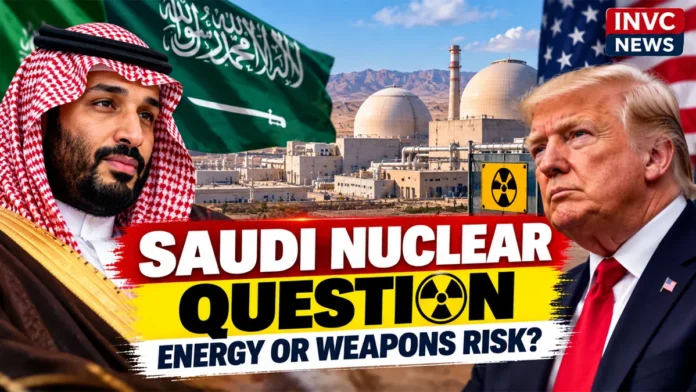
Saudi Arabia’s nuclear ambitions are drawing fresh scrutiny in Washington after a U.S. intelligence assessment concluded that Riyadh has not ruled out the possibility of developing a nuclear weapons program in the future.
The assessment does not say that Saudi Arabia has decided to build a bomb.
But it has intensified concern over a separate development: the Trump administration’s new civil nuclear cooperation agreement with Riyadh, which creates a pathway for Saudi Arabia to enrich uranium domestically under certain conditions.
That combination has raised a difficult question for U.S. lawmakers and nonproliferation experts:
Could a civilian nuclear program eventually give Saudi Arabia capabilities that could also support a weapons program?
The Trump administration says the agreement strengthens nonproliferation standards and keeps Saudi Arabia tied to U.S. technology and oversight.
Critics say the safeguards may not go far enough.
THE 60-SECOND BRIEF
US intelligence assessment: Saudi Arabia has not ruled out developing nuclear weapons.
What it does not say: It does not conclude that Riyadh has made a decision to build a bomb.
Trump administration deal: Washington and Riyadh signed a civil nuclear cooperation agreement in July 2026.
Enrichment issue: The agreement can potentially allow uranium enrichment in Saudi Arabia under specific conditions.
Congressional concern: Lawmakers fear enrichment technology could eventually give Riyadh a latent weapons capability.
Saudi position: Riyadh says its nuclear program is peaceful and will operate with high levels of responsibility and transparency.
What Has US Intelligence Assessed?
Classified documents provided to Congress include an assessment from the U.S. intelligence community that Saudi Arabia has not eliminated the option of eventually developing a nuclear weapons program.
That is a carefully worded judgment.
It does not mean intelligence agencies believe Saudi Arabia is currently building a weapon.
It means U.S. analysts do not believe Riyadh’s long-term intentions can be treated as definitively limited to civilian nuclear energy.
That distinction is central to the debate.
Why Is Washington More Worried Now?
The intelligence assessment has arrived while Congress is reviewing a major U.S.-Saudi nuclear cooperation agreement.
The agreement, signed in July, would allow American companies to participate in Saudi Arabia’s civilian nuclear program and could lead to tens of billions of dollars in reactor and fuel-cycle investment.
But the deal also goes further than some previous U.S. nuclear agreements.
It does not permanently prohibit Saudi Arabia from enriching uranium.
That is where the controversy begins.
Why Uranium Enrichment Matters
Uranium enrichment can serve peaceful purposes.
Low-enriched uranium is used as fuel in civilian nuclear reactors.
But the same basic technology can also be used to produce highly enriched uranium suitable for nuclear weapons.
The difference lies in the enrichment level and the political decision governing how the technology is used.
That is why enrichment capability is one of the most sensitive issues in global nuclear diplomacy.
Could Saudi Arabia Enrich Uranium to 20 Percent?
According to details reported from the agreement, Saudi Arabia would initially face a lower enrichment limit.
However, after an additional bilateral study and written agreement, the framework could allow enrichment to rise to nearly 20 percent.
That level is still below weapons grade.
But nuclear experts note that once uranium reaches higher enrichment levels, the technical path to weapons-grade material becomes shorter.
This possibility has become one of the central concerns in Congress.
Why Is the Saudi Deal Different From the UAE Model?
The United Arab Emirates accepted much stricter restrictions in its 2009 nuclear cooperation agreement with the United States.
The UAE agreed not to enrich uranium or reprocess spent nuclear fuel domestically.
That commitment became known as the so-called “gold standard” for U.S. civilian nuclear agreements.
Saudi Arabia has resisted accepting the same permanent restriction.
The Trump administration’s agreement therefore gives Riyadh greater flexibility than the UAE received.
That difference is driving much of the criticism.
Saudi Arabia Says Its Program Is Peaceful
Saudi Arabia has consistently said its nuclear ambitions are focused on peaceful energy development.
Saudi Energy Minister Prince Abdulaziz bin Salman has said the kingdom intends to develop its nuclear program with responsibility and transparency.
Saudi Arabia wants nuclear energy partly to diversify its power generation system and reduce the amount of oil and gas burned domestically for electricity.
Riyadh also wants to develop domestic expertise across the nuclear fuel cycle.
Mohammed bin Salman’s Earlier Comment Still Matters
A major source of concern remains a statement made by Crown Prince Mohammed bin Salman in 2018.
He said that if Iran developed a nuclear bomb, Saudi Arabia would seek one as quickly as possible.
That statement has remained central to U.S. proliferation debates.
Iran’s nuclear program and the wider regional security situation continue to shape Saudi strategic calculations.
The latest U.S. intelligence assessment suggests American agencies are not prepared to assume that Saudi Arabia has permanently abandoned the weapons option.
What Is a 123 Agreement?
The U.S.-Saudi pact is known as a Section 123 Agreement, named after Section 123 of the U.S. Atomic Energy Act.
Such agreements establish the legal framework required before significant U.S. nuclear technology, material or equipment can be transferred to another country.
They typically include requirements related to peaceful use, safeguards, physical protection and restrictions on sensitive nuclear activities.
The agreement must also go through congressional review before it can take effect.
Trump Administration Says the Deal Improves Security
The Trump administration argues that keeping Saudi Arabia inside a U.S.-led nuclear framework is safer than allowing Riyadh to turn to other suppliers.
Officials say American involvement gives Washington greater influence over safety, safeguards and nuclear security.
The Energy Department has said the agreement upholds strong nonproliferation standards while also giving U.S. companies access to Saudi Arabia’s large nuclear-energy market.
Why Russia and China Matter
Another major factor is geopolitical competition.
Saudi Arabia has alternatives.
Russia and China both have large state-backed nuclear industries and are seeking influence across the Middle East.
Washington fears that if the United States refuses Saudi demands entirely, Riyadh could turn to Moscow or Beijing.
That could reduce U.S. oversight and weaken American commercial and strategic influence.
The Trump administration therefore views nuclear cooperation partly as a way to keep Saudi Arabia within the U.S. security and technology orbit.
Why Critics Say the Deal Could Be Risky
Some U.S. lawmakers and nonproliferation experts argue that this strategic calculation creates a different risk.
If Saudi Arabia gains enrichment technology, reactor infrastructure and nuclear expertise, it could develop what experts call a latent nuclear capability.
That does not mean a country possesses nuclear weapons.
It means it may acquire much of the technical infrastructure needed to move toward a weapons program relatively quickly if its political leadership makes that decision.
Critics argue that this possibility is especially important given Saudi Arabia’s past statements about matching any Iranian nuclear weapon.
The IAEA Inspection Question
Another source of concern is the role of the International Atomic Energy Agency.
Saudi Arabia is preparing to grant the IAEA stronger monitoring and inspection powers.
However, Riyadh has not committed to adopting the full Additional Protocol, which gives inspectors broader rights to access undeclared locations and investigate possible hidden nuclear activities.
IAEA Director General Rafael Grossi has said alternative arrangements under discussion could give inspectors additional powers over sensitive activities.
Supporters of the deal say this provides meaningful oversight.
Critics say the Additional Protocol would offer stronger assurance.
Congress Is Now Reviewing the Agreement
The U.S.-Saudi agreement is undergoing a congressional review period.
A bipartisan group of senators has demanded more information about the deal, including classified side letters.
Some lawmakers have also introduced measures seeking to block it.
Their main concerns include uranium enrichment, plutonium reprocessing and whether the inspection arrangements are strong enough.
The administration argues that the pact meets U.S. legal nonproliferation requirements.
Is Trump Helping Saudi Arabia Build a Nuclear Weapon?
There is no evidence that the Trump administration is helping Saudi Arabia build a nuclear weapon.
The agreement is explicitly presented as a civil nuclear cooperation deal.
The administration says it opposes nuclear proliferation and would not support a Saudi weapons program.
The controversy is narrower but still significant.
Critics fear that some technologies permitted for civilian use could eventually provide capabilities relevant to weapons development if Saudi policy changed in the future.
That is a proliferation-risk debate, not evidence of a current U.S.-backed weapons program.
Why Would the US Accept More Flexible Terms?
Washington appears to be weighing several strategic interests at once.
It wants to strengthen relations with Saudi Arabia.
It wants U.S. companies to win major nuclear contracts.
It wants to prevent Russia and China from dominating Saudi Arabia’s nuclear sector.
And it wants to retain influence over how Riyadh develops sensitive nuclear capabilities.
The Trump administration’s argument is that U.S. involvement creates more leverage and stronger safeguards than leaving Saudi Arabia to pursue its program with other partners.
Opponents argue that Washington should instead insist on a permanent ban on enrichment and reprocessing.
Could This Trigger a Middle East Nuclear Arms Race?
That risk is one reason the deal is attracting so much attention.
Saudi Arabia’s strategic calculations are closely connected to Iran.
If Riyadh developed a domestic enrichment capability, other countries in the region could seek similar rights.
Nonproliferation experts warn that this could weaken long-standing international efforts to limit the spread of sensitive nuclear fuel-cycle technology.
Whether that happens will depend heavily on the future of Iran’s nuclear program, regional security and the safeguards ultimately applied to Saudi facilities.
What Happens Next?
Three issues will determine how serious the proliferation concern becomes.
Congressional review: U.S. lawmakers can attempt to block or modify the agreement.
IAEA safeguards: The scope of international inspections will be critical.
Saudi enrichment: The conditions under which Riyadh could eventually enrich uranium will remain the most closely watched part of the deal.
Saudi Arabia’s future relationship with Iran will also play a major role.
INVC NEWS Bottom Line
U.S. intelligence has reportedly assessed that Saudi Arabia has not ruled out developing nuclear weapons in the future.
That is not the same as concluding that Riyadh has decided to build a bomb.
But the assessment is increasing scrutiny of President Donald Trump’s civil nuclear agreement with Saudi Arabia because the deal could eventually allow domestic uranium enrichment.
The administration argues that U.S. cooperation provides stronger oversight, keeps Russia and China out of the Saudi nuclear market and strengthens regional security.
Critics fear the same agreement could give Riyadh technologies that shorten the path to a nuclear weapons capability if Saudi leaders ever decide to pursue one.
The central question is therefore not whether Saudi Arabia is building a bomb today.
It is whether Washington can help Riyadh build a sophisticated civilian nuclear program without creating the option for a future military one.