KYIV, Ukraine | September 3, 2026 —
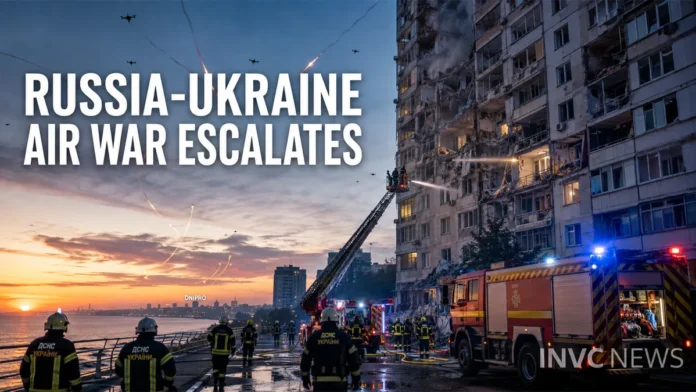
The Russia-Ukraine War Today entered a more dangerous phase as Russian aerial attacks killed two civilians in Dnipro, injured at least six more and damaged food warehouses, while another strike hit a high-rise residential building in Odesa and wounded eight people, including a child.
Russia launched a large overnight aerial assault involving 174 attack drones, two ballistic missiles and two air-launched missiles, according to Ukraine’s air force.
About half of the drones were jet-powered systems, which pose a tougher challenge for Ukrainian air defenses because of their speed.
At the same time, Ukraine intensified its own long-range drone campaign inside Russia.
Russian authorities said Ukrainian drones killed two people and wounded 16 in the Belgorod border region, as both countries increasingly pushed the air war far beyond the front line.
Russian Strikes Kill Two in Dnipro
Russian forces struck Dnipro in central Ukraine during the latest aerial assault.
Local authorities said a man and a woman died in the attack.
At least six other people suffered injuries.
The strikes also hit food-storage warehouses belonging to a local retail chain, creating another disruption to civilian supply infrastructure.
Russian attacks have increasingly targeted warehouses, transport networks, energy facilities and other logistics sites across Ukraine.
Kyiv argues that Moscow wants to disrupt everyday life and weaken public morale in addition to attacking military targets.
The latest strike reinforces that concern.
Odesa High-Rise Hit, Eight People Injured
Russia also struck the Black Sea port city of Odesa.
The attack damaged a 24-story residential building and destroyed apartments across several floors.
Officials said eight people suffered injuries, including a child.
Emergency crews moved quickly into the damaged building as authorities assessed structural risks and searched affected apartments.
Odesa remains one of Ukraine’s most strategically important cities.
Its ports handle major export flows, while the region also supports energy, logistics and transport infrastructure linked to the Black Sea.
That strategic importance has made Odesa a frequent target throughout the war.
Russia Launches 174 Drones and Four Missiles
The scale of the latest Russian aerial operation highlights how rapidly drone warfare has evolved.
Ukraine’s air force said Russia launched 174 attack drones along with four missiles.
Roughly half of those drones used jet propulsion.
Traditional propeller-driven attack drones often travel more slowly, giving defenders additional time to detect and engage them.
Jet-powered drones can reduce that reaction time.
Their growing use forces Ukraine to spend more expensive air-defense resources and creates additional pressure on radar networks.
Russia has steadily expanded the number, speed and sophistication of drones used against Ukrainian cities.
Kyiv Faces Seventh Straight Day of Attacks
The Ukrainian capital remains under relentless pressure.
Kyiv came under Russian aerial attack for a seventh consecutive day.
Although the latest barrage was not as intense as some previous strikes, it kept residents under repeated air-raid alerts.
Two people suffered shrapnel injuries in the wider Kyiv region during morning attacks.
Daily drone strikes have increasingly disrupted transport, education, offices and ordinary life in the capital.
Ukraine says the continued campaign demonstrates why Western partners must accelerate deliveries of air-defense systems and interceptors.
Zelenskyy Demands More Air Defense
President Volodymyr Zelenskyy again pressed Ukraine’s allies for stronger military support.
He said partners already understand what Ukraine needs: additional air defenses, tougher sanctions on Russia and greater defense production.
Ukraine has struggled to secure enough interceptors to match the increasing volume of Russian drones and missiles.
Patriot air-defense systems remain particularly important because Ukraine relies on them against ballistic missiles.
However, interceptor supplies remain limited.
The rapid expansion of Russian drone attacks has further complicated the problem.
Ukraine Takes Drone War Deep Into Russia
Ukraine has simultaneously expanded attacks inside Russian territory.
Its domestically developed long-range drones now regularly strike oil refineries, fuel depots, industrial facilities and logistics centers.
Kyiv describes these operations as pressure on Russia’s war economy.
Ukrainian officials say the objective is to reduce Moscow’s ability to finance military operations and supply fuel to its forces.
The campaign has grown significantly during recent months.
Ukraine says its drones struck 12 Russian oil refineries during August alone.
They also targeted three fuel terminals and oil depots, along with two gas-processing and petrochemical facilities.
Belgorod Drone Attacks Kill Two
Russia reported serious casualties from Ukrainian drone activity in the Belgorod border region.
Regional authorities said two people died and 16 suffered injuries.
Officials reported roughly 140 Ukrainian attacks on the region within 24 hours.
The Russian Defense Ministry said its air-defense systems destroyed 130 Ukrainian drones overnight.
Russia said interceptions occurred across 11 regions, the Black Sea and Crimea.
Ukraine has dramatically expanded its drone reach, bringing the effects of the conflict deeper into Russia.
Russia’s Oil Sector Faces Growing Pressure
Ukraine’s long-range campaign increasingly targets Russia’s most important source of revenue: energy.
Repeated refinery strikes have reduced processing capacity in several areas.
That damage can affect supplies of gasoline, diesel and other fuels.
Pressure on refineries also creates economic problems far from the battlefield.
Russia’s largest bank, Sberbank, has warned that reduced refining capacity from Ukrainian attacks is contributing to inflationary pressure.
The connection gives Ukraine’s drone campaign a strategic economic dimension.
Instead of trying only to destroy military equipment, Kyiv increasingly seeks to impose costs on Russia’s wider economy.
Zelenskyy Warns Airlines About Russian Airspace
Zelenskyy also issued an unusual warning to international airlines.
He said expanding Ukrainian long-range drone operations mean Russian airspace is becoming increasingly unsafe.
Ukraine wants the aviation warning to intensify economic pressure on Moscow.
Frequent drone alerts have already caused airport closures and flight disruption across parts of Russia.
Russian Transport Minister Andrey Nikitin rejected concerns that Ukrainian attacks could severely disrupt civil aviation.
He said authorities continue strengthening aviation security.
Nevertheless, drone incursions have forced temporary airport shutdowns on numerous occasions.
Putin Raises Stakes Over British Weapons
President Vladimir Putin also hardened his rhetoric.
Putin accused Ukraine of what he called state terrorism and rejected negotiations under current conditions.
He also addressed reports that Ukrainian forces used British-made drones in strikes inside Russia.
When reporters asked whether Moscow might strike British military facilities if the United Kingdom continues providing weapons to Ukraine, Putin did not categorically rule out such a possibility.
His remarks add another layer of tension between Russia and NATO countries supporting Kyiv.
Britain remains one of Ukraine’s strongest military backers.
Any direct Russian action against a NATO member would carry far greater escalation risks than the current conflict.
Ukraine Rejects Putin’s Terrorism Claim
Ukrainian officials strongly rejected Putin’s accusation.
Kyiv argues that Russia started the war and continues attacking Ukrainian cities, homes and infrastructure.
Ukraine maintains that its long-range strikes focus on facilities that support Russia’s military and war economy.
Both sides regularly accuse each other of attacks that endanger civilians.
Those competing claims have become a central feature of the information war surrounding the conflict.
Russian Offensive Losing Momentum, Analysts Say
The battle on the ground looks different from the rapidly expanding air war.
Western analysts say Russia’s spring and summer offensive has failed to produce the breakthrough Moscow sought.
The Institute for the Study of War said Russian territorial gains during August represented only a fraction of the territory Moscow captured during the same month a year earlier.
Russian forces continue to make advances in some areas.
However, analysts describe those gains as slow and limited.
That creates a striking contrast.
The front line remains difficult to move, while both sides rapidly expand attacks hundreds of kilometers behind enemy lines.
Drone War Becomes Central to Russia-Ukraine Conflict
Drones now shape almost every level of the war.
Small battlefield drones attack troops and vehicles near the front.
Long-range drones hit factories, refineries, ports and cities far behind enemy lines.
Russia uses mass drone waves to exhaust Ukrainian air defenses.
Ukraine uses long-range systems to attack Russia’s economic and logistical infrastructure.
This transformation allows both countries to inflict damage without capturing territory.
It also means civilians living far from the traditional battlefield increasingly face air-raid alerts and disruption.
Black Sea Security Remains Under Pressure
The Black Sea has become another major front.
Russian attacks target Ukrainian ports and export infrastructure.
Ukraine strikes Russian maritime facilities and energy terminals.
Commercial ships traveling through the region now face growing security concerns.
Some cargo and tanker operators have begun adding improvised anti-drone protection as attacks around the Black Sea increase.
The conflict therefore threatens not only military operations but also international trade and commodity flows.
Ukraine remains a major agricultural exporter, while Russia plays a central role in global grain and energy markets.
Peace Efforts Still Show Little Progress
Despite the growing damage, diplomatic efforts have failed to produce a ceasefire.
US-led attempts to move Russia and Ukraine toward negotiations have not produced a clear pathway to peace.
Moscow and Kyiv remain far apart on territory, security guarantees and the political terms of any settlement.
The latest strikes make diplomacy even more difficult.
Every major attack creates additional casualties, hardens public opinion and increases pressure on leaders to retaliate.
That cycle now drives much of the conflict.
Russia Ukraine War Today: What to Watch Next
The next stage of the war will likely depend on four key developments.
First, Russia could continue large-scale drone and missile attacks against Ukrainian cities and infrastructure.
Second, Ukraine may further expand its long-range strikes against Russian refineries and logistics networks.
Third, Western countries must decide how quickly they can provide more air-defense ammunition to Kyiv.
Fourth, tensions between Russia and NATO countries could rise if Moscow acts on threats involving Western military support.
For now, the battlefield remains largely locked.
The air war does not.
Russia and Ukraine are striking deeper, more frequently and with increasingly capable drones.
The result is a conflict spreading further from the front line even as neither side achieves a decisive breakthrough on the ground.