NEW DELHI | August 11, 2026
Russia-India rail link discussions have intensified after Moscow proposed exploring an ambitious overland freight corridor. The proposed network could connect Russia with India through Central and South Asia.
Russian Deputy Prime Minister Marat Khusnullin recently described the concept as worth examining. However, the proposal remains exploratory and lacks an approved route, budget, agreement, or completion schedule.
What Has Russia Proposed?
Khusnullin suggested examining alternative railway routes connecting Russia with the Indian Ocean and India. He highlighted growing risks surrounding the Bosphorus and Strait of Hormuz.
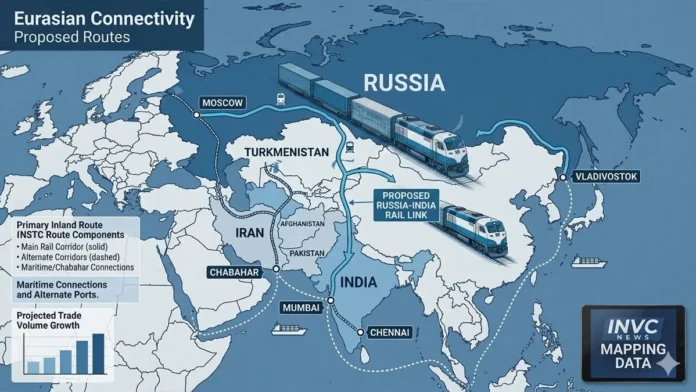
One possible alignment could cross Russia, Turkmenistan, Iran, Afghanistan, Pakistan, and India. However, this route would require extensive multinational agreements and major infrastructure development.
Russian President Vladimir Putin previously outlined a broader north-south connectivity strategy. It would connect Baltic and Barents Sea ports with the Persian Gulf and Indian Ocean.
Putin presented the plan during his 2024 address to Russia’s Federal Assembly. The wider strategy seeks faster freight movement and reduced dependence on traditional maritime routes.
Is a Direct Railway Already Approved?
No direct Russia-India railway has received formal approval. Moreover, neither government has announced construction costs, operating arrangements, or a launch date.
The suggested alignment also includes several difficult sections. Afghanistan lacks continuous nationwide railway infrastructure, while India-Pakistan relations present another substantial obstacle.
Railway gauge differences would create additional complications. Russia and several Central Asian countries use broad-gauge tracks, while Iran uses standard-gauge infrastructure.
Therefore, freight may require bogie changes, container transfers, or specialized border facilities.
Bypassing Pakistan would also prevent a completely land-based connection. Cargo could instead reach Iran’s Chabahar port before continuing to India by sea.
How India and Russia Currently Move Cargo
India and Russia already use several maritime and multimodal trade routes.
1. Traditional Suez Canal Route
The established maritime route connects Russian ports with India through European waters, the Mediterranean, Suez Canal, and Red Sea.
However, this journey can require several weeks. Additionally, congestion, insurance costs, conflicts, and chokepoint disruptions can increase delivery times.
2. International North-South Transport Corridor
The International North-South Transport Corridor combines ships, roads, railways, and Caspian Sea connections.
Cargo generally travels between India and Iranian ports by sea. It then moves through Iran, Azerbaijan, Central Asia, or the Caspian region toward Russia.
The network can reduce transit times and freight costs compared with longer European maritime routes. However, sanctions, customs procedures, and missing railway sections continue affecting regular operations.
3. Chennai-Vladivostok Maritime Corridor
This corridor connects India’s eastern coast with Russia’s Far East. Therefore, it bypasses the traditional route through Europe and the Suez Canal.
An official Indian government assessment estimated savings of 5,608 kilometers and nearly 16 travel days.
However, both countries must expand cargo volumes and port infrastructure before realizing its full commercial potential.
4. Northern Sea Route
Russia is also developing Arctic shipping through the Northern Sea Route. India has shown interest in linking this network with the Chennai-Vladivostok corridor.
Consequently, the route could support future shipments of coal, oil, gas, fertilizers, and other commodities.
What Could the Proposed Railway Route Look Like?
Two broad options are currently under discussion.
| Route option | Possible alignment | Current limitation |
|---|---|---|
| Overland railway | Russia–Turkmenistan–Iran–Afghanistan–Pakistan–India | Missing links, security concerns and political barriers |
| Expanded INSTC | Russia–Kazakhstan–Turkmenistan–Iran–Indian port | Final Iran-India section remains maritime |
| Chabahar connection | Russia–Central Asia–Iran–Chabahar–India | Requires sea transport from Chabahar |
| Existing eastern corridor | Vladivostok–Chennai | Entirely maritime rather than railway-based |
Therefore, “direct rail link” currently describes a strategic objective, rather than a ready continuous railway.
Why Russia Wants an Alternative Corridor
The Bosphorus connects the Black Sea with the Mediterranean system. Meanwhile, the Strait of Hormuz remains vital for global oil and liquefied natural gas shipments.
Regional conflicts can raise insurance premiums and disrupt commercial shipping near both chokepoints. Therefore, Russia wants diversified freight routes toward the Indian Ocean.
However, a land corridor through Iran and Afghanistan would carry different risks. These include sanctions, border delays, security threats, infrastructure gaps, and transit fees.
Energy Security and the $100 Billion Trade Target
Russia remains an important energy supplier for India. Nevertheless, India has also expanded procurement across approximately 40 countries.
Government figures showed non-Hormuz crude sourcing rising from 55% to nearly 70% during recent disruptions. Notably, that percentage represents shipping routes, not Russia’s share of Indian oil imports.
India and Russia have targeted $100 billion in bilateral trade by 2030. Therefore, faster and more predictable logistics could support energy, agriculture, engineering, pharmaceuticals, and industrial trade.
The 2025 India-Russia joint statement prioritized the INSTC, Chennai-Vladivostok corridor, and Northern Sea Route.
It also recognized growing railway technology cooperation between both countries.
What Happens Next?
The Russia-India rail link will require detailed feasibility studies before advancing. Governments must evaluate costs, cargo demand, security, customs rules, sanctions exposure, and railway compatibility.
Moreover, every transit country must approve the route and provide operational guarantees.
For now, the proposal signals Russia’s search for resilient access to India and the Indian Ocean. However, existing multimodal corridors remain more practical than a continuous overland railway.